🦃 Turkey Average Weight Calculator
Estimate average raw turkey weight per bird, cooked edible yield, servings covered, stuffing effect, appetite adjustments, and planned leftovers.
Use plan mode to estimate total raw turkey and average bird size from a guest count. Use check mode when you already have one or more birds and want cooked yield and servings.
| Turkey Type | Typical Raw Weight | Cooked Edible Yield | Planning Use |
|---|---|---|---|
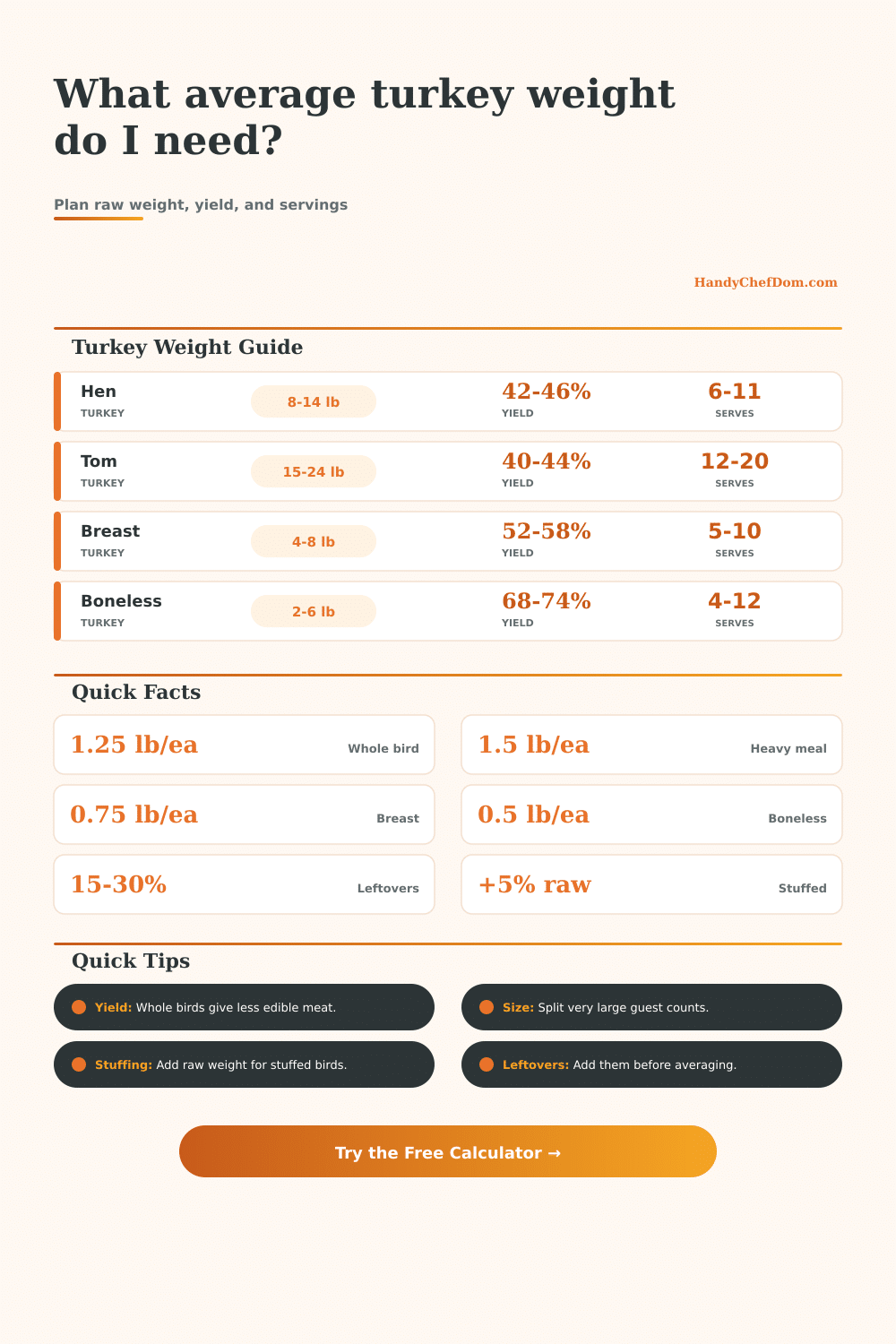
| Whole turkey hen | 8 to 14 lb | 42% to 46% | Small holiday dinner or single-bird family meal. |
| Whole turkey tom | 15 to 24 lb | 40% to 44% | Larger gathering where one big bird is preferred. |
| Broad-breasted whole turkey | 12 to 22 lb | 43% to 47% | General supermarket whole-bird planning. |
| Heritage whole turkey | 8 to 16 lb | 41% to 45% | Leaner birds with a little less breast meat. |
| Bone-in turkey breast | 4 to 8 lb | 52% to 58% | White-meat service without a full carcass. |
| Boneless turkey breast roast | 2 to 6 lb | 68% to 74% | Dense carved portions and predictable yield. |
| Mixed turkey parts | Any mix | 50% to 58% | Dark meat, drumsticks, thighs, or mixed trays. |
| Spatchcocked whole turkey | 10 to 18 lb | 43% to 47% | Whole-bird yield with slightly easier carving loss. |
| Serving Plan | Cooked Portion | Whole Bird Raw Rule | Boneless Raw Rule |
|---|---|---|---|
| Light lunch or children | 4 oz each | 0.9 to 1.0 lb per guest | 0.35 to 0.45 lb per guest |
| Buffet with several sides | 5 oz each | 1.0 to 1.15 lb per guest | 0.45 to 0.55 lb per guest |
| Holiday dinner plate | 6 oz each | 1.2 to 1.35 lb per guest | 0.55 to 0.65 lb per guest |
| Turkey-focused meal | 8 oz each | 1.5 to 1.75 lb per guest | 0.7 to 0.85 lb per guest |
| Sandwich carving station | 4 oz each | 0.95 to 1.1 lb per guest | 0.4 to 0.5 lb per guest |
| Meal prep containers | 5.5 oz each | 1.1 to 1.3 lb per container | 0.5 to 0.6 lb per container |
| Guests | Whole Turkey Average | With Leftovers | Bird Split |
|---|---|---|---|
| 4 guests | 6 to 8 lb | 8 to 10 lb | 1 small hen or breast |
| 8 guests | 10 to 12 lb | 12 to 14 lb | 1 whole hen |
| 12 guests | 14 to 16 lb | 16 to 18 lb | 1 medium bird |
| 18 guests | 20 to 22 lb | 24 to 26 lb | 1 tom or 2 hens |
| 25 guests | 30 to 34 lb | 36 to 40 lb | 2 medium birds |
| 40 guests | 48 to 54 lb | 58 to 64 lb | 3 to 4 birds |
| Stuffing or Side Choice | Meat Portion Effect | Raw Weight Effect | Calculator Use |
|---|---|---|---|
| Unstuffed bird, normal sides | No change | No change | Best baseline for average turkey weight. |
| Stuffed bird or stuffed cavity | Guests may eat slightly less meat | Add about 5% raw weight | Allows room for stuffed-bird planning and carving margin. |
| Dressing on the side | Reduce meat by about 3% | Slightly lower need | Good for holiday plates with bread dressing. |
| Many filling sides | Reduce meat by about 8% | Lower average bird size | Use for casserole-heavy menus. |
| Few sides, turkey featured | Increase meat by about 12% | Higher average bird size | Use when turkey is the main attraction. |
| Yield Item | Whole Turkey | Bone-In Breast | Boneless Roast |
|---|---|---|---|
| Raw starting weight | 100% | 100% | 100% |
| Moisture and drippings | 18% to 25% | 16% to 22% | 18% to 24% |
| Bones, skin, and carcass | 30% to 38% | 20% to 28% | 2% to 8% |
| Edible cooked meat | 40% to 47% | 52% to 58% | 68% to 74% |
| Best planning margin | 15% to 30% | 10% to 20% | 8% to 15% |
A turkey’s weight when raw is what you pay for; a turkey’s weight after cooking are what you serve. More than half the turkey’s original weight dissapears in the form of bones, skin, and water loss, and that makes a big difference. Here’s a handy calculator to help you convert your number of guests into a target raw weight. It takes invisible losses into consideration and ensures no one goes home with an empty stomach.
But consider the bird: It’s not a solid block, it’s a delivery system for protein. When hen cooks, much of that water turns to steam and escapes through evaporation. It then drips out onto pan as juice. All of this mean that a whole hen will lose a lot of weight in the oven. And the carcass is unsuitable for consumption; only about four to four and a half pounds of the ten-pound bird become edible. That’s the ratio you need to keep in mind, especially in your planning.
How to Choose the Right Size Turkey
If you opt for a boneless breast roast, removal of all that heavy skeletal material increases your yield a lot. Use the tool to toggle back and forth between these cuts. Note the difference that changing meat’s form makes to its raw weight requirement.
The minimum number of pounds of meat depend on who’s coming to the party, but what they’re eating complicates things. If you’re having a light meal served with lots of sides, then each person will consume less turkey. Because there is less bread or potato to fill gap, guests will eat more meat. On the other hand, if you’re setting out a variety of salad, stuffing, and casseroles, the calculator takes into account that people will be eating less turkey, since there are so many dishes to fill them up.
For example, it knows that a buffet environment functions different than a plated holiday dinner. While you might think that you’ll use just as much meat no matter how many side dish are involved, human appetites change. They expand and contract according to the contents of the plate.
The other common misstep in calculating is stuffing. If you intend to stuff your bird, you will need to plan on even more time to cook it so it is cooked through. That increased cooking time will force more water out of the bird, reducing your total yield. Also, you’ll want to consider volume occupied by your stuffing. Consider this: it’s not just food safety, it’s volume displacement! For birds intended as stuffed options, the calculator takes into account an additional margin required in raw weight due to presence of the stuffing. So that your bird isn’t too big, but effectively drained by the added warmth exposure.
Strategic leftovers aren’t just something that happens afterwards, they’re a strategic asset. Most hosts shoot for a leftover level of 20-30% for use on sandwiches, in soup, or as their fried turkey later in the week. By planning strictly for people who will sit down to eat, you could of end up with too little and nobody gets seconds. You can specify a leftover target percentage in the calculator which adds a buffer to your overall raw weight need. It is better to have one more pound of meat in the fridge than to have to explain to your in-laws that you don’t have any ham left for dinner tomorrow.
Different people has different appetites. There is a big difference between feeding light eaters and kids versus a ravenous group of adult who regard turkey as the main event. Making an adjustment for appetite means that if everyone is bound to go easy on the portions, you won’t buy too much food. And if you’ve got a ravenous crowd on your hands, you won’t be embarrassed when you run out. That takes the guess work out of it all.
No need to memorize some strange ratio or anything. Just describe the nature of your event and the tool figures out how many pounds you’ll need to convert that desire into. This way there’s no fear of an empty platter. You can shop confidently knowing that raw weight doesn’t translate into edible yield; you’ll have just the right amount to get onto guests’ plates. You will have just enough to save for tomorrow.
The math keeps the mood of the gathering good. When it is time to carve, you won’t hope that all goes well… You’ll be certain, and you’ll know by how many pounds. It’s worth every penny of the price of the bird.