🍰 Cake Cooling Time Calculator
Estimate cooling time for cake layers by pan shape, layer thickness, cake density, starting temperature, room temperature, rack method, air movement, target stage, and layer count.
Enter the cake as it comes out of the oven. The estimate assumes layers are separated with space around them and adjusts for pan geometry, cake density, air flow, and the target stage.
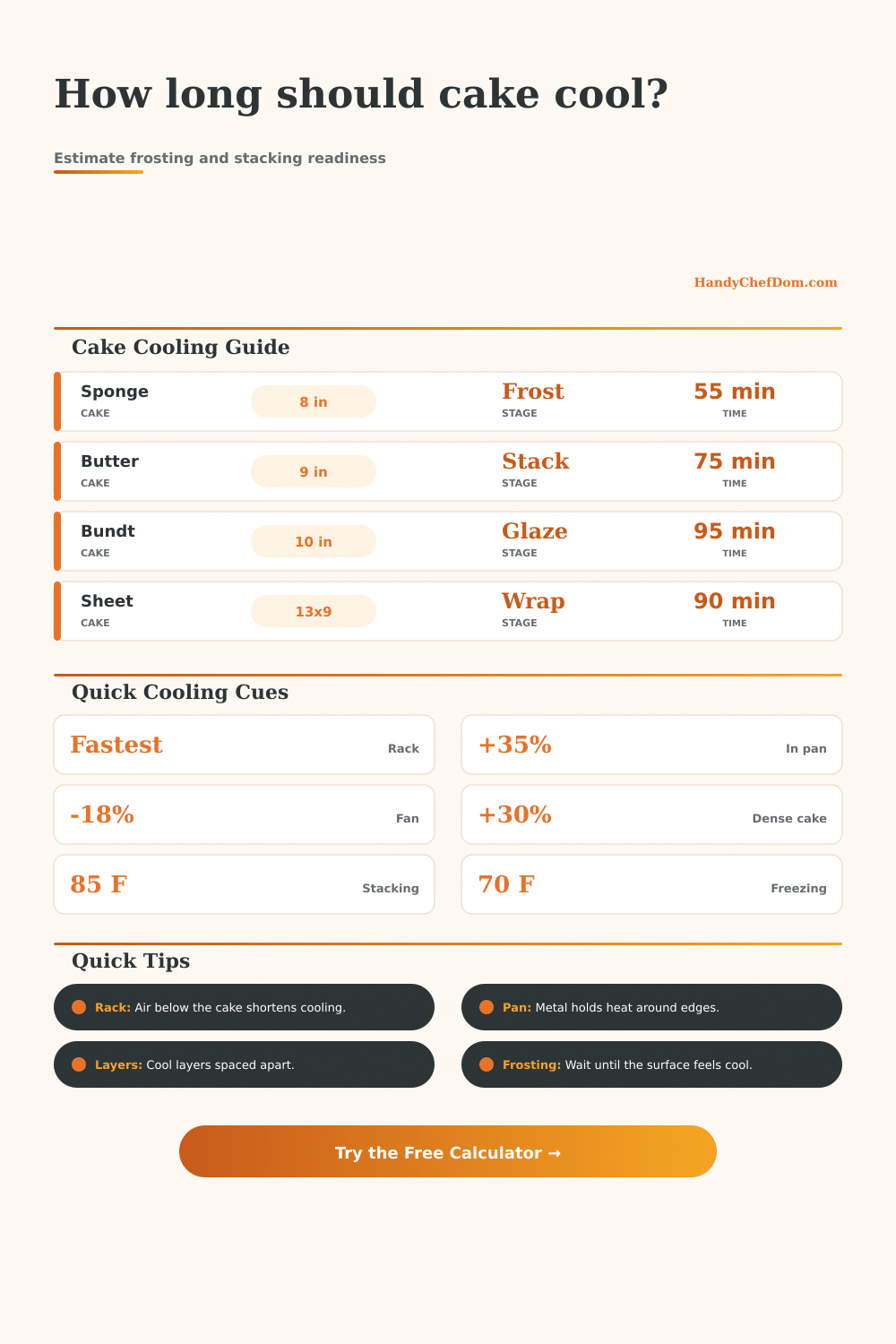
| Cake Type | Typical Density | Cooling Effect | Best Target Stage |
|---|---|---|---|
| Sponge or chiffon cake | Very light crumb | Fastest cooling | Frosting or stacking once surface is cool |
| Genoise or thin torte | Light and shallow | Short cooling window | Wrap or layer after the center settles |
| Vanilla butter layer cake | Medium crumb | Standard baseline | Buttercream frosting or crumb coat |
| Chocolate fudge cake | Moist dense crumb | Slower cooling | Frosting after the top feels cool |
| Carrot or fruit cake | Moist with inclusions | Slower center cooling | Stack only after the middle firms |
| Pound cake or loaf cake | Dense and tall | Long cooling window | Wrap after warmth leaves the core |
| Dense Bundt cake | Heavy ring cake | Moderate to slow | Glaze warm or wrap when cool |
| Cheesecake style cake | Very dense custard crumb | Slowest cooling | Chill after counter cooling |
| Pan Shape | Size Example | Layer Thickness | Typical Counter Time |
|---|---|---|---|
| Round layer pan | 8 to 9 in | 1.5 to 2.25 in | 55 to 90 min for frosting |
| Square cake pan | 8 to 9 in side | 1.75 to 2.5 in | 60 to 95 min for frosting |
| Rectangular sheet pan | 13 by 9 in | 1 to 2 in | 45 to 85 min for frosting |
| Loaf pan | 8 to 10 in long | 2.5 to 4 in | 95 to 160 min for wrapping |
| Tube or Bundt pan | 9 to 10 in ring | 2.5 to 3.5 in | 75 to 130 min for glaze or wrap |
| Cupcake or mini cake pan | 2 to 4 in | 1 to 1.75 in | 20 to 45 min for frosting |
| Cooling Method | Method Factor | What Changes | Best For |
|---|---|---|---|
| Unmolded on wire rack | Fast | Bottom and sides cool with open air | Layer cakes and sponge cakes |
| 10 min in pan, then wire rack | Balanced | Crumb sets before full air cooling | Most butter and chocolate layers |
| Left in pan until stage | Slow | Pan keeps heat near bottom and edges | Fragile cakes that need support |
| Rack over parchment | Moderate | Less sticking with slightly reduced airflow | Moist chocolate or carrot layers |
| Rack rest, then refrigerator | Fast finish | Counter cooling begins before chill assist | Stacking and crumb coating |
| Rack rest, then freezer assist | Fastest finish | Short firming stage after steam drops | Wrapping or firm slicing |
| Target Stage | Approx Target Temp | Readiness Cue | Cooling Note |
|---|---|---|---|
| Pan release and turn out | 130 F or 54 C | Edges pull slightly from pan | Often occurs well before full cooling |
| Warm glaze or crumb set | 105 F or 41 C | Warm but no longer hot to touch | Useful for Bundt glaze or crumb settling |
| Buttercream frosting ready | 90 F or 32 C | Top feels cool, not warm | Prevents soft frosting and sliding layers |
| Stacking layer cake ready | 85 F or 29 C | Center feels barely warm | Better for level filled cakes |
| Wrapping or crumb coat ready | 78 F or 26 C | No trapped warmth under wrap | Reduces condensation against the crumb |
| Freezing or firm slicing ready | 70 F or 21 C | Fully cool to room temperature | Longest target on the calculator |
| Serving or Pan Size | Imperial Size | Metric Size | Cooling Planning Use |
|---|---|---|---|
| Mini cake | 4 in | 10 cm | Quick individual cake cooling |
| Standard round layer | 8 in | 20 cm | Two-layer birthday cake planning |
| Large round layer | 10 in | 25 cm | More servings with similar height |
| Quarter sheet style | 13 by 9 in | 33 by 23 cm | Wide surface and medium depth |
| Loaf cake | 9 by 5 in | 23 by 13 cm | Tall center needs extra time |
| Bundt cake | 10 in | 25 cm | Ring shape with dense crumb |
New cake layers just hit counter and you’re panicking. Buttercream and a spatula await, but your plan doesn’t account for physics. Frosting a still-warm cake is like having heat melt frosting from the inside out, structure slumps. Crumbs dissolve. Visual appeal dissapears before you even reach for that knife.
Assembly isn’t about technique; it’s all about timing. Once you know your pan sizes and densities, the calculator do the math. No more guesswork on how long the heat stay in the crumb. Surface area does not drive cooling time; it’s all about thickness.
Why You Must Let Cake Cool Down
Because the distance from outside edge to center is so small, a thin slice of sponge cake cool fast. Dense pound cake keep its heat for a long time. Why? It has too much mass, so air can’t reach in and cool it off fast enough.
Cake type and layer thickness are critical inputs here. Moist chocolate fudge cake isn’t treated the same than a dry angel food sponge. Density matter. Rushing this process compromise the structure of your dessert. Lots of folks gets it wrong. They view cooling as passive. Nope. Cooling is an active management of heat loss.
This all comes down to the geometry of pan, too. Because metal is good at conducting heat, it’s also good at retaining it. When you leave your cake in the pan, any residual warmth stay trapped against the sides and especially bottom. There’s nowhere for the heat to go because there’s no air underneath. As soon as you unmold the cake onto a wire rack, it’s exposed to air on all surfaces. Not only does the heat escape out the top, but now it escapes out the bottom, too. That can save you up to twenty minutes waiting time.
And this is why we’re not putting cakes on plates: we want them to be structurally stable and the only way to do that is to let the crumb cool completely.
Air Movement & Room Temperature matter too: You may think nothing of them, but they change the timing dramaticly. In summer, a still kitchen becomes a hot box for a just-out-of-the-oven cake. There’s a small temperature gradient between the cake and the room because air is saturated with heat. When there isn’t much difference, heat travel slowly.
A cross breeze (or even a gentle fan) speeds convection along. It withdraws some of that warm air above the cake surface and pushes it away, replacing it with cool air. This will speed things along without shocking your cake.
Unless you’re in a rush, don’t throw it in the freezer. If you do, go easy: sudden cooling will cause moisture to condense onto its surface and make the crumb soggy. Better to have it vent out gradually then to have cold air seal it in.
What you plan to do with your cake is even more important than how it starts out. Are you planning on freezing some layer for next month? Or maybe you’d like to glaze a warm Bundt cake. These has wildly different temperature needs.
Generally speaking, a little leftover warmth help with the glaze application, allowing it to cling and harden properly. But freezing? No way! That will destroy the texture by freezing the water inside the cake into ice crystals. The chart makes it clear: different desired outcomes call for different final temperatures.
The best ingredient in a baker’s tool kit? Patience. Measuring exactly can be done with flour. Whipping can be mastered for butter. But it can all fall apart in matter of minutes unless you pay proper attention to cooling down the cakes.
Believe in the physical laws of thermal diffusion. Give the cake time to cool. Feel it with your finger… Or use a thermometer. Wait until it is no longer warm on the outside and in the middle, that last part matters more than you think. Willingness to wait makes all the difference between amateur hour and a look worthy of pros.
You should of waited for the cake to reach room temperature.