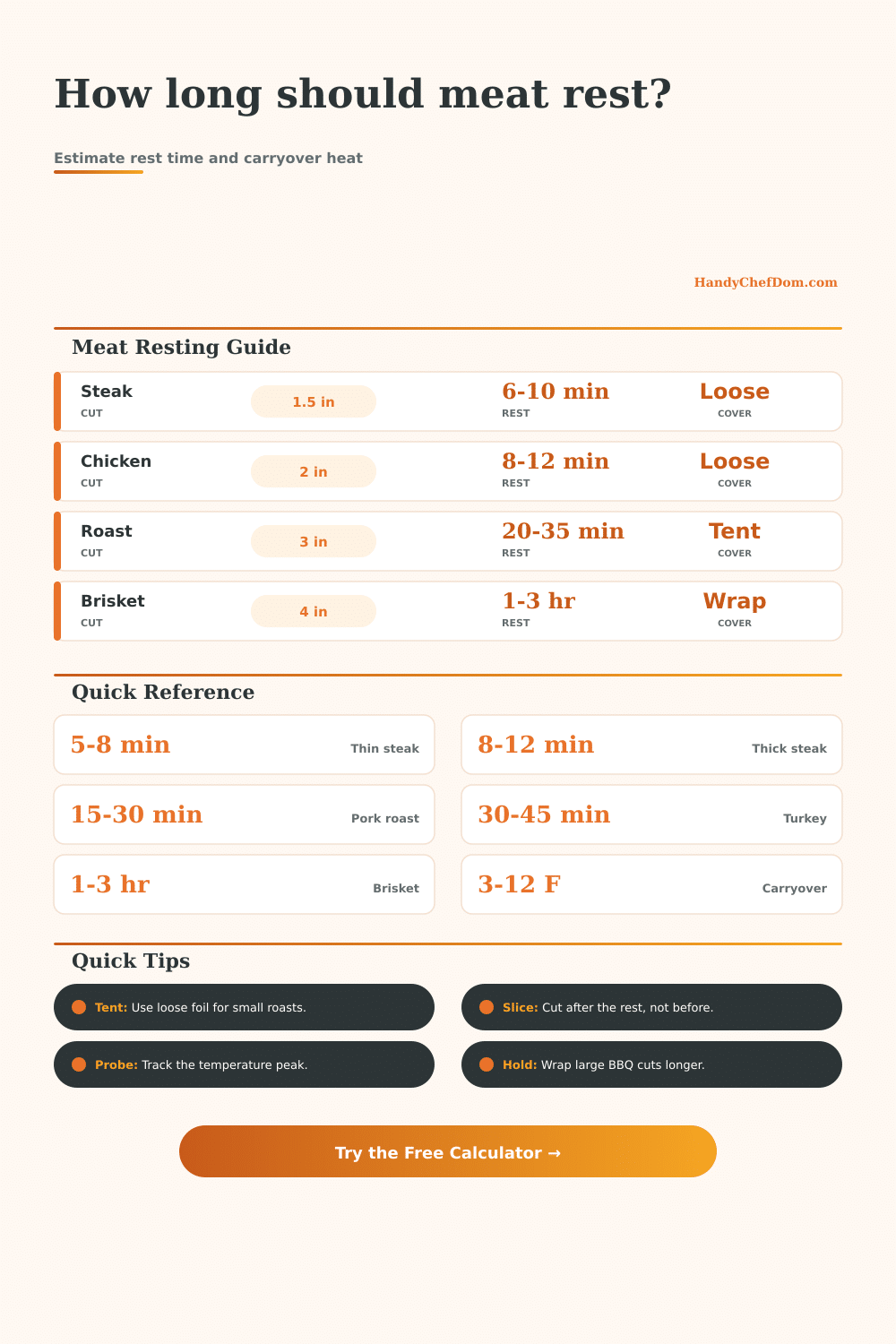
🥩 Meat Resting Time Calculator
Estimate rest time, carryover temperature, tenting level, slicing window, and serving temperature timing for steaks, roasts, poultry, pork, lamb, and BBQ cuts.
Enter the cooked size, method, temperatures, tenting, and room conditions. The calculator estimates a practical rest and slicing window after the meat comes off the heat.
| Meat or Cut | Typical Thickness | Common Weight | Resting Range |
|---|---|---|---|
| Steak or chop | 1 to 2 in | 0.5 to 2 lb | 5 to 12 minutes |
| Beef tenderloin roast | 2 to 3 in | 2 to 5 lb | 12 to 25 minutes |
| Prime rib or rib roast | 3 to 5 in | 4 to 12 lb | 25 to 45 minutes |
| Pork loin roast | 2 to 4 in | 2 to 5 lb | 15 to 30 minutes |
| Whole roast chicken | 2 to 3 in | 3 to 5 lb | 10 to 20 minutes |
| Whole turkey | 4 to 7 in | 10 to 20 lb | 30 to 60 minutes |
| Leg of lamb | 3 to 5 in | 4 to 8 lb | 20 to 40 minutes |
| Brisket or pork shoulder | 3 to 6 in | 6 to 16 lb | 60 to 180 minutes |
| Cooking Method | Carryover Level | Resting Behavior | Calculator Effect |
|---|---|---|---|
| Pan sear or grill sear | Moderate | Hot surface, smaller center mass | Short rest with 3 to 7°F gain |
| Direct then indirect grill | Moderate-high | Edges hold more heat after grilling | Adds a few minutes for thicker cuts |
| Oven roast | High | Even heat through a larger piece | Longer rest and higher carryover estimate |
| Reverse sear | Low-moderate | Gentler center with a quick finish | Shorter rest and lower carryover |
| Low and slow smoker | Low | Long cook, lower surface heat | Long hold for texture, not peak heat |
| Covered braise or moist roast | Low | Moist covered environment | Gentle rest with slower cooling |
| Rotisserie or convection roast | Moderate-high | Dry moving air heats surface evenly | Similar to oven roast with steady carryover |
| Tenting Choice | Best For | Heat Retention | Texture Tradeoff |
|---|---|---|---|
| Uncovered rest | Steaks and crisp-skinned pieces | Lowest | Surface stays drier, cools faster |
| Loose foil tent | Most steaks, chops, roasts, poultry | Moderate | Balances warmth and surface texture |
| Tight foil cover | Lean roasts or late service timing | High | Can soften crisp surfaces |
| Wrapped insulated hold | Brisket, pork shoulder, large BBQ | Very high | Extends rest into a serving hold |
| Conversion or Reference | Imperial | Metric | Use In Calculator |
|---|---|---|---|
| Thickness | 1 inch | 2.54 cm | Thickest cooked section |
| Weight | 1 pound | 0.454 kg | Cooked weight after trimming |
| Temperature step | 5°F | 2.8°C | Pull-to-serve planning gap |
| Room condition | 65 to 75°F | 18 to 24°C | Neutral ambient adjustment |
| Cool kitchen | Under 65°F | Under 18°C | Shortens uncovered rest |
| Warm kitchen | Over 78°F | Over 26°C | Allows a slightly longer window |
Don’t slice up that steak yet. It’s important for the hot centre of meat to continue cooking from inside out, which requires some patience. Cutting into it prematurely cause the juices to run and the meat will suffer.
By resting, the meat has time to soak back up those juices and its fibers can relax. Giving you a more tender piece of meat with a deeper flavour.
Why You Should Let Meat Rest
And no need to make an educated guess about what thermal conductivity is or does; that’s all handled by the calculator. All you have to do is input thickness, weight, and which cooking method you’re using, and it will tell you how long it should of rest. Because if you’ve got a really thick piece of prime rib on there, that changes things different than a thin strip steak.
It factors in two things: (1) the ambient temp of your kitchen; and (2) the thermal mass of whatever meat is on there.
If you want to wrap stuff tightly, that steams the outside, so it’ll mess up its textural integrity. But if you loosely tent with foil, that controls heat, keeping the crust intact.
Plan the rest based off the cooking style. If you seared something quickly in a pan, there was a lot of high-temperature heat focused on surface but not much deeper. Once out of the pan, thing will cool off pretty fast unless covered up.
With the low-and-slow smoker, that same brisket cooks for several hours with a big pile of residual internal heat building up. That heat keeps rising even after it’s pulled from smoke. This is why briskeys get rested for such a long time, usually an hour or more.
A pork chop might be done in as little as eight minutes. Thicker cuts needs more time. See the table below:
There’s also an element of resting in the act of cooking. This means adjusting the last few degrees of internal temperature. Pull your chicken at a hundred and fifty-five degrees? Odds are good it’ll still climb. Ignoring carryover effect results in dry chicken.
The calculator predicts that rise, allowing you to aim for the appropriate serve temperature. It helps you transition from taking food off the heat to being ready to eat it.
Resting has a feel to it that no tool can measure. It teaches you how to read when the meat is steady and what level of firmness signify doneness. Some chefs rest their meat over a warm plate, which slows down the cooling process. Some will put it on a wire rack, which prevents bottom from sitting in its own juice. Which one works? Depends on the cut.
Always retain moisture and improve texture. The rest is really just about honoring what’s inside the food.
It is not long enough to matter, except that it makes everything you do with the heat even stronger. From a steak on a weeknight to a holiday turkey, investing those few minutes will pay you back in dividends. When you cut into it, that’s when we find out who did the cooking and a good rest lets that show through.