Breast Milk Shelf Life Calculator
Estimate expressed breast milk storage timing using CDC-style limits for fresh, thawed, travel cooler, and unfinished bottle scenarios.
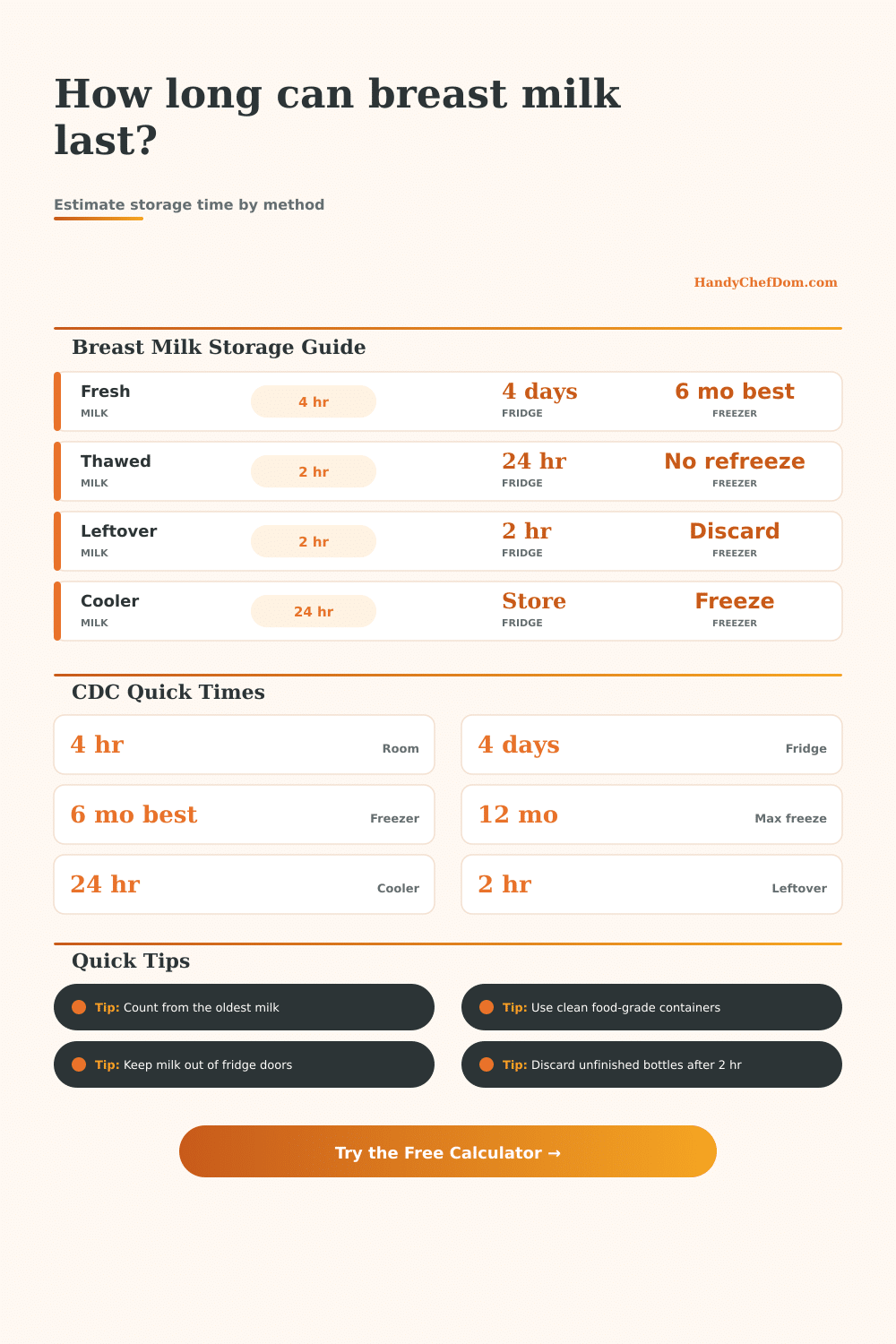
| Storage Location | Temperature | CDC Time | Calculator Rule | Useful Note |
|---|---|---|---|---|
| Countertop | 77°F / 25°C or colder | Up to 4 hours | 4 hour base | Chill sooner when possible. |
| Refrigerator | 40°F / 4°C | Up to 4 days | 96 hour base | Store toward the back, not the door. |
| Freezer | 0°F / -18°C or colder | 6 months best | 6 month quality base | Up to 12 months is acceptable. |
| Travel cooler | Frozen ice packs | Up to 24 hours | 24 hour cooler cap | Use, refrigerate, or freeze at destination. |
| Thawed State | Storage | CDC Time | Calculator Rule | Reminder |
|---|---|---|---|---|
| Fully thawed in refrigerator | Refrigerator | Use within 24 hours | 24 hour base | Count from fully thawed, not freezer removal. |
| Brought to room temperature | Countertop | Use within 2 hours | 2 hour base | Applies after thawing or warming. |
| Warmed milk | Ready to feed | Use within 2 hours | 2 hour base | Do not microwave breast milk. |
| Thawed milk | Refreezing | Never refreeze | Stop rule | Calculator flags freeze plans after thawing. |
| Scenario | Exposure | CDC Time | Calculator Rule | Best Use |
|---|---|---|---|---|
| Baby started bottle | Mouth contact | Use within 2 hours | 2 hour override | Discard after that window. |
| Leftover after feeding | Partly consumed | Use within 2 hours | 2 hour override | Do not return to long storage. |
| Fresh bottle prepared | No mouth contact | Original storage clock | Uses milk state limit | Count from expression or thaw time. |
| Mixed older milk | Combined batches | Oldest clock | Use oldest time entered | Label containers clearly. |
| Item | CDC-Aligned Guidance | Calculator Effect | Why It Matters | Storage Note |
|---|---|---|---|---|
| Storage bag | Made for breast milk | Full window | Clean and sealed | Freeze flat in small amounts. |
| Glass or food-grade plastic | Tight fitting lid | Full window | Food-safe surface | Leave headspace before freezing. |
| Loose lid | Less protected | Shorter estimate | More handling risk | Move to a sealed container. |
| Disposable liner | Not for storage | Discard warning | CDC says not intended | Use a proper storage container. |
On Tuesday you froze a batch because the baby liked it. Fast forward to Friday, and there’s a bag of milk that you’re looking at that looks a bit separated. Your instinct tells you no, right? But the truth is it all depends on what you’ve done with that milk since Tuesday night. That’s why the calculator above does the math for you when you plug in your specific situation. It saves you from having to guess if the separation is normal fat rising or if something’s begun to go wrong.
The thing is, breast milk isn’t ordinary dairy; it’s got an internal clock all to itself. It lasts four days in the fridge and four hours at room temperature. That’s a good starting point. But here’s the deal: the moment you throw a variable into the mix, you’ve changed the clock’s speed. Did you put that milk in the back of your fridge? Well then: it’s actually shorter-lived than four days, because the back of the fridge is coldest. Did you store it in the fridge door? You guessed it: that also changes things. This is why the tool lets you adjust for container type, storage method, and yes, even the sort of lid you use. It does not simply give you four days. It spits out four days less than whatever risk you imposed with a loose lid or storing it next to a warm vent.
How To Store Breast Milk Safely
Thawing is the most complicated piece of storing breast milk. Milk kept in the fridge will stay good until 24 hours after thawing. When you defrost and warm milk to drink, that drops to just two hours. Why? Because when milk freezes, the ice crystals protect the milk from bacteria, but as soon as those ice crystals melt and the milk is no longer cold, bacteria begin to grow very quickly. No bueno. From a biological view, it’s a one way street. You’re not going to be able to stick it back into the freezer, ever. As soon as you choose “thaw” and hit calculate, the app knows your milk won’t make the return trip. This saves you from being like me and mistakenly believing that you’re resetting the timer.
But travel adds another level of complexity that pure memory often misses. For example, just because you’ve got an insulated cooler packed with ice packs doesn’t mean it’s going to keep your milk good for days. In fact, it won’t. Fresh milk can only be kept in a cooler for 24 hours if the ice packs remain frozen and the cooler remains tightly closed. And if you’re running errands or commuting, and you’re opening that bag each time you hit a stoplight to check everything…you let all the cold air out and rush all the warm air inside. This allows you to consider the condition of the cooler. Is it a bag that you opened three times at stoplights? Or is it a sealed package that never saw the light of day? Temperature fluctuations cause food to go bad faster then constant warmth will. That distinction is far more important than most folks realize.
Next is the “what do I do with the rest of the bottle” thing that gets most people. For example, say you have a 4 ounce bottle, and the baby only took two ounces out of it and stopped. That extra part isn’t good past two hours. The milk in the bottle now has bacteria from the baby’s mouth. Yuck. And it multiplies rapidly. So even though the milk used to be fresh, at this point, it’s not anymore. Ugh, it sucks to throw it away, but saving it will make your baby sick. Being sick because you saved milk is much, much, MUCH worse than losing two ounces of milk. When you say you’ve started a feeding, the calculator kicks in and overrides everything else. No matter what time you pumped or how cold the bottle is, it’ll force you back down to that hard-and-fast two hour mark.
To lessen the anxiety, think in terms of tradeoffs. Storage isn’t a set of hard-and-fast rules but a series of them. You want to minimize risk and waste. You also want to maximize your supply. Contaminant-free sealing will help you get the full time window; that’s why guidelines caution against using disposable liners because they don’t seal well. Food grade containers like proper breast milk bags or glass work well and seal out contamination. That’s what those reference tables on the page is explaining: how your container choice relates to temperature to impact safety. It’s not so much remembering all the numbers as it is getting the logic behind them.
There are no wrong answers when it comes to safely storing milk, it’s all about being honest (with yourself) and consistent. Did you really close that cooler? Is your fridge actualy at forty degrees or closer to fifty because it is old? If you’re not sure, use the conservative buffers in the tool as your safety net and rest easy knowing that you won’t have wasted a drop of milk that you worked so hard for.
Pumping helps nourish, not stress. Storing milk safely will ensure that every drop you’ve pumped goes directly to helping your baby. Watch your baby, not the timer.