🍖 Spiral Ham per Person Calculator
Estimate spiral ham per person by guest count, bone-in or boneless type, serving style, appetite, sides, leftovers, glaze loss, cooked yield, and slice thickness.
Use plan mode to calculate how much spiral ham to buy. Use check mode to estimate servings from a ham you already have.
| Spiral Ham Type | Typical Package Size | Edible Yield | Planning Note |
|---|---|---|---|
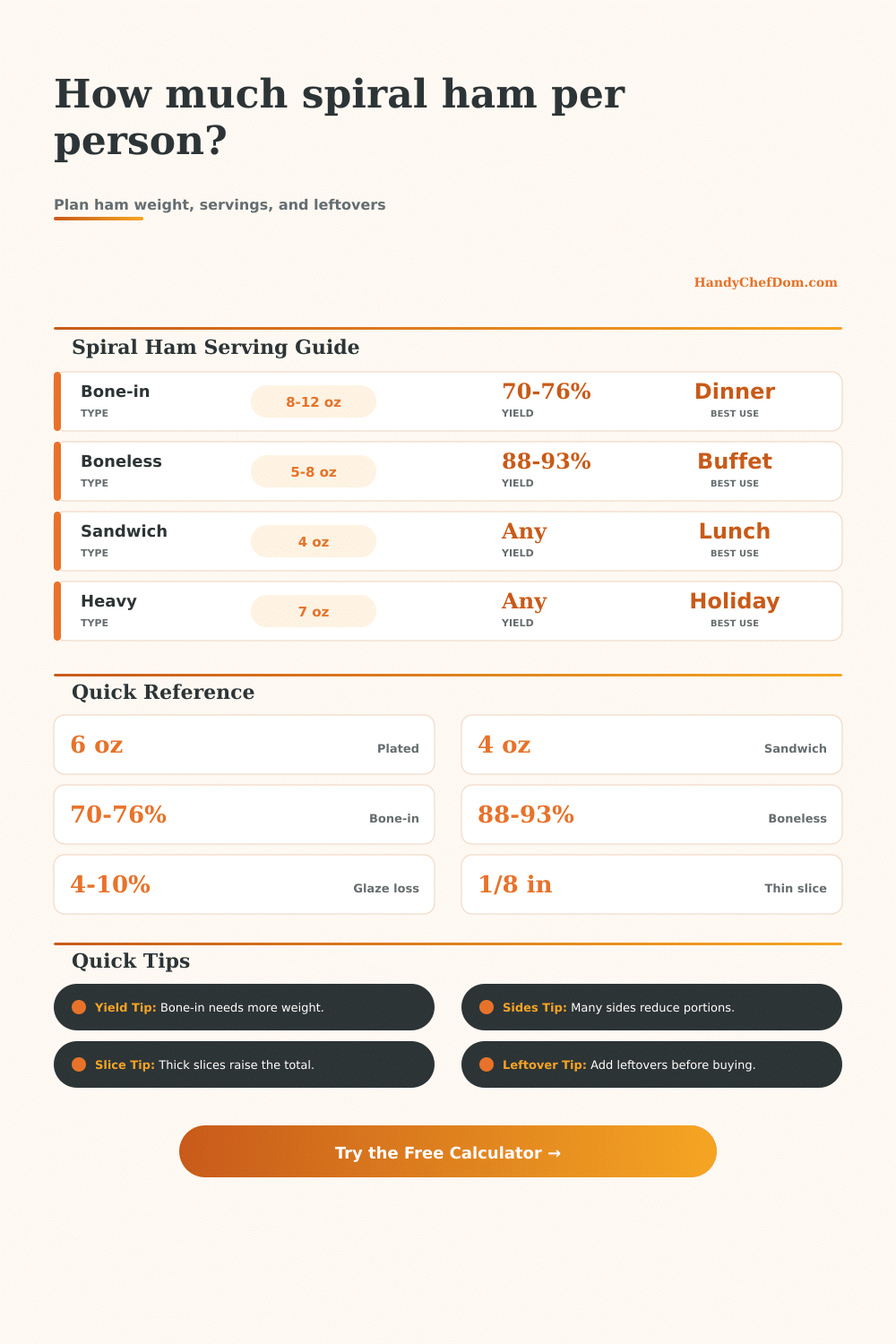
| Bone-in half spiral ham | 7 to 10 lb | 70% to 76% | Good all-purpose estimate for holiday dinners and family meals. |
| Bone-in whole spiral ham | 14 to 20 lb | 65% to 72% | Plan a lower yield because the whole bone structure adds weight. |
| Boneless spiral sliced ham | 3 to 8 lb | 88% to 93% | Useful when you want predictable portions and very little carving waste. |
| Mini boneless spiral ham | 2 to 4 lb | 88% to 94% | Best for small dinners, brunch spreads, or sandwich portions. |
| Shank portion spiral ham | 6 to 10 lb | 62% to 69% | Allow extra package weight because the shank end can carve less evenly. |
| Butt portion spiral ham | 5 to 9 lb | 66% to 73% | Often yields better slices than shank, but still needs bone allowance. |
| Small bone-in quarter ham | 3 to 6 lb | 70% to 78% | Good for fewer guests when you still want a bone-in presentation. |
| Lean boneless sliced ham | 3 to 7 lb | 90% to 95% | Highest edible yield and the simplest choice for exact guest counts. |
| Serving Style | Edible Ham Per Person | Side Dish Assumption | Best Use |
|---|---|---|---|
| Appetizer slices | 2.5 to 3 oz | Many snacks or courses | Small plates, grazing boards, or brunch add-ons. |
| Sandwich or roll tray | 3.5 to 4.5 oz | Bread and sides included | Lunch service, sliders, rolls, or casual buffets. |
| Mixed meat table | 4 to 5 oz | Other proteins served | Ham with turkey, roast beef, chicken, or sausage. |
| Buffet with several sides | 5 oz | Standard side spread | Potluck tables and open serving lines. |
| Plated main dish | 6 oz | Normal dinner sides | Family dinners where ham is the main protein. |
| Holiday ham centerpiece | 6.5 to 7 oz | Guests may take seconds | Holiday meals, big appetites, and ham-focused menus. |
| Meal prep portions | 5 to 6 oz | Planned containers | Leftover boxes, sliced portions, and next-day meals. |
| Guest Count | Bone-In Half Ham | Boneless Ham | Serving Assumption |
|---|---|---|---|
| 6 guests | 5 to 6 lb | 3.5 to 4.5 lb | Plated dinner with a small leftover target. |
| 8 guests | 6 to 7.5 lb | 4.5 to 5.5 lb | Average appetite and standard sides. |
| 12 guests | 9 to 11 lb | 6.5 to 8 lb | Holiday half ham with planned extra slices. |
| 18 guests | 13 to 16 lb | 10 to 12 lb | Large dinner, buffet, or two smaller hams. |
| 25 guests | 18 to 22 lb | 14 to 17 lb | Buffet service with standard side dishes. |
| 40 guests | 29 to 35 lb | 22 to 27 lb | Event platter with a modest serving buffer. |
| 60 guests | 43 to 52 lb | 33 to 40 lb | Large event, usually several hams for easier service. |
| Slice Thickness | Typical Slice | Calculator Factor | Serving Effect |
|---|---|---|---|
| Thin slices | About 1/8 inch | 0.94x | More pieces per pound and easier portion control. |
| Standard spiral slices | Common package cut | 1.00x | Use for most grocery spiral hams and plated slices. |
| Thick slices | About 1/4 inch | 1.07x | Raises the total because each served slice is heavier. |
| Very thick slices | Large carved portions | 1.13x | Best for hearty servings, but plan more ham per guest. |
| Mixed thin and thick | Uneven platter | Add buffer | Use the service buffer instead of changing yield. |
| Small end pieces | Irregular cuts | Add buffer | Helpful for bone-in hams where end slices are less uniform. |
| Leftover Target | Extra Edible Ham | Best Use | Planning Effect |
|---|---|---|---|
| 0% | No planned extra | Exact guest count | Use only when the serving count is firm. |
| 10% | About 1 extra serving per 10 | Small cushion | Covers uneven slices and a few second helpings. |
| 15% | About 1.5 extra servings per 10 | Holiday dinners | Good default for next-day sandwiches. |
| 25% | About 2.5 extra servings per 10 | Meal prep | Creates planned sliced portions after the meal. |
| 40% | About 4 extra servings per 10 | Leftover trays | Often justifies a second small boneless ham. |
| 60% | About 6 extra servings per 10 | Large prep batch | Use when leftovers are a main goal, not just a cushion. |
Holiday meals often feature spiral ham as their main focus. That thing might look big but the weight in the pack doesn’t match how much ham will be served. Is a nine-pound bone-in ham sufficient for a dozen people? What’s the difference between what it says on label, and what you’ll be feeding your guests?
Remember that the bone, rind, and burnoff from glaze result in less weight than expected. Hungry people eats more; factor this into your planning. That’s where the calculator comes in. It does the math for you. Just put your guest count into tool and select your type of ham. Then, voila, there’s the answer: a certain amount of weight.
How to Buy the Right Amount of Ham
But how do you know why that amount? Why did the calculator told you that? Typically, the bone is the determining factor. While most hams is bone-in, that bone reduces amount of actualy edible meat compared to a boneless ham. Guests can’t eat the bone. So you have more weight taken up by the bone then by the meat itself.
For example, with a shank end you’ll get even less (because it has less meat, as well as being a much odd-shaped bone), and you’ll find yourself yielding less. A boneless ham yields about ninety percent. That’s right… Practically all of what you’re seeing on the scale is meat. Most people fails to account for waste when they go shopping.
The meat servings also depend based off serving style. For a tray of sandwiches, four ounces per person work. Because it’s bread, you’re filling stomachs with different textures instead of just serving meat. If you are serving a buffet with ham as main dish, you want less meat (maybe five ounces each), since people may get full from side dishes like rolls and potatoes. This is what the calculator account for, but make sure to choose the apropriate selection.
Small details matter, as thickness of slice affects both how it looks and how much there is to feed each person. Thicker slices appears nicer. But there’s more weight per inch when the slices are thicker, which means more overall meat required. Depending on how hungry your guests will be, scale up the portion accordingly. You can do that by adding a buffer here with the tool. Better too much meat than not enough.
The other thing is leftovers. How much will you want to eat this week? If you want to use some as sandwich meat, buy extra ham now so it lasts through the week’s meals. Add an extra 15-25% for leftover goal so you know exactly how much will be left over for those meals.
Finally, there’s glaze loss. Some of that burns off leaving less on final product. Expect about 6-10% lost during the cooking process. As you can see from the reference table, bone-in hams needs to weigh more in packages. It is a straightforward trade-off. More bone, more weight.
Take those into consideration and then you develop a strategy. You would of didn’t have to guess anymore. Plan on slicing that ham, and plan on feeding everybody with it.