🍎 Apples in Dehydrator Dehydrating Time Calculator
Estimate apple drying time from variety, slice thickness, tray load, dehydrator temperature, pretreatment, room humidity, target texture, tray count, and starting moisture.
Use evenly sliced apples in a single layer. The estimate gives a practical time window because sugar, apple moisture, fan strength, and room air all affect drying speed.
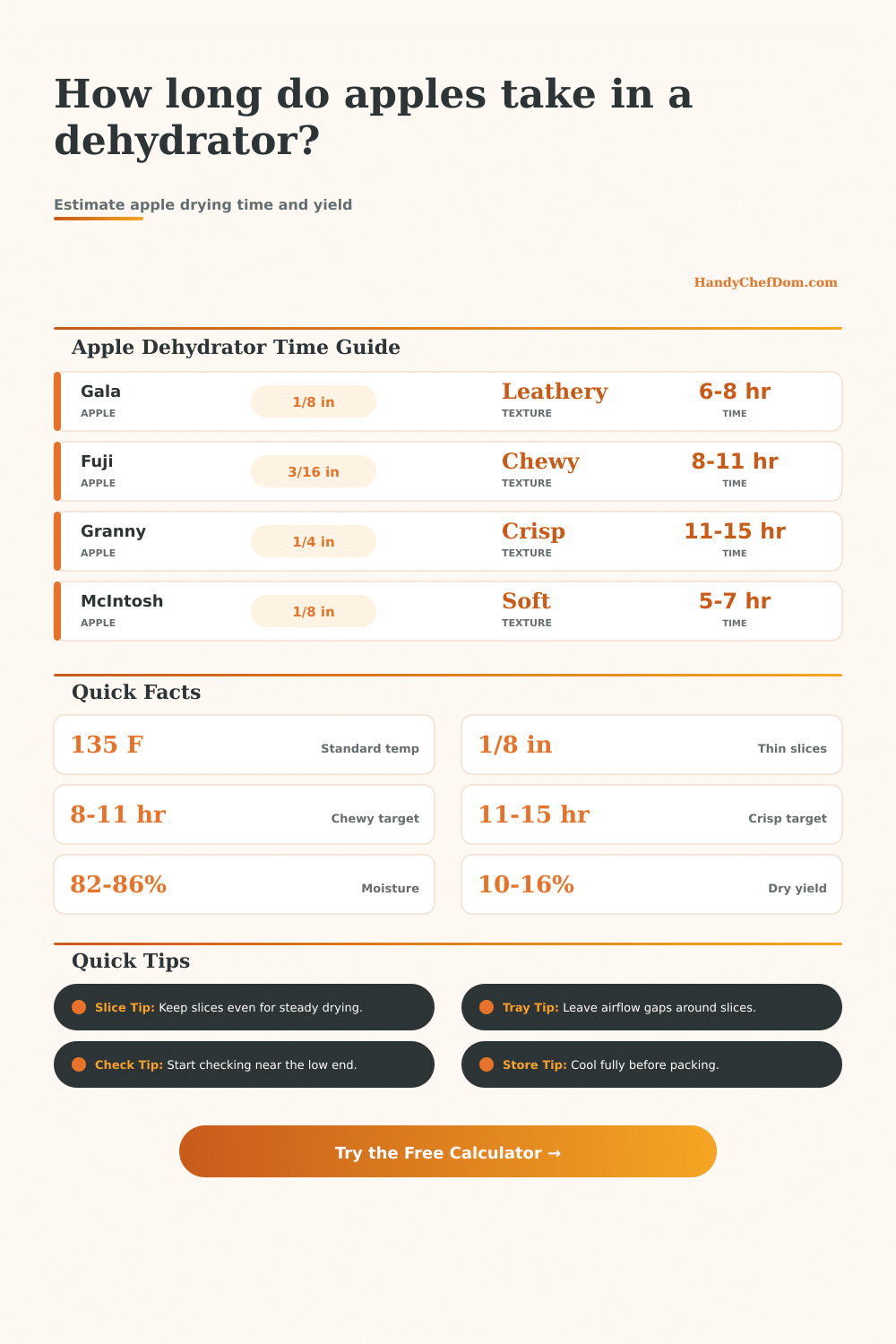
| Apple Variety | Typical Moisture | Base Time at 135 F | Texture Note |
|---|---|---|---|
| Gala | About 84% | 6 to 8 hours | Balanced sweetness, dependable snack rings. |
| Fuji | About 84% | 7 to 9 hours | Dense and sweet, often a little slower. |
| Honeycrisp | About 85% | 6.5 to 8.5 hours | Juicy slices need steady airflow. |
| Granny Smith | About 84% | 6.5 to 8.5 hours | Firm tart slices hold shape well. |
| Pink Lady | About 83% | 6.5 to 8.5 hours | Firm texture, good for chewy slices. |
| McIntosh | About 86% | 5.5 to 7 hours | Softer flesh dries faster but can be fragile. |
| Golden Delicious | About 85% | 6 to 8 hours | Soft sweet slices brown easily without dip. |
| Braeburn | About 83% | 7 to 9 hours | Dense, tart-sweet slices suit chewy drying. |
| Slice Thickness | Best Cut | Texture Target | Typical Time Effect |
|---|---|---|---|
| 1/16 inch or 1.5 mm | Chip slices | Crisp chips | About 25% faster than 1/8 inch. |
| 1/8 inch or 3 mm | Rings or half-moons | Leathery snacks | Standard baseline for most calculators. |
| 3/16 inch or 5 mm | Half-moons | Chewy slices | About 40% longer than 1/8 inch. |
| 1/4 inch or 6 mm | Wedges or thick rings | Chewy or soft | Often nearly doubles the time. |
| Diced small pieces | Small cubes | Soft dry pieces | Depends on cube size and tray density. |
| Matchsticks | Thin strips | Fast snack pieces | Fast if separated with clear airflow. |
| Dehydrator Setting | Approximate Use | Drying Speed | Planning Note |
|---|---|---|---|
| 125 F or 52 C | Gentler drying | Slower | Add time for thick slices or humid rooms. |
| 130 F or 54 C | Moderate fruit setting | Medium | Good when slices are thin and trays are open. |
| 135 F or 57 C | Common apple baseline | Standard | Use as the reference point for most batches. |
| 140 F or 60 C | Faster fruit drying | Faster | Check earlier near the end to avoid overdrying. |
| 145 F or 63 C | Fast finish | Fastest here | Works best with even slices and good airflow. |
| Batch Setup | Tray Load | Humidity | Expected Adjustment |
|---|---|---|---|
| Open single layer | Light | Dry room | Time may shorten by 10% to 20%. |
| Standard snack batch | Single layer | Normal room | Use the calculator estimate as planned. |
| Full trays | Edges close | Normal room | Add about 15% to 25% drying time. |
| Crowded trays | Limited gaps | Humid room | Add 30% or more and rotate trays. |
| Many stacked trays | 8 or more trays | Any room | Add a small fan-load factor if airflow drops. |
| Crisp chip target | Any load | Any room | Plan extra time beyond leathery dryness. |
If you are a home dehydrator owner, there’s something that always disappoints: You wake up in the morning after an all-night drying session and pull out those leather-like apple ring rather than crispy chips. Many of us have experienced this at some point. How do you achieve that satisfying snap? Why does your fruit come out chewy when it could be crunchy? Patience isn’t usually the deciding factor. Physics is.
Dehydrating fruit is less like sitting back and letting time pass and more like a process of managing heat, air speed, and moisture. When you input thickness and variety, the calculator does the math for you (above). You no longer need to do conversions or guess coefficients. But what’s realy useful: knowing why these variables matter.
Why Apples Don’t Get Crispy
Of all the factors within your control, slice thickness is the biggest. If you double the thickness of a slice of apples, that doesn’t simply double drying time. It often will double it again. First, the moisture has to travel through the core of the slice to the outside, where evaporation occur. That’s not double, but exponentially harder; you’re up against the inner resistance of the fruit tissue itself. Not only is a quarter-inch slice not just twice as difficult to dry as an eighth-inch slice; it can be twice again, since there’s all that interior resistance to get past first. And tool scales the timing window to match, taking into account this aggressive change with any increased dimension.
It also turns out that variety is not as irrelevant as most novices think. A wedge of Granny Smith isn’t quite the same than a ring cut from a Gala; each apple’s cellular structure hold onto moisture with varying strength. Apples like Honeycrisp or Pink Lady are dense and crisp; their cell walls is tight and hold moisture close to the core. Softies like McIntosh will break down sooner, which accelerates the rate at which they give up moisture initially, but can lead to a sticky situation if pushed above their limits. The base times in the reference table reflect how the natural density of an apple affects its starting point. While a firm Braeburn might be treated the same way as a juicy Honeycrisp at the same time, don’t go expecting the same outcome.
There’s also another lever: temperature. To speed things along, many people will crank it up to a hundred and forty-five degrees Fahrenheit. Big mistake. When you do that, the outside of the apple will cook, but the inside remain wet. That’ll form a barrier that holds steam within the slice. What happens next? This leads to uneven drying or something worse down the road. Why does one hundred thirty-five degrees Fahrenheit work so well? It lets the water move outwards without cooking the sugars too fast. For crispy chips, you need patience. For chewy snacks, you can get away with being a little more aggressive, but just a little.
It also needs airflow. If you crowd your trays, the dehydrator has to work even harder to pull humid air off the fruit. Slices pressed against each other form their own humid microclimate and slow down evaporation. Letting some air flow between them isn’t just a matter of looks; it’s essential to how the process works. Tray load density matters, which is why the calculator asks how densely you will fill it. However, the calculator cannot make you stack the slices correctly. Leave room. Turn the trays around halfway through drying. This is necessary unless your machine includes a convection fan that circulates vertical airflow.
The last part of the strategy is pretreatment. Just dipping into some lemon water isn’t just to keep fruit from going brown; the slight acid breaks down pectins a bit, making for easier moisture release. A tiny little bit of chemistry goes on here, and you reap the rewards in both color and texture. Yes, without the dip, apples will look attractive at first, but they turn dark and unappealing when dry.
In the end, drying apples is a negotiation with water, gently drawing it out without cooking the flavor out in the process. Your fingers (and your nose) are the last line of quality control, but the tool gives you a framework. Taste them before shutting down the timer. Let one slice cool all the way through and then decide how they’re doing. When warm, those apples will feel like they’re ready, but cool apples tell you the truth. Snap ’em? Success. Bend ’em? Keep on keepin’ on.
As you get more comfortabley with the rhythm, the process shifts from science experiment to reliable routine. You should of used the calculator earlier.