🧂 Cure Salt per Pound Calculator
Scale curing salt by meat weight, Prague #1 or #2, target ppm, dry or wet cure method, brine water, salt percentage, sugar percentage, cure duration, and batch units.
The cure salt result is based on nitrite ppm and meat weight. For wet cover brines, the brine water field helps estimate brine strength and total mix weight; always follow the method and limits in your own tested recipe.
| Meat Project | Common Cure Type | Typical Target PPM | Calculator Note |
|---|---|---|---|
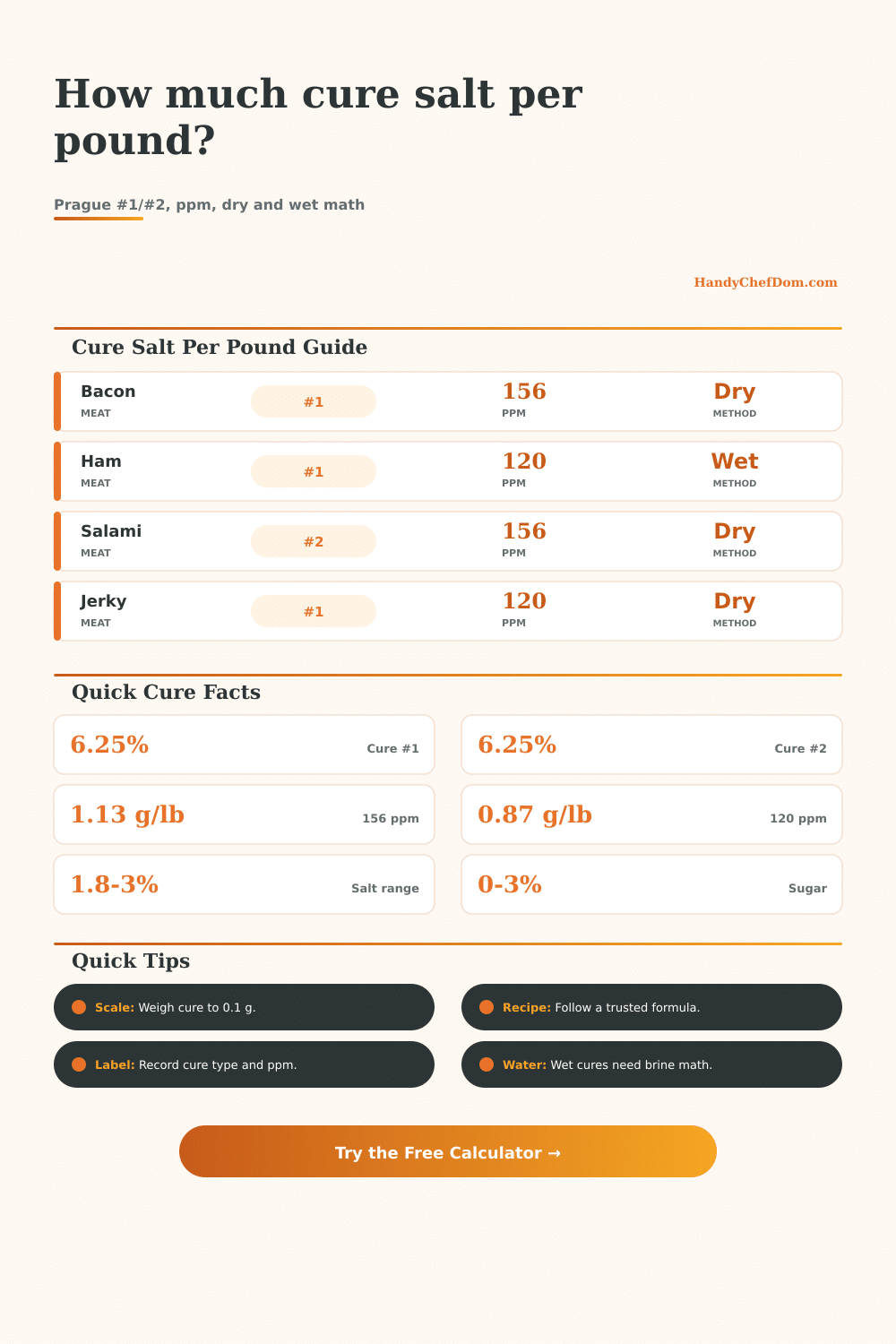
| Bacon slab or pork belly | Prague Powder #1 | 120 to 156 ppm | Dry rub and equilibrium recipes commonly calculate from meat weight. |
| Ham roast or picnic shoulder | Prague Powder #1 | 120 to 156 ppm | Wet brines may also require pickup or injection math. |
| Corned beef or pastrami | Prague Powder #1 | 120 to 156 ppm | Use the recipe target, especially for cover brines. |
| Smoked sausage | Prague Powder #1 | 120 to 156 ppm | Ground batches must be mixed thoroughly and weighed as one batch. |
| Dry salami | Prague Powder #2 | 120 to 156 ppm | Long dry cures need the cure type named by the recipe. |
| Pancetta or coppa | Prague Powder #2 | 120 to 156 ppm | Longer dry aging commonly uses Cure #2 calculations. |
| Jerky | Prague Powder #1 | 100 to 156 ppm | Thin pieces still use total trimmed meat weight. |
| Fish or poultry cure | Recipe specified | Recipe specified | Do not borrow meat-cure numbers without a tested formula. |
| Cure or Method | Calculation Basis | What the Calculator Uses | Recipe Check |
|---|---|---|---|
| Prague Powder #1 / Cure #1 | 6.25% sodium nitrite | Target ppm x meat kg / 62.5 | Used for many short cured, cooked, or smoked projects. |
| Prague Powder #2 / Cure #2 | 6.25% nitrite plus nitrate | Same nitrite math, plus nitrate amount shown | Used only when a long dry-cure recipe calls for it. |
| Dry rub cure | Meat weight | Cure, plain salt, and sugar are scaled by meat weight. | Rub evenly and keep each batch clearly labeled. |
| Equilibrium bag cure | Meat weight | Uses meat weight with no extra water basis. | Recipe duration still matters because thickness affects penetration. |
| Wet cover brine | Meat plus brine context | Cure is meat-based while brine salt strength is estimated. | Follow tested brine concentration and pickup directions. |
| Pump plus cover brine | Meat, liquid, and pickup | Shows brine water, pickup, and mix concentration. | Large cuts need a recipe written for injection. |
| Conversion | Imperial Amount | Metric Equivalent | Use in Cure Math |
|---|---|---|---|
| Meat pound | 1 lb | 453.6 g | Core basis for per-pound curing salt. |
| Meat kilogram | 2.205 lb | 1000 g | Core basis for ppm formulas. |
| Cure #1 at 156 ppm | 1.13 g per lb | 2.50 g per kg | Equals about 0.25% of meat weight. |
| Cure #1 at 120 ppm | 0.87 g per lb | 1.92 g per kg | Use only when the recipe target is 120 ppm. |
| Water cup | 1 cup | 236.6 ml | Water grams are close to milliliters. |
| Water quart | 4 cups | 946 ml | Wet brine volume scaling reference. |
| Teaspoon cure salt | 1 level tsp | About 5.6 g | Approximate only; weigh instead of scooping. |
| Scale precision | 0.1 g | 0.1 g | Better for small cure batches than whole grams. |
| Meat Weight | 120 PPM Cure #1 | 156 PPM Cure #1 | 2.5% Plain Salt Target |
|---|---|---|---|
| 1 lb / 0.45 kg | 0.87 g cure | 1.13 g cure | 11.34 g total salt before cure subtraction |
| 2 lb / 0.91 kg | 1.74 g cure | 2.27 g cure | 22.68 g total salt before cure subtraction |
| 5 lb / 2.27 kg | 4.35 g cure | 5.66 g cure | 56.70 g total salt before cure subtraction |
| 10 lb / 4.54 kg | 8.71 g cure | 11.34 g cure | 113.40 g total salt before cure subtraction |
| 15 lb / 6.80 kg | 13.06 g cure | 17.01 g cure | 170.10 g total salt before cure subtraction |
| 25 lb / 11.34 kg | 21.77 g cure | 28.35 g cure | 283.50 g total salt before cure subtraction |
Seeing on the label of a pack of curing salt “less than a teaspoon per 5 pounds of meat” might make your heart rate spike, because it seems as if you’re praying and hoping to cure some meat. Math time. Let’s use our heads. Here’s a calculator that will handle all the math for you and take the guessing out of it.
First off, everyone knows that salt dehydrates and preserves things. That makes sense. The second part of this equation trips folks up: the nitrites. Sodium nitrite isn’t simply a preservative that inhibits rot. It bond with the myoglobin in your meat and stabilizes the color to make it pink instead of gray. Sodium nitrite also prevents botulism spores from producing toxins in anaerobic environments. So without nitrite, your smoked ham will all go uniformly gray.
How to Use a Curing Salt Calculator
The switch above allow you to select between two types of curing salts: Prague Powder #1 and #2. These are the most important steps. The number one thing to know about #1 is that it’s pure nitrite. It’s designed for short cures (e.g., corned beef or bacon). You’ll be cooking or eating those meats relatively soon.
Powder #2 includes sodium nitrates which break down over time into the same nitrite. That’s why you want to use it for long dry cures (e.g., prosciutto or salamis) where they cure and age for months. Folks often mix these up, which result in dangerous spikes of nitrites later in the cure.
You might notice the interface isn’t so much about input. Everything depends on what you put in. If you type in your meat weight, then the tool will scale up the nitrites to the desired concentration. It is usually expressed as parts per million. For example, for immediate consumption, many people like their bacon at about 156 ppm. Others want less bitter, so they’ll cook for 120 ppm. Whatever the recipe, the tool calculates exactly how many grams of curing powder are necessary to get there.
And it factors in that curing powder isn’t pure active ingredients. At least not entirely. It’s mostly sodium nitrite, 6.25 percent. The rest is regular old sodium chloride. So don’t assume you can throw some extra salt on top. The tool will figure out the salt contribution of the curing powder and remove that amount. Then it will calculate the remaining sodium content to keep things within a good tasting and safe zone.
With wet brines and dry cures, there’s a different mental model at work. With a dry rub, you apply the cure directly to the surface of the food. Water draws out of the meat, which loses weight. The resulting salt concentration increases. A wet brine, on the other hand, lets the meat absorb liquid. The calculator will help you guesstimate the strength of the brine based off the amount of water and wanted pickup.
For example, if you’re injecting a big ol’ ham, you’ll want to know how much of the cure went into the meat itself. How much stayed in the brine bath? That’s why the duration input matters: over time, the cure penetrates the meat. You might need more time depending on how thick the cut is, but that doesn’t necessarily mean you need a higher-strength cure.
The math has to consider the overall size of the batch. There’s no eyeballing this. You must get an accurate measurement. For smaller batches, I use a digital scale that measures down to 0.1 grams. There’s just too much variance in humidity and how different powders is dense to try measuring half a gram out using a spoon. Use the calculator. The number will match the gram weight on your scale exactly.
Write it down. Mark your bag clearly. Curing is cool because as it ages, so does the flavor. If you make a mistake and don’t realize until the meat has already gone bad… That’s the sucky part of curing. You should of invested the time into checking your inputs.