🍰 Frosting per Cake Calculator
Estimate frosting for round, square, rectangle, heart, and sheet cakes by layers, height, filling, crumb coat, finish, side coverage, and piping.
Use finished cake dimensions after trimming. For rectangle and sheet cakes, enter width and depth. For round, square, and heart cakes, the second size field is ignored.
| Style | Side Coverage | Typical Add-On | Best Fit |
|---|---|---|---|
| Naked cake | 25-45% | 0-8% | Rustic layers |
| Semi-naked | 55-80% | 5-15% | Light finish |
| Smooth full coat | 100% | 10-20% | Classic cakes |
| Rustic swirls | 100% | 15-25% | Visible texture |
| Rosette sides | 100% | 35-65% | Piped sides |
| Drip cake base | 90-100% | 18-35% | Borders and top |
| Frosting | Gram/Cup | Texture | Use |
|---|---|---|---|
| American buttercream | 225 g | Firm | Borders |
| Swiss meringue | 210 g | Silky | Smooth coat |
| Cream cheese | 230 g | Soft dense | Layer cakes |
| Whipped ganache | 300 g | Heavy | Chocolate cakes |
| Whipped cream | 120 g | Light | Sheet cakes |
| Ermine frosting | 200 g | Smooth | Classic finish |
| Cake Size | Layers | Smooth Coat | With Piping |
|---|---|---|---|
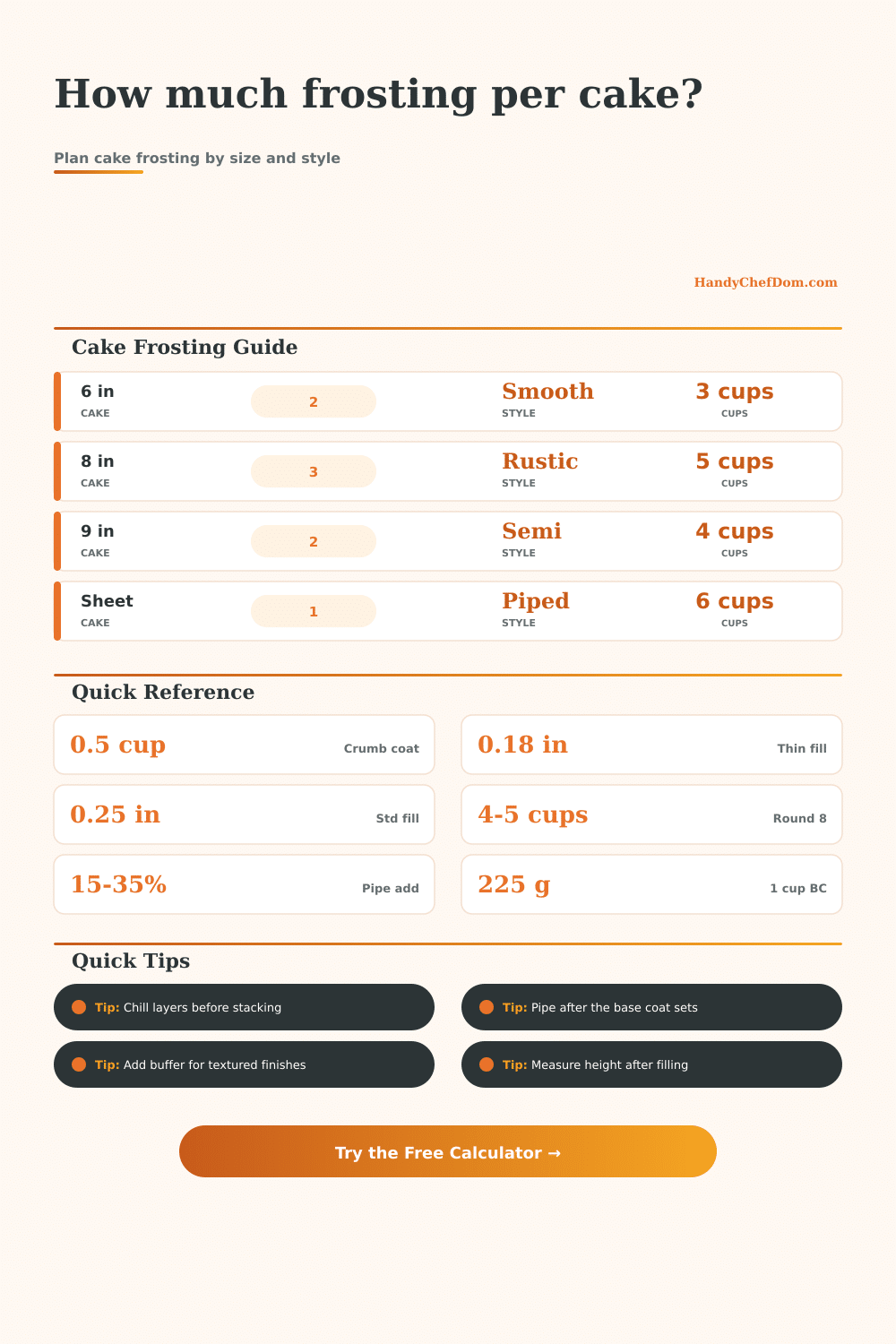
| 6 inch round | 2 | 2.5-3 cups | 3-4 cups |
| 8 inch round | 3 | 4-5 cups | 5-6 cups |
| 9 inch round | 2 | 4-5 cups | 5-6 cups |
| 10 inch round | 3 | 6-7 cups | 7-9 cups |
| 9 x 13 sheet | 1 | 3-4 cups | 4-5 cups |
| 12 x 18 sheet | 1 | 6-8 cups | 8-10 cups |
| Detail | Light | Standard | Generous |
|---|---|---|---|
| Filling thickness | 0.15 in | 0.25 in | 0.35 in |
| Crumb coat | Thin veil | Even seal | Thicker seal |
| Side scraper | Short cake | Layer cake | Tall cake |
| Offset spatula | Top coat | Filling | Texture |
| Piping bag | Border | Swirls | Rosettes |
| Serving reserve | 0.6 oz | 0.9 oz | 1.2 oz |
The trial-and-error method is how most home bakers learn to eyeball their frostings. You’re smoothening out the last side of your cake when suddenly you realize there’s no more buttercream, and now you have a structural crisis on your hands. Trying to scrape out the leftover frosting from bowl only to put it in mixer again never turns out quite right, because then the new frosting won’t be the same color.
This is one time when planning wins over improvisation.
How to Calculate Frosting Amounts
Surface area is at the root of the problem. A 3 dimensional item (i.e.: a cake) have height, width, and multiple horizontal planes. Each layer add more to the sides as well as increasing the height (if the filling is thick). Stacking layers increases surface area on the sides and adds thickness to the whole.
The beauty of this calculator are that it does the geometry for you, without you having to imagine yourself holding a greasy, cylindrical object. It divides the math up into base coat + filling + any decor items to be added on top.
Know what you’re measuring. Next is the crumb coat. You know, that thin layer of frosting used to seal in any remaining crumbs so they don’t show up on the final coating? People waste frosting here. They think it’s an optional step and then get mad when their final coat has bits of cake speckle throughout. With this tool, they can chooses between a heavy or standard crumb coat, showing that the first layer is a structural step, not just something nice-to-have. That makes all the difference in terms of how much frosting you need overall.
Finally, consider your finish style. A fully piped design, or even a rustic swirl, takes up more space on cake than a nice, smooth professional looking coat. Remember, piping use a lot of volume. Squeeze all that detail into an intricate border and you’re pushing out fat and air at a rapid pace. Add in a percentage buffer for your piping and décor on the calculator. A simple border may only take ten percent more, while full side rosettes can gobble up twice what’s required for a plain coat. Don’t forget about this variable or you’ll be out of icing just when you need it most.
How much frosting do you need? The weight of the frosting also make a difference. Some frostings are heavier than others. Heavy and dense: American buttercream will hold up well on a tall cake because it’s heavy with structure. Swiss meringue buttercream is lighter and silkier but have less body. This whipped cream is fluffy. If you have dense icing like a ganache, then you’ll want less volume by weight compared to something fluffy like whipped cream for the same amount of coverage. To help with that, I’ve got a table of gram equivalents listed on page in case you’re converting a cup-based recipe to grams to get more precise.
Remember the buffer: Add some additional frosting just to be safe. Things go wrong when mixing… Bags pop open. You run out of color matching frosting. Mixing new batches into what is already in bowl requires even more frosting. A 12-18 percent buffer is enough to accommodate the unexpected. Better to end up with some leftover in the bowl than scrape the bottom of a bowl that’s completely empty.
Finally, calculate the final stack. The cake height is NOT equal to the pan height. After trimming your dome tops and adding filling, the surface area for frosting will change. Do you want a lot of frosting on the side? Then make sure your layers is tall enough. Want a lot of filling in between? That will increase the total height. This is why the calculator ask for both baked layer height AND thickness of filling. It makes you consider the final product BEFORE cracking an egg.
It is actualy geometry. Decorating is geometry. Chemistry is baking. Respect the surface area.
Stop guessing, and start planning. No more panic; just smooth sides. Walk into the kitchen with a full bowl, a steady hand, and a cake that looks exactly like the picture in your head. It’ll be just like the picture in your head.