🧁 Cupcakes per Batch Calculator
Estimate cupcakes per batch from batter volume or weight, cup size, liner fill, recipe yield, pan cavities, waste, frosting plan, and servings.
Choose whether you know the batter by volume, weight, or recipe yield. The calculator converts that into filled liners, full pan rounds, frosting needs, and final servings.
Best for party trays, dessert samplers, and child-size servings.
The most predictable batch size for 12-cavity pans and paper liners.
Good for bakery liners when you want a higher top and fewer pieces.
Works for muffin tins, large liners, and single-dessert portions.
Use tablespoons for scoop-level batter planning.
Metric volume is converted from US cups.
Classic batter density for weight-to-volume estimates.
Classic swirl amount for one standard cupcake.
| Cupcake Size | Approx Liner Capacity | Typical Fill | From 6 Cups Batter |
|---|---|---|---|
| Bite-size candy cup | 0.75 tbsp | 65% to 70% | 120 to 130 pieces |
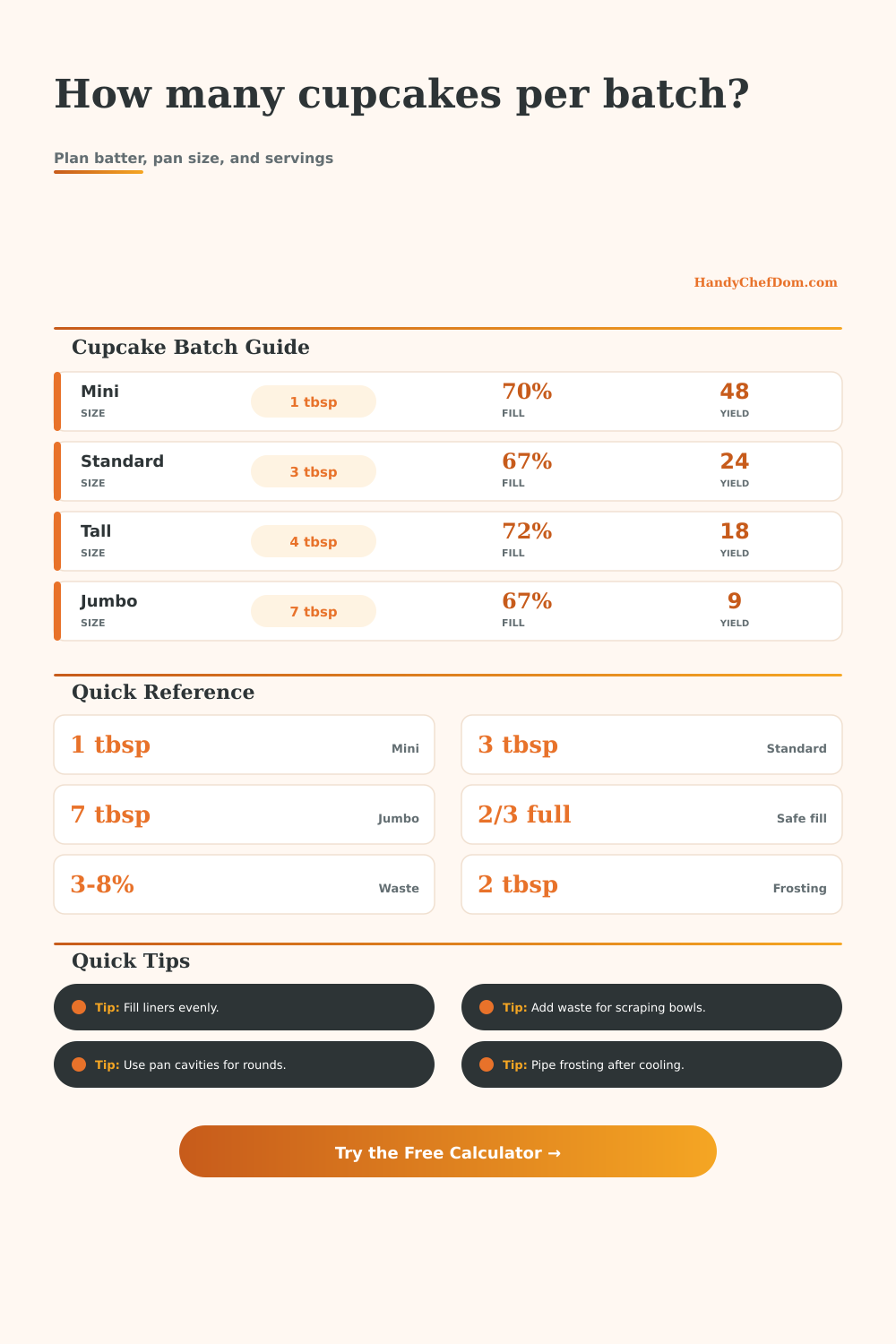
| Mini cupcake liner | 1.4 tbsp | 65% to 75% | 60 to 70 pieces |
| Tall mini liner | 1.8 tbsp | 65% to 75% | 46 to 54 pieces |
| Standard cupcake liner | 4.5 tbsp | 60% to 70% | 30 to 36 pieces |
| Shallow standard liner | 3.8 tbsp | 60% to 68% | 37 to 42 pieces |
| Tall bakery liner | 5.8 tbsp | 68% to 78% | 21 to 25 pieces |
| Jumbo muffin cup | 10.5 tbsp | 62% to 72% | 13 to 15 pieces |
| Muffin-style cup | 8.0 tbsp | 72% to 85% | 14 to 17 pieces |
| Fill Percent | Visual Level | Best For | Batch Effect |
|---|---|---|---|
| 50% to 58% | Just over half full | Very flat tops, heavy frosting | More cupcakes, lower profile |
| 60% to 67% | About two-thirds full | Classic cupcakes | Balanced yield and shape |
| 68% to 75% | Three-quarters full | Rounded bakery tops | Fewer cupcakes per batch |
| 76% to 85% | Near the rim | Muffin-style domes | Highest spill risk |
| Pan Setup | Cavities | Common Use | Round Planning |
|---|---|---|---|
| Mini cupcake pan | 24 cavities | Party bites | 48 cupcakes need 2 rounds |
| Standard muffin pan | 12 cavities | Most recipes | 24 cupcakes need 2 rounds |
| Jumbo muffin pan | 6 cavities | Large bakery portions | 12 cupcakes need 2 rounds |
| Two standard pans | 24 cavities | Double batches | 48 cupcakes need 2 rounds |
| Mixed mini and standard | Flexible | Leftover batter | Use minis for partial cups |
| Frosting Plan | Amount Per Cupcake | Best Match | For 24 Cupcakes |
|---|---|---|---|
| No frosting | 0 tbsp | Muffins or plain cakes | 0 cups |
| Thin glaze or smear | 0.75 tbsp | Mini or light standard | 1.1 cups |
| Light spread | 1.5 tbsp | School parties | 2.25 cups |
| Classic swirl | 2 tbsp | Standard cupcakes | 3 cups |
| Tall piped swirl | 3 tbsp | Bakery look | 4.5 cups |
| Bakery rosette | 4 tbsp | High frosting finish | 6 cups |
There’s a certain type of panic that comes from mixing a batch large enough for 20 cupcakes and having space in your pans for only 18. There is a bowl of leftover batter that are destined to become a sad, dense cupcake. That was going to happen, and this calculator prevents that. It connects liner size, batter volume, and fill percentage. It turns these into an actual number of servings so there’s no guessing involved in your batch plan.
No more guessing. Engineering a batch. Knowing how many cups of batter you start with is crucial to developing a good batch plan. It is at the root of most recipes which take into account a 12 cavity pan filled to two-thirds mark. Why? It’s not random! If you don’t fill it enough, you’ll have nothing but a flat, dry disc; and if you fill it too full, the batter will spill over in the oven, creating a mess that ruin the other cupcakes. So, while this tool above does the math for you, you should understand WHY your inputs are important.
Why You Should Use This Calculator
For instance, swapping to a taller bakery liner instead of a standard one can dramaticly change the capacity. You can’t just dump the exact same amount of batter as before and expect to achieve similar results. The increase in volume for cake means less yield per cup of batter.
Another overlooked variable is density. Carrot or chocolate batters is heavier than a light sponge; they will act different in the oven. If you’re entering the weight rather than the volume of your ingredients, the calculator has a density coefficient to approximate how much space the mixture will actualy take up. That’s what it means when it asks about batter type. A buttery, heavy cake will weigh more per unit of volume (space) then a whipped-up chiffon batter. Get this one wrong and you’ll be off on your estimated yield, running out of batter or having more left over than you planned.
Waste is precision baking’s silent killer. A little bit of wasted batter on the side of the bowl here. A few drops of wasted liquid stuck to measuring cup there. That adds up over time. There’s typically a waste percentage field on the calculator that’s generally between three and eight percent. This acknowledges the fact that you’ll have batter scraped off the sides of the bowl and drops left in your measuring cup. If you don’t take this into account, your expected yield is always going to be greater then your actual yield. This may seem like a minor adjustment but it means the difference between a full tray and a hole in the center.
The second key is frosting plans. For every cupcake, you’ll need about two tablespoons of frosting for a classic swirl. For those tall, piped rosettes? You will need four tablespoons. Using the end count of cupcakes, the calculator will estimate how much frosting you’ll need altogether so that you don’t embarrass yourself by running out in the middle of assembly. It will also tell you whether or not you should double up on a frosting recipe.
To make things even easier, the tool comes equipped with reference tables that allow for easy comparison between different cupcake sizes. For example, mini cupcakes will produce many more servings (with a lot less batter!) and would be perfect for an event in which people are sampling instead of committing (i.e. Large party). On the opposite end of the spectrum, jumbo cupcakes needs more batter but give off a high-end feeling, think of them as individual cakes!
So what’s right for you? If you’re having a wedding tasting, it may be best to go with the minis so that guests can try different flavors. But if it’s a birthday bash, you’ll probably want the classic standard size.
At its heart, baking is all about having control. The temperature of the oven? It is about control. The amount of time you mix? It is about control. The ingredients that go in? It is about control. How big is the batch? It is all about control. By considering your waste and tweaking the fill percentage, you can take a crazy chaotic mixing process and create a predictable outcome. The next time you stand in front of your mixer, you’ll know exactly how many cups to expect. And that’s the best ingredient you could of put into the bowl: clarity.