🍚 Rice Paper in Water Soaking Time Calculator
Estimate dip seconds, rest time, rolling window, and batch rhythm from wrapper size, thickness, water temperature, filling moisture, rolling speed, pliability, humidity, and stacking method.
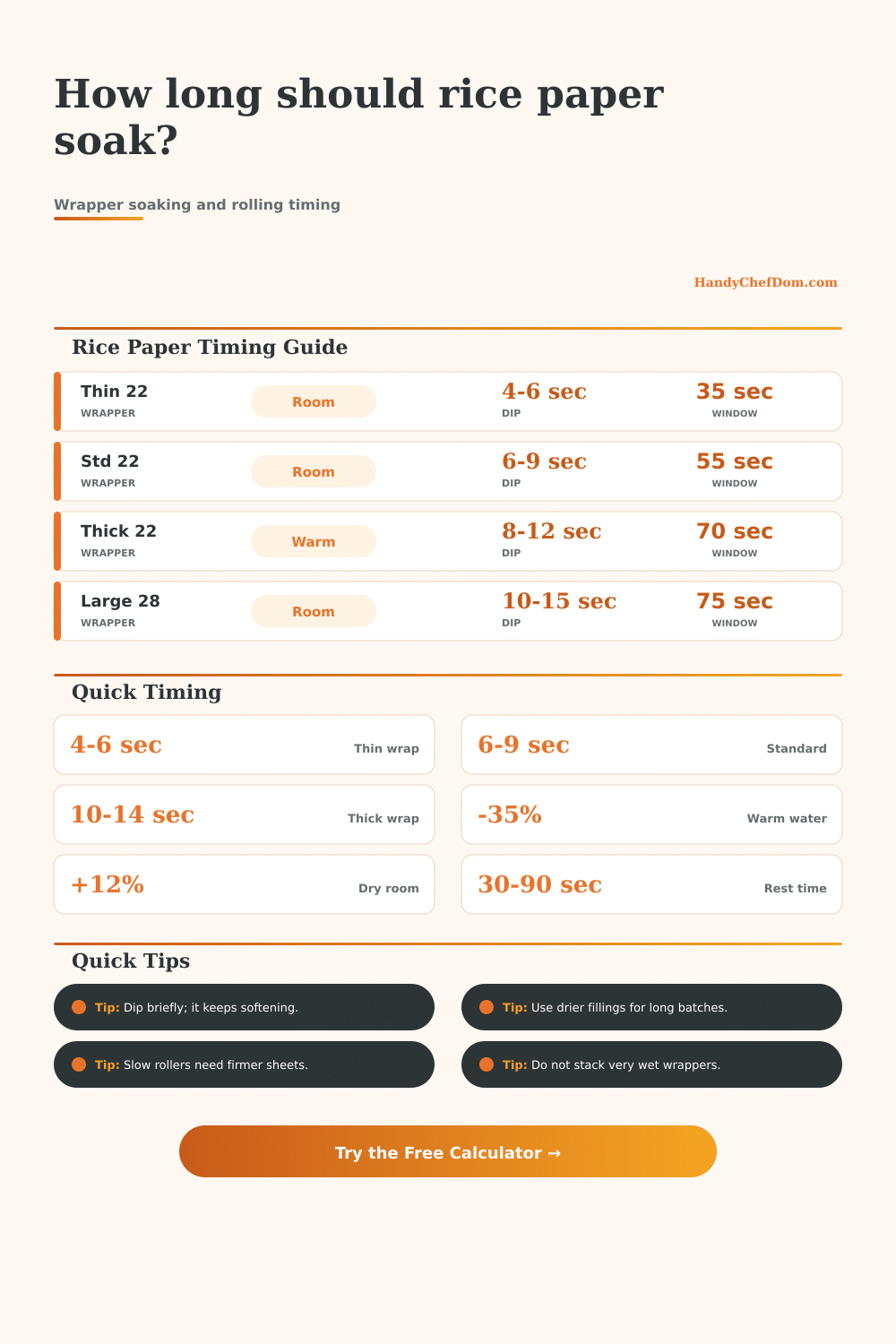
Rice paper keeps softening after the water dip. This calculator targets the short dip plus rest rhythm that gives the wrapper enough bend without becoming gluey before it is rolled.
| Wrapper type | Typical size | Room-water dip | Best target | Rolling note |
|---|---|---|---|---|
| Mini appetizer round | 16 cm or 6.3 in | 3 to 5 seconds | Firm to flexible | Fills fast, so do not oversoften. |
| Thin rice-only sheet | 20 to 22 cm | 4 to 6 seconds | Flexible | Rest briefly on the board before filling. |
| Standard Vietnamese round | 22 cm or 8.7 in | 6 to 9 seconds | Flexible | The most forgiving range for fresh rolls. |
| Chewy rice-tapioca blend | 22 to 25 cm | 8 to 12 seconds | Soft and stretchy | Needs more water but can become tacky. |
| Large restaurant wrapper | 28 cm or 11 in | 10 to 15 seconds | Firm to flexible | Roll quickly because the large surface keeps hydrating. |
| Water or method | Timing factor | Best use | Watch point |
|---|---|---|---|
| Cool water | About 35% longer | Slow, controlled rolling sessions | Thin wrappers may feel stiff at first. |
| Room temperature water | Baseline | Most fresh spring roll work | Keep the dip shallow and consistent. |
| Lukewarm water | About 28% shorter | Thick or stiff wrappers | Shorten rest time if sheets sag. |
| Quick dunk | About 35% shorter | Thin sheets and fast rollers | Board rest finishes the softening. |
| Damp towel | About 50% longer | Delicate sheets and patient prep | Refresh the towel as it dries. |
| Factor | Dip change | Window change | Practical setup |
|---|---|---|---|
| Dry herbs and drained protein | Slightly shorter | Longer window | Good for party batches and firmer rolls. |
| Balanced noodles and vegetables | Baseline | Baseline | Use one dip station and one rolling board. |
| Juicy vegetables or tofu | Shorter dip | Shorter window | Drain fillings well before rolling. |
| Saucy noodles or dressed filling | Much shorter dip | Much shorter window | Roll one at a time and serve soon. |
| Beginner pace | Shorter dip | Needs more structure | A firmer wrapper is easier to handle. |
| Batch size | Dip approach | Rest range | Rolling pace | Total active time |
|---|---|---|---|---|
| 4 to 6 wrappers | One at a time | 0 to 30 seconds | Relaxed | 4 to 7 minutes |
| 8 to 12 wrappers | One or two at a time | 30 to 60 seconds | Steady | 7 to 12 minutes |
| 18 to 24 wrappers | Two-person station | 30 to 90 seconds | Fast and organized | 15 to 24 minutes |
| 36 or more wrappers | Small rolling waves | 30 seconds with dividers | Assembly line | 30 minutes plus |
Making Vietnamese spring rolls is usualy traumatic the first time. Out come the water, the wrappers, and the filling. Everything were laid out with care. Then comes the dipping. You wait too long, and rice paper becomes a wet napkin ready to tear at the slightest touch. Trust me: It’s frustrating. But it’s rarely the paper that has gone wrong. It’s almost always the timing.
Rice paper doesn’t cook in water like pasta. It hydrates. You want just the right moment. It needs to be still a little wet inside so you can fold it without tearing, but also dry on top so it holds onto filling instead of sliding it off. That’s where the rice paper calculator comes in. Once you know how fast you’re going and what type of rice paper you have, you’ve got the math solved. No more guessing at rest periods or hydration rates.
How to Make Vietnamese Spring Rolls
The first variable that trips folks up is water temperature. According to most instructions, you’re supposed to use room temperature water, which works fine when you’re working with regular twenty-two centimeter wrappers. However, if you work with thicker blends, such as those that use tapioca starch, you’ll need warm/luke-warm water instead. That’s because it will penetrates into the denser structure fast. Working with warm water speeds up the hydration process significantly. In fact, it can reduce dip time by as much as one-third. The difference in timeline is reflected in the reference table on the page. This isn’t a minor tweak. This is the difference between a sticky mess and a smooth roll.
Most home cooks also overlook the resting period. Even when removed from water, rice paper continues to soften. Those little starch granules are continuing to absorb whatever water is present on the sheet and in the air around it. If you try to roll immediately after a short dip, you might find center of the wrapper is still stiff. Let it sit too long, and those same edges will become see-through and brittle. Resting it for a half-minute on a clean board (or even just another slightly damp towel) help balance out the moisture. You should of do this if you want reliable results.
How long? The amount of time you can let the wrapper soak depends on how much water there is to soak up. Juicy tofu and saucy noodles will quickly make their way into the wrapper. Start with a slightly firmer sheet so it acts as a barrier to all that wet stuff inside. A forgiving filling would include something dry such as shredded lettuce or herbs. That gives you more wiggle room for soaking the wrapper longer without worry that it’ll come apart. Remember, the wrapper’s job is to stand up to whatever it holds. It must stand up to the moisture and weight of that content.
Another invisible factor is humidity in the kitchen. If your kitchen has low humidity (like mine does during the winter), rice paper will get stiff quicker then you expect as it sits on the counter. To avoid cracking of unused sheets, you might want to lay out a damp towel over them. Alternatively, if you have a high-humidity summer kitchen (the way I do), there’s enough moisture in the air to help moisten the rice paper too. So you can roll a bit quicker because you don’t have to dip it as long. The tool factors that into play; adjusting the rolling window based on your environment. It is a small detail, but it matters when you want to keep a rhythm for a party.
Your work flow depends on the batch size. Casual: Four rolls for dinner? No worries. Dip. Rest. Roll. You need a system if you are prepping for a party and need to make 30 rolls. You’re gonna need a system. Dip one or two sheets at a time. Rest on a board. Then roll each one before dipping the next batch. Don’t stack wet wrappers without dividers; that’s asking for trouble. They’ll stick together. They will tear apart when you separate them.
Rice paper is beautiful in its simplicity. It is just rice and water. But there’s something special to be respected here: this simple combination requires attention. You must have patience. You cannot cheat time while hydrating the paper, nor can you overlook other elements. Get your timing correct and you’re left with a tight, neat cylinder. Miss it by an inch and it’s a soggy pancake instead.
There’s no magic formula for mastering these rolls; the secret lies largely in knowing exactly what you’re measuring. It is not about how long to cook anything. It is about how to manage moisture.
Begin with the basics. For standard sheets, start with room temp water. Dip for 6-9 sec. Let sit for 30 sec. Roll with care. And when you’ve got that down, start playing around… Try hotter water, different thicknesses of paper, even heftier fillings inside. Listen to the paper and it’ll tell you exactly what it wants.