🥛 Vinegar to Make Buttermilk Calculator
Estimate vinegar or lemon juice for a buttermilk substitute, then see the milk volume needed to finish the batch at the classic 1 tablespoon acid per cup ratio.
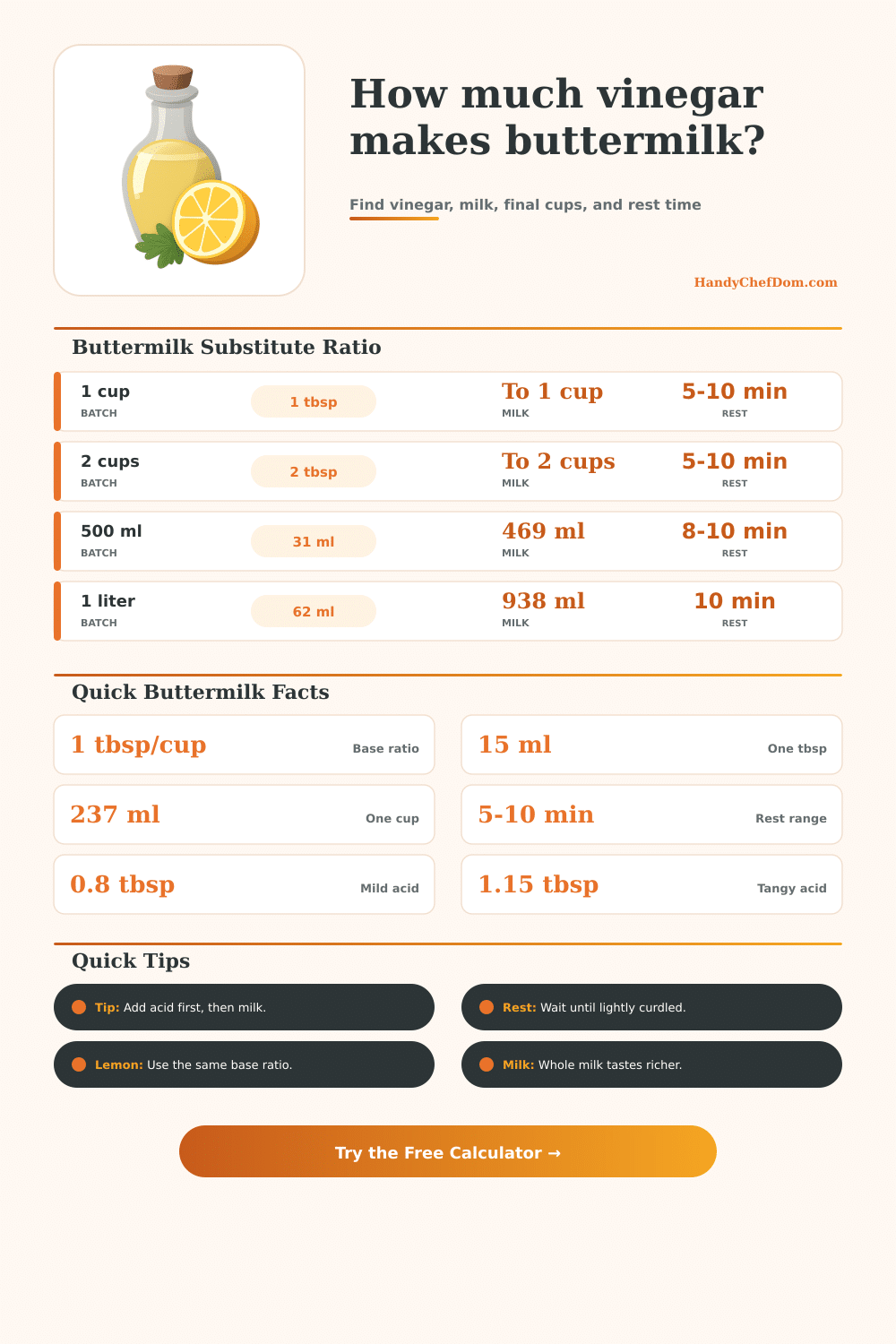
Reference ratio: add 1 tablespoon vinegar or lemon juice, then add milk to make 1 cup total. Rest 5 to 10 minutes, or until the milk looks slightly thickened and lightly curdled.
Use 1 tablespoon vinegar or lemon juice, then add milk to reach 1 cup total substitute.
Lemon juice can replace vinegar at the same base amount when you want a brighter taste.
Whole milk gives a rounder substitute than skim milk, especially in biscuits and cakes.
Most batches are ready once the milk looks slightly thickened or lightly curdled.
| Finished substitute amount | Standard acid amount | Milk to add after acid | Best use |
|---|---|---|---|
| 1/2 cup finished substitute | 1/2 tablespoon or 1 1/2 teaspoons | Fill with milk to 1/2 cup total | Small pancake, muffin, or dressing adjustment |
| 1 cup finished substitute | 1 tablespoon or 3 teaspoons | Fill with milk to 1 cup total | Most baking recipes that call for 1 cup buttermilk |
| 2 cups finished substitute | 2 tablespoons or 6 teaspoons | Fill with milk to 2 cups total | Biscuits, cornbread, cake batter, or family pancakes |
| 500 ml finished substitute | About 31 ml acid | About 469 ml milk | Metric baking batches and larger batters |
| 1 liter finished substitute | About 62 ml acid | About 938 ml milk | Large griddle batches or marinade prep |
| Acid type | Calculator factor | Flavor note | Good fit |
|---|---|---|---|
| White distilled vinegar | 1.00x | Clean acidity with the least added flavor | General baking, pancakes, biscuits, and cakes |
| Apple cider vinegar | 1.00x | Light fruity note that blends well with warm bakes | Muffins, quick breads, cornbread, and pancakes |
| Rice vinegar | 1.10x | Milder acidity, so the calculator raises the amount slightly | Mild batters and delicate cakes |
| Champagne vinegar | 1.00x | Soft bright acidity with a gentle finish | Cakes, cupcakes, and dressings |
| Malt vinegar | 0.95x | Toasty flavor that can be more noticeable | Savory batters and fried chicken marinades |
| Lemon juice | 1.00x | Bright citrus acidity at the same base ratio | Pancakes, cakes, muffins, and lighter batters |
| Recipe type | Acidity level | Rest target | Practical note |
|---|---|---|---|
| Pancakes or waffles | Classic or mild | 5 to 7 minutes | Use when the recipe needs acidity for tenderness and leavening reaction. |
| Biscuits or scones | Classic | 7 to 10 minutes | Whole milk gives a richer result, while skim milk makes a leaner substitute. |
| Muffins or quick bread | Classic or tangy | 7 to 10 minutes | Apple cider vinegar or lemon juice usually blends smoothly with sweet batters. |
| Cake or cupcakes | Mild or classic | 8 to 10 minutes | A softer acid level keeps delicate cake flavor from turning sharp. |
| Fried chicken marinade | Tangy or extra tangy | 10 to 12 minutes | The substitute is for mixing a marinade base, not a true cultured buttermilk soak. |
| Dressing or dip | Mild | 5 minutes | Use less acid first because the flavor stays more obvious when uncooked. |
| Dairy choice | Typical fat percent | Substitute texture | Calculator note |
|---|---|---|---|
| Skim milk | 0% to 0.5% | Thinner and sharper tasting | Works for pancakes, but may feel lean in biscuits or cake. |
| Low-fat milk | 1% to 2% | Light but balanced | A dependable everyday choice for most baking substitutes. |
| Whole milk | About 3.25% | Richer and rounder | Closest common milk choice when tenderness matters. |
| Half-and-half | About 10% to 12% | Very rich and heavy | Use carefully because it can make batter denser than expected. |
| Plain yogurt thinned with milk | Varies | More body and tang | Different substitute method; not calculated by this vinegar ratio. |
When you dont have buttermilk available for a recipe, you must use an buttermilk substitute. A buttermilk substitute are created by combining milk with acid. This buttermilk substitute allow you to mimic the chemical property of buttermilk.
The acid is needed in a buttermilk substitute for the acid to react with the milk to create a tenderizing effect in the baked goods that uses this ingredient. Using the incorrect amount of acid in your recipe will dramatic impact the outcome of your recipe. Using too little acid will create a weak leavening effect from the buttermilk substitute.
How to Make a Buttermilk Substitute
Using too much acid can create baked goods that has a sharp taste or that may even collapse during the baking process. The ratio of acid to milk in a buttermilk substitute is important. A common ratio is use one tablespoon of acid for every one cup of buttermilk substitute.
The ratio may need to be altered with different types of acid and milk. For instance, using white distilled vinegar as the acid will yield a slightly different substitute than use apple cider vinegar. The apple cider vinegar will add a fruity flavor to the buttermilk substitute.
Another example is use rice vinegar instead of white distilled vinegar. In this case, the rice vinegar is much milder in flavor, so you will need more rice vinegar in the recipe. Lemon juice can also be used as an acid in place of other acids.
In this case, the buttermilk substitute will have a brightly flavor to it. The type of milk that you use will also alter the outcome of the baked good. Using whole milk instead of skim milk will result in a richer texture to the baked good.
This is due to the fat content of the whole milk. Using skim milk will result in a dry baked good due to a lack of fat content in the skim milk. The fat content of the milk can dramatic alter the outcome of the baked good.
Another critical aspect of making a buttermilk substitute is allowing it to rest. During this time, the milk will thicken. The rest time for a buttermilk substitute is five minute, but some recipes may take seven or ten minutes for the buttermilk substitute to thicken.
Using a thicker buttermilk substitute may be beneficial for other recipes, like fried chicken marinades. People often make mistake when creating a buttermilk substitute. One of the most common mistake is adding the milk to the bowl before the acid.
In this case, first add the acid to the bowl and then add the milk until you reach the prescribed volume. People also tend to skip the resting period for the buttermilk substitute. If you do not allow the buttermilk substitute to rest, the baked good will not set proper.
Lastly, if people are increasing the recipe, they may not realize that doubling the recipe does not necessarily mean doubling the amount of acid needed for the buttermilk substitute. Creating a buttermilk substitute requires people to remember different aspect of the recipe. Using a calculator will make it easier for people to remember the correct amount of acid and milk needed.
These calculators allow people to input the type of acid they will use, the fat content of the milk, and how strong the acid flavor they would like in their buttermilk substitute. The calculator will provide the exact amount of acid and milk needed to create the buttermilk substitute. Using the calculator will allow people to ensure that the amount of acid and milk needed is correct.
Thus, using this calculator will ensure the buttermilk substitute will work correct in the recipe that is being made.