🍰 Baking Pan Size Converter
Convert recipes between round, square, rectangular, loaf, sheet, Bundt, and springform pans using shape, dimensions, batter depth, fill height, scale, material, time, and servings.
Use inside dimensions when possible. For round pans, enter diameter in the length field and leave width as the suggested value; for Bundt or tube pans, use the listed cup capacity when the maker provides it.
| Original Pan | Typical Capacity | Close Substitution | Conversion Note |
|---|---|---|---|
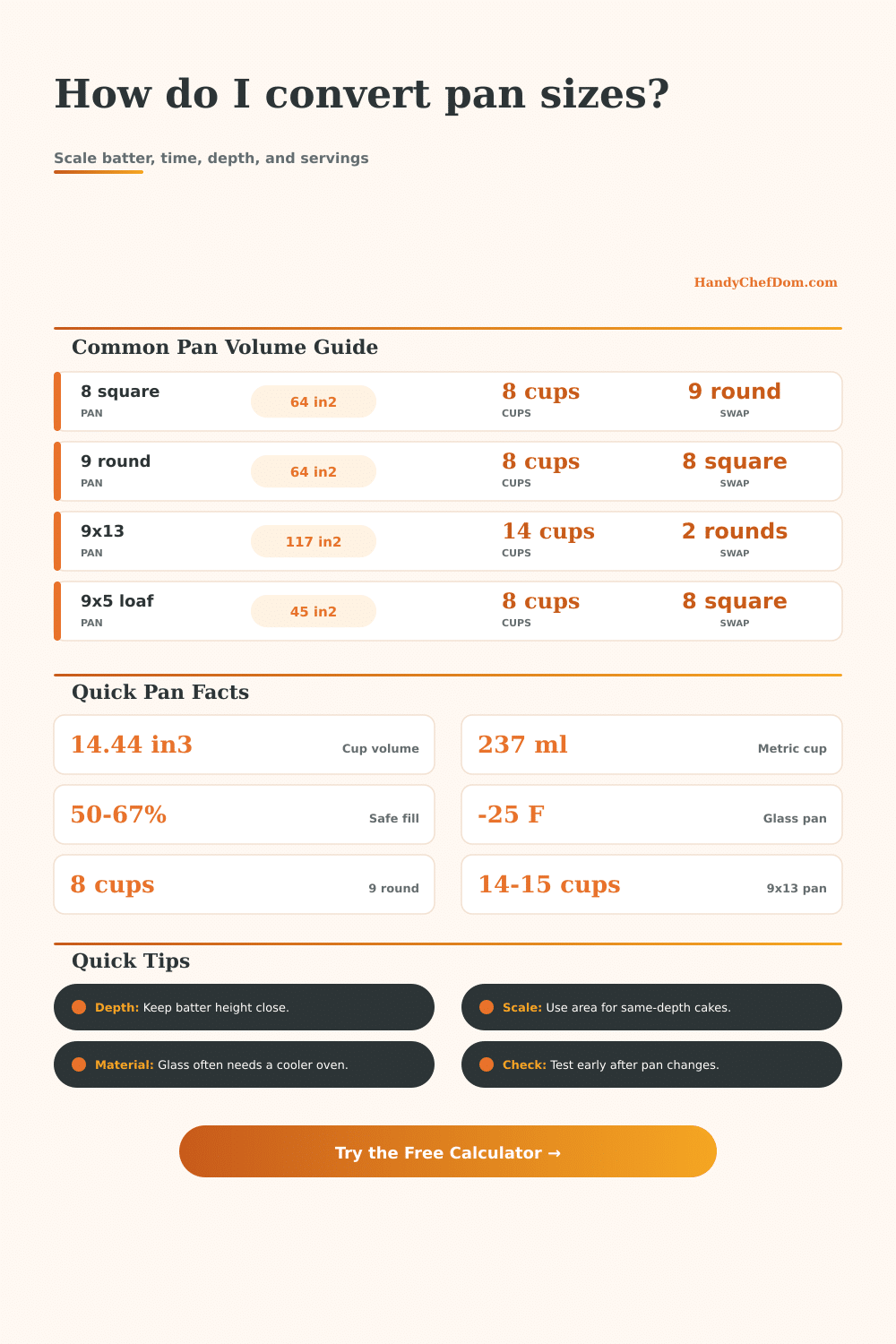
| 8 x 8 x 2 inch square | 8 cups / 1.9 L | 9 inch round | Very similar area and depth |
| 9 x 9 x 2 inch square | 10 cups / 2.4 L | 10 inch round | About 25% more area than 8 square |
| 9 x 13 x 2 inch pan | 14-15 cups / 3.3-3.5 L | 2 x 9 inch rounds | Good layer cake conversion |
| 11 x 7 x 2 inch dish | 6-10 cups / 1.4-2.4 L | 8 inch square | Check actual depth carefully |
| 9 x 5 inch loaf pan | 8 cups / 1.9 L | 8 inch square | Shape changes center depth |
| 8 x 4 inch loaf pan | 6 cups / 1.4 L | 8 inch round | Smaller quick-bread batch |
| 10 x 15 inch jelly roll | 10-15 cups / 2.4-3.5 L | 9 x 13 pan | Shallower rim bakes faster |
| 10 inch Bundt pan | 10-12 cups / 2.4-2.8 L | 9 x 13 pan | Never fill mold to the rim |
| Shape | Area Formula | Volume Formula | Best Use |
|---|---|---|---|
| Rectangle or square | length x width | area x batter height | Bars, sheet cakes, casseroles |
| Round pan | 3.1416 x radius x radius | area x batter height | Layer cakes and cheesecakes |
| Loaf pan | length x width | area x batter height | Quick breads and pound cakes |
| Springform pan | 3.1416 x radius x radius | area x batter height | Cheesecake and tall cakes |
| Bundt or tube mold | use listed capacity | cups x 14.44 cubic in | Ring cakes and molded batters |
| Cupcake wells | well count x well area | about 1/4 cup each | Portioned cake batter |
| Target Material | Temp Adjustment | Time Tendency | Method Cue |
|---|---|---|---|
| Light metal | No change | Baseline | Best default for cakes and bars |
| Dark nonstick metal | Reduce 10-25 F | Check early | Edges brown faster |
| Glass baking dish | Reduce 25 F | Often longer | Retains heat after baking |
| Ceramic stoneware | Reduce 25 F | Often longer | Slow heat-up, strong heat hold |
| Silicone mold | No change | May need longer | Less browning and softer sides |
| Cast iron | Reduce 10-25 F | Check early | Strong edge browning |
| Measure | Imperial | Metric | Pan Math Use |
|---|---|---|---|
| 1 US cup | 14.44 cubic inches | 237 ml | Convert pan volume to batter cups |
| 1 cubic inch | 0.069 US cup | 16.39 ml | Convert area x height |
| 1 liter | 4.23 US cups | 1000 ml | Read metric pan capacities |
| 1 inch | 1 inch | 2.54 cm | Convert pan dimensions |
| 2/3 full | 66.7% | safe fill guide | Common cake batter limit |
| 1/2 full | 50% | safe fill guide | Good for rising batters |
Don’t freak out just because your recipe says “pan” and yours doesn’t match any of them. To make it work, think in terms of volume (forgiving math) rather than pan shape. If it’s baked, it’s a matter of chemistry, which isn’t terribly sensitive to what type of pot it’s cooked in. Replacing a pan become a matter of how to manage temperature; too hot, burn; too cool, gummy.
That’s where the calculator steps in. It does the math on the batter volume for you. It figures out the depth and surface area so it can advise on what amount of batter to use. But it doesn’t stop at the numbers. The other half of the equation is heat transfer. Moving the batter into a narrower but deeper pan cause heat to flow more slow towards the middle. You need to either bump up the bake time (or drop the temp). If you forget that the batter’s depth has changed, you’ll have a burnt exterior and a raw interior.
How to Use Different Pans for Baking
So what do we, as home bakers, concentrate on? It is surface area. Specifically, it’s space available for the batter to distribute itself. An eight-inch square and a nine-inch round pretty much share the same footprint. In most recipes, you can swap one for the other with no change in batter amount. This explains why they are lumped together on reference tables.
But what about a nine by thirteen pan? This dish holds almost twice as much than a single nine-inch round. If you pour your single layer recipe into such a big dish, you’ll end up with a flat, crusty slab that burns in half the time.
The material used is very important in these conversions. Metal pans transfer heat quick, and give it back just as fast. Ceramic and glass are insulators. They pick up heat slowly but retain the heat for a long time, once they become hot. It’s that retention of heat that is problematic for glass pans. The pan becomes a bright heat source, and the edges bake at a higher rate then does the center. Reduce your temperature by twenty-five degrees if you’re going from metal to glass. That little change could of saved you from burned cake. Dark nonstick pans also act like glass. They absorbs heat from the oven elements in the form of infrared radiation.
• Neutral baseline: Light aluminum acts as neutral baseline. Be careful because food may brown too early with a dark pan. Temperature offsets (as suggested by the calculator) account for this.
• But your eyes remain most reliable. Don’t get lulled into thinking that a timer can be trusted absolutely. Look at it, smell it…
The last thing that throws people off is filling height. Don’t ever fill anything to the top. Why? Because the batter rise. Fill your springform pan all the way up to the top and what happens? The batter overflows… and dries out your cake. Leave about 50-60% unfilled in order to give it room to rise. This is safe fill line. The converter takes this into account so that you don’t cram too much batter into a tiny area.
Adaptation is the art of baking with different pans. It’s like reading a recipe as opposed to just following directions. It’s learning from the tool itself. It’s using your judgement for everything else. If the pan is deeper, insert a toothpick earlier. If the pan is wider, cook it a bit longer. Look for an even crumb throughout and a tender crust. When you understand how materials and heat levels work, you’ll be able to use just about any pan for just about anything. This kind of flexibility make a rigid recipe into a dependable technique.