Rice to Water Ratio Rice Cooker Calculator
Calculate rice cooker water, yield, and servings by grain type, cooker style, and texture target.
Use the same measuring cup for rice and water. If you switch to metric, rice is entered as grams and water is reported in milliliters.
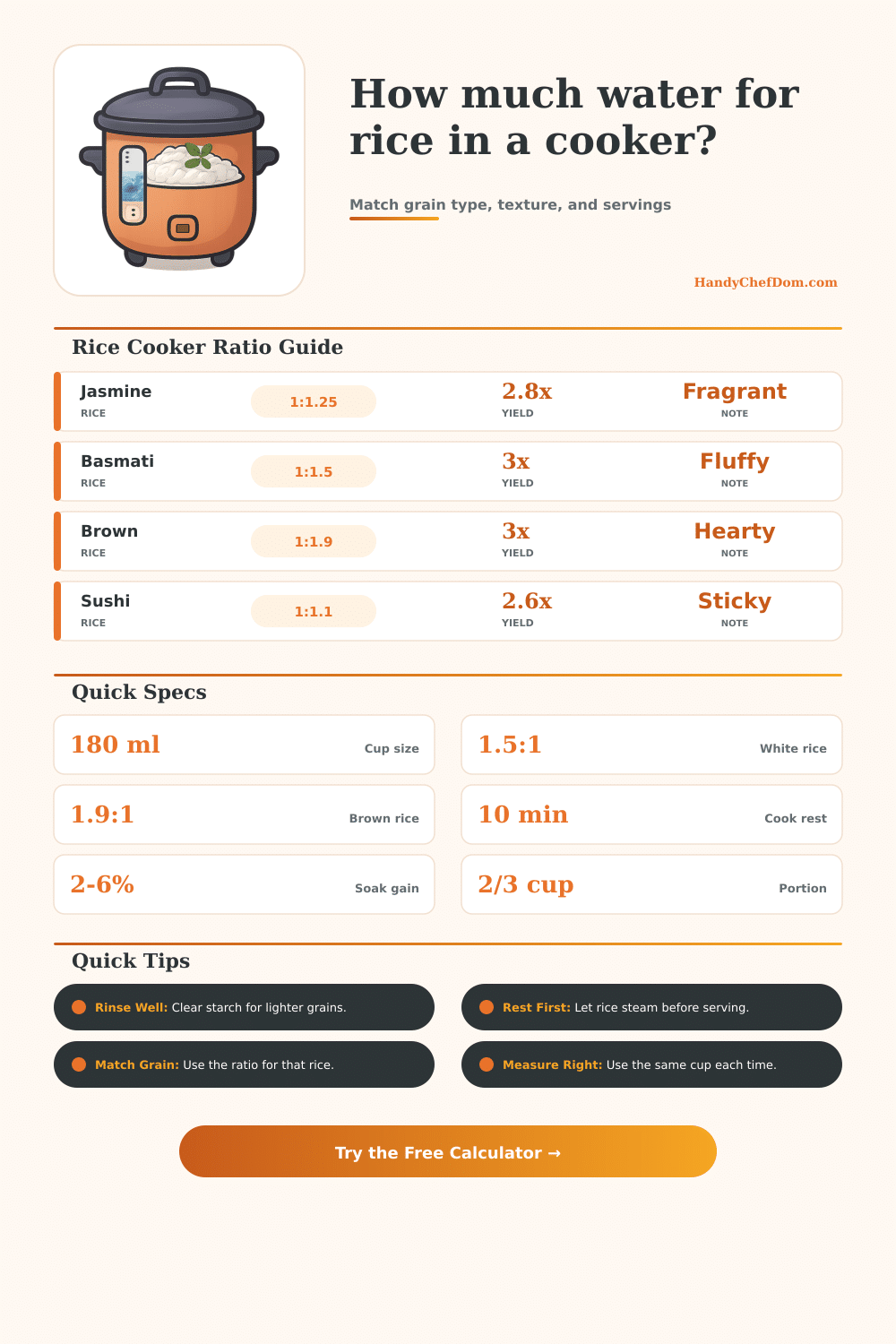
| Rice | Water Ratio | Cook Yield | Note |
|---|---|---|---|
| Jasmine | 1:1.25 | 2.8x | Fragrant |
| Basmati | 1:1.5 | 3.0x | Fluffy |
| Brown | 1:1.9 | 3.0x | Nutty |
| Sushi | 1:1.1 | 2.6x | Sticky |
| Parboiled | 1:1.75 | 3.2x | Firm |
| Wild Blend | 1:2.4 | 2.7x | Hearty |
| Cooker Cup | Volume | Grams Rice | Note |
|---|---|---|---|
| US cup | 240 ml | 185 g | Kitchen cup |
| Rice cup | 180 ml | 140 g | Cooker cup |
| Mini cup | 150 ml | 115 g | Compact |
| Brown cup | 185 ml | 145 g | Drier grain |
| Sushi cup | 200 ml | 155 g | Sticky grain |
| Metric cup | 250 ml | 195 g | Rounded cup |
| Servings | Dry Rice | Cooked Rice | Water |
|---|---|---|---|
| 2 | 1 cup | 2.6-3.0 c | 1.1-1.5 c |
| 4 | 2 cups | 5.2-6.0 c | 2.2-3.0 c |
| 6 | 3 cups | 7.8-9.0 c | 3.4-4.5 c |
| 8 | 4 cups | 10-12 c | 4.4-6.0 c |
| 10 | 5 cups | 13-15 c | 5.5-7.5 c |
| 12 | 6 cups | 15-18 c | 6.6-9.0 c |
| Adjustment | Water | Time | Use |
|---|---|---|---|
| Light rinse | 1.00x | 1.00x | Cleaner grains |
| Well rinsed | 0.97x | 0.98x | Less starch |
| 10 min soak | 0.98x | 0.97x | White rice |
| High altitude | 1.05x | 1.04x | Thin air |
| Sticky target | 0.92x | 0.96x | Clingy grains |
| Pressure style | 0.90x | 0.75x | Shorter cycle |
Rice preparation require the correct ratio of water to rice. If you add too much water to the rice, the rice will become soggy and mushy. However, use too little water will result in dry and crunchy rice.
To prepare rice to your desired texture, you need to understand how different types of rice requires different amounts of water to prepare. For example, jasmine rice require less water because its grains is slender. Brown rice contain a bran layer that requires more water so that the rice can soften.
How Much Water to Use for Rice
Basmati rice requires a specific amount of water so that the rice will remain fluffy when cooked. Additionally, sushi rice requires a specific amount of water for the rice to becomes sticky when cooked. As with the examples above, the variety of rice you use will dictate the amount of water the rice will absorb during the cooking process.
Another factor that will impact the amount of water that you must use is your rice cooker. If you use a pressure cooker, it will require less water then a rice cooker that dont have a pressure function. Before cooking the rice, it is important to rinse the rice to remove excess starch that may be on the surface of the rice grains.
If the rice still contain this starch, the rice will clump together during the cooking process. Make sure to rinse the rice until the water run clear before cooking the rice. Another method to wash the rice before cooking.
When soaking the rice, the rice grains will swell with water before being cooked. Since the rice has already absorbed some of the water, you may need to use slightly less water when cooking the rice. You can also soak the rice to allow the grains to absorb water before being cooked.
You will need to account for the altitude at which you are cooking the rice. At higher altitude, there is more evaporation of the cooking water. To account for this evaporation, you will need to add more water to the rice when preparing it for cooking.
Depending on the desired texture of the rice, you may need to use more or less water when preparing the rice. For example, if you want your rice to be fluffy with each grain of rice separate from the other grains, you will need to use less water when cooking the rice. Conversely, if you would like your rice to have a creamy texture, like rice used for porridge, you will need to use more water when cooking the rice.
Whatever type of rice that you use to prepare your meals, the amount of water that you use should be poured into the same measuring cup that you use to measure the rice. Many rice cooker come with a small cup that holds 180 ml of water and rice; use this cup to measure the amount of water and rice you will use in your meal preparation. After adding the rice and water to the rice cooker, make sure to allow the rice to rest for at least ten minutes once the cooking process is complete.
Allowing the rice to rest allows the heat from the rice cooker to continue to moisten the rice grains. Do not fluff the rice while it is still cooking. Only after the rice has rested for at least ten minutes should you fluff the cooked rice.
There are some common mistake that you can avoid while cooking rice. For starters, do not use your eyes to estimate how much water to use in the rice cooker. Always use a measuring cup to measure the water.
Second, do not ignore the type of rice you are using. Each type of rice requires a specific amount of water. Third, do not open the lid of the rice cooker while the rice is cooking.
Opening the lid release the steam and the pressure within the rice cooker. Fourth, do not overcrowd the rice cooker when adding rice. Overcrowding the rice cooker will cause the rice to steam unevenly.
By following these step and using the appropriate ratios of water and rice, you will be able to prepare rice that remains delicious every time that you prepare rice for your meals.