🍰 Baking Time Calculator
Estimate bake time from pan shape, pan size, batter depth, oven temperature, convection, altitude, pan material, and doneness target.
Use measured batter volume and pan dimensions for the best estimate. For cupcakes, enter the number of cups in Length / Count and one cup diameter in Width.
| Bake Style | Typical Target | Depth Time | Visual Cue |
|---|---|---|---|
| Butter cake | 198 F to 205 F | 17 min per in | Springy center |
| Sponge cake | 195 F to 200 F | 14 min per in | Light rebound |
| Brownies | 180 F to 195 F | 24 min per in | Moist crumbs |
| Quick bread | 200 F to 210 F | 27 min per in | Cracked dome |
| Cheesecake | 145 F to 155 F | 30 min per in | Slight jiggle |
| Cupcakes | 198 F to 205 F | 13 min per in | Clean pick |
| Pan Shape | Area Formula | Good Fill | Common Note |
|---|---|---|---|
| Round | 3.14 x radius x radius | 60% to 70% | Layer cakes |
| Square | side x side | 55% to 70% | Even corners |
| Rectangle | length x width | 50% to 70% | Sheet cakes |
| Loaf | length x width | 55% to 75% | Taller center |
| Bundt | round area x 0.72 | 55% to 70% | Tube reduces mass |
| Cupcake | count x cup area | 55% to 67% | Fast check |
| Adjustment | Time Effect | When To Use | Calculator Logic |
|---|---|---|---|
| Convection | Shorter | Fan oven or air fry mode | Multiplies by 0.88 |
| Dark metal | Shorter | Dark nonstick pans | Multiplies by 0.92 |
| Glass | Longer | Glass baking dishes | Multiplies by 1.08 |
| Silicone | Longer | Flexible molds | Multiplies by 1.10 |
| High altitude | Varies | Above 2,000 ft | Adds about 2% per 1,000 ft |
| Chilled batter | Longer | Fridge rested batter | Multiplies by 1.06 |
| Pan Example | Approx Capacity | Typical Batter | Typical Time |
|---|---|---|---|
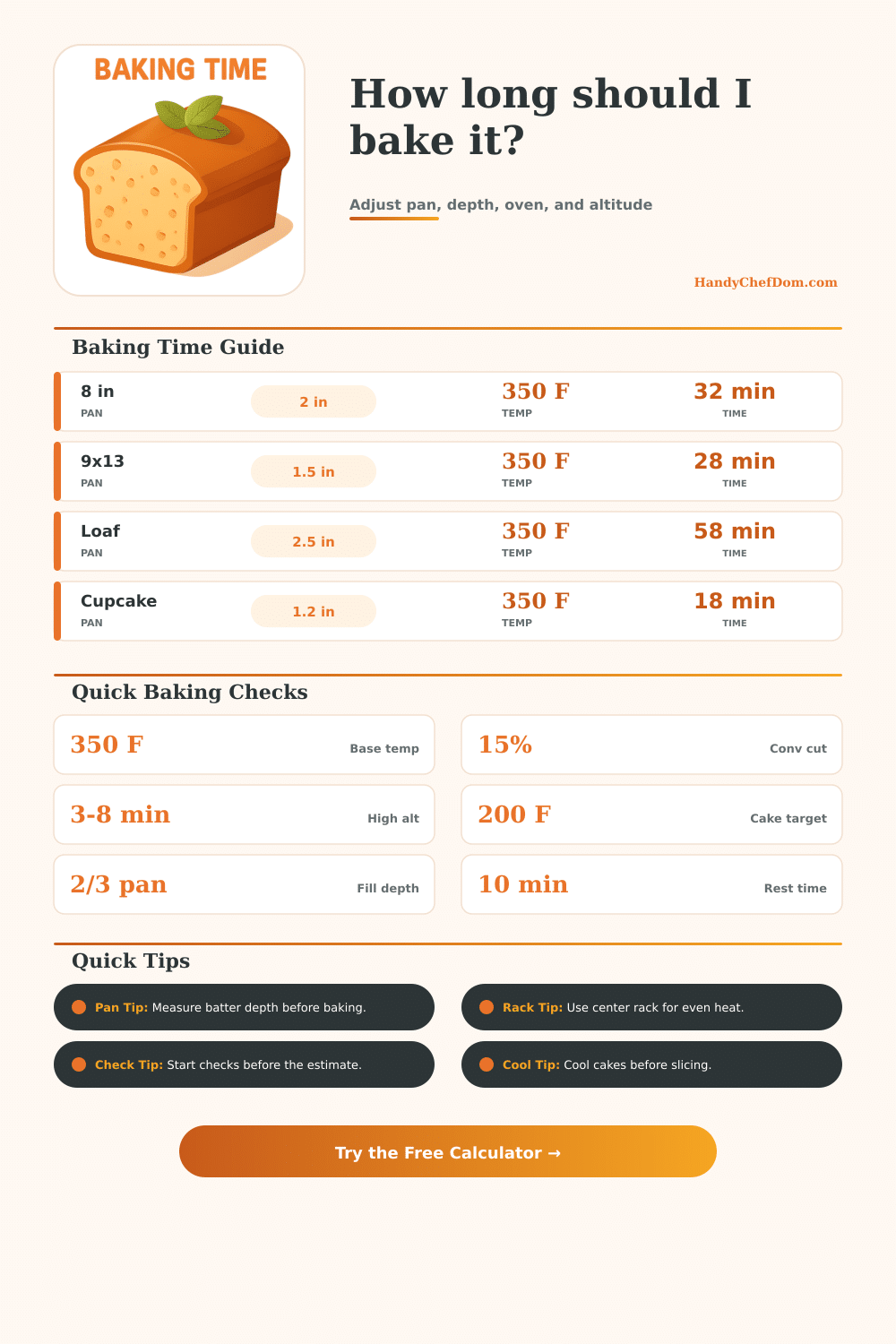
| 8 in round x 2 in | 8 cups | 4 to 5 cups | 30 to 36 min |
| 9 in round x 2 in | 10 cups | 5 to 6 cups | 28 to 34 min |
| 9 x 13 x 2 in | 18 cups | 7 to 10 cups | 28 to 38 min |
| 9 x 5 loaf | 8 cups | 5 to 6 cups | 50 to 70 min |
| 12 cupcakes | 3 to 4 cups | 3 cups | 16 to 22 min |
| 10 in bundt | 10 to 12 cups | 8 to 10 cups | 45 to 60 min |
This calculator estimates timing from geometry and oven factors. Ovens vary, so begin checking at the suggested start time and finish by doneness cues.
Baking times is determined by geometry and heat transfer, but the baking times for a particular recipe will change depending on the choices that the baker makes during the baking process. The batter that is cooked in the center of the pan must reach a certain temperature, but that center temperature must be reached before the edges of the pan dry out or the top of the pan begins to brown too far. A calculator will help to manage these variable.
A calculator can account for the size of the pan, the depth of the batter, the temperature of the oven, the convection settings of the oven, the altitude of the pan, and the target doneness of the cookie. The shape of the baking pan is another variable. Pan shape will alter the surface area of the pan, which will alter the time that it takes for the batter to reach the center of the pan.
What Changes Baking Time and How a Calculator Helps
An eight-inch round pan may contain the same volume as a nine-by-thirteen sheet pan, but because the sheet pan has more surface area than the round pan, the sheet pan will take longerer to cook. A calculator will make it easy for you to account for the different dimension of the pans and the volume of the batter. The depth of the pan is usually the most important variable in baking, since the baking time is proportional to the thickness of the batter poured into the pan.
People often do not account for the depth of the batter when they place the batter into the pan. The material and color of the pan can alter the baking time. If the pan is made of dark metal, it will absorb heat more readily than a light metal pan.
This means that the same recipe will take less time to cook in a dark pan than it will in a light pan. If the pan is made of materials like glass or ceramic, it will retain the heat that is applied to the pan once the pan material has warmed up. This indicates that the baking time will be longer for pans made of glass or ceramic than for pans made of a metals.
Oven temperature adjustments are not always as expected. Raising the oven temperature will cause the outside of the cookies to brown faster than the center of the cookies will bake fast. A calculator will help to adjust for this and will apply a shorter baking time adjustment than the number of degrees that the oven is heated.
If the oven utilize a convection setting, the baking will be different from conventional ovens. Convection ovens will cause the air inside the oven to move around the food, which will remove the layer of still air that sits between the pan and the oven. Because most recipes are written for conventional ovens, when convection settings are used, the oven temperature will need to be reduced.
A baking calculator will account for this adjustment to the temperature. The altitude at which the baker is located can play a role in the baking time. At higher altitudes, the air pressure is lower.
This allows the steam to escape more easily from the pans. It also causes the water to boil at a lower temperature. Because of these factor, the bakers may find that their cookies rise very fast when they are baked, only to collapse later.
The solution to this problem is to increase the baking temperature of the cookies, especially if the baker is located at a high altitude. The baking calculator will allow for a small time penalty for the altitude at which the baker is located. However, the baking time that the baking calculator calculates is only a window of time in which the baking should occur.
The target doneness temperature is the most accurate means of determining when baking is complete. A thermometer will allow the baker to read the temperature of the cookie and determine when the proteins in the cookie have set and when the excess moisture in the cookie has evaporated. The target doneness for different type of cookies will vary.
For instance, brownies will have a different baking time than cheesecakes or butter cakes. A table will list the type of cookie that is to be baked and the target doneness temperature for each type. There are many common mistake with baking time.
One of the most common is the use of the pan size that is listed on the box of baking products without measuring the depth of the batter. Using the incorrect temperature for the oven is another mistake. Bakers should begin to check the food several minute before the estimated baking time is completed.
This will allow the baker to find the exact moment that the center of the food is cooked or that a cooking insert comes out of the food with moist crumbs. The temperature of the batter will alter the baking time. Using batter that is cold from the refrigerator will require that several minutes of baking time be added to the bake cycle.
This is because the pan must heat the mass of the cold batter before baking begins. Using batter that is at room temperature will allow the batter to begin to cook as soon as it is placed into the pan. This is why baking recipes ask that the baker use room temperature batter.
The baking calculator can be used to flag the batter as cool, room temperature, or warm so that the baking time will account for the actual temperature of the batter. The level at which the pan is filled will interact with each of the other baking variables. If the pan is only half full of batter, the pan will heat and brown faster on the top of the pan.
If the pan is filled beyond the recommended level of batter, the pan may retain some of its steam, which may extend the baking time of the cookies by five or ten minutes. A tool can be used to calculate the percentage of the pan that is filled so that the baker can decide whether to split the baking recipe into two pans or to allow for additional baking time. Finally, baking time can be treated differently in baking recipes.
The baking time that is calculated is an estimate only. When the timer indicates that the baking time is near the early end of the baking time estimate, the oven should be opened to check the temperature of the cookie or whether the center of the cookie has set or begun to spring back when touched. By checking the cookies at this early time in the baking cycle, bakers will ensure that the cookie is neither underbaked nor overbaked.
This process will ensure that the baking calculator becomes a helpful and reliable tool to the baker.