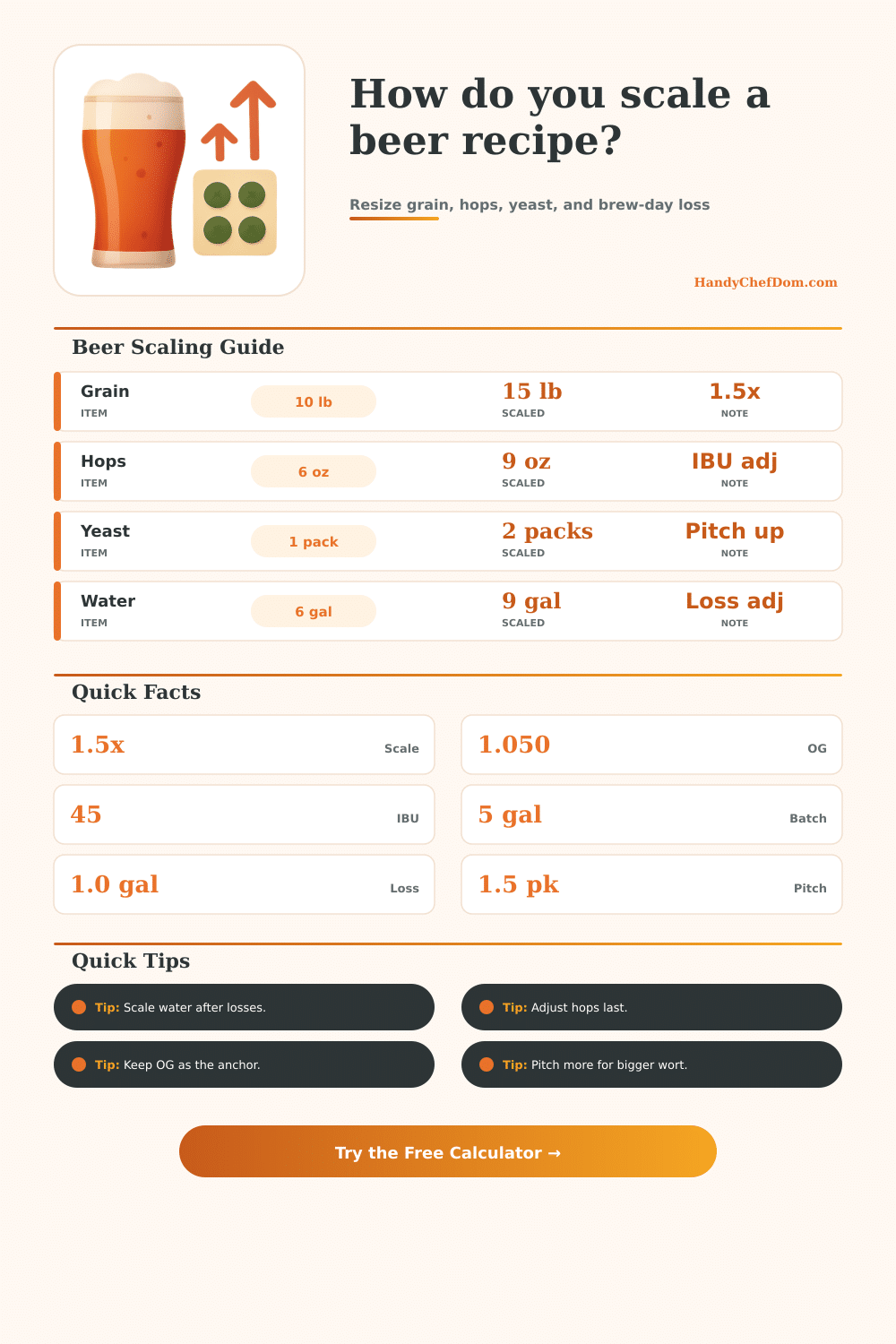
Beer Recipe Scaling Calculator
Resize grain, hops, yeast, and brew-day losses while keeping gravity and bitterness on target.
| Malt | PPG | Color | Use |
|---|---|---|---|
| Pilsner | 37 | 2 L | Light base |
| Pale Malt | 36 | 3 L | Clean body |
| Munich | 35 | 10 L | Bready depth |
| Crystal 60 | 34 | 60 L | Caramel note |
| Wheat | 38 | 2 L | Soft head |
| Chocolate | 34 | 350 L | Dark roast |
| Hop Stage | Time | IBU | Note |
|---|---|---|---|
| 60 min | Long | High | Bittering |
| 30 min | Mid | Med | Balance |
| 10 min | Short | Low | Flavor |
| 5 min | Very short | Low | Aroma |
| Whirlpool | 80 C | Low | Fresh nose |
| Dry hop | Cold | None | Late aroma |
| Yeast | Pitch | Temp | Style |
|---|---|---|---|
| Ale | 0.75 M/mL | 64-68 F | Clean |
| IPA | 1.00 M/mL | 66-70 F | Hoppy |
| Lager | 1.50 M/mL | 48-52 F | Crisp |
| Belgian | 0.80 M/mL | 68-74 F | Estery |
| Saison | 0.70 M/mL | 72-80 F | Dry |
| Wild | Varies | 60-75 F | Mixed |
| Loss | Rate | Action | Note |
|---|---|---|---|
| Boil-off | 1.0 gal/hr | Add water | Before boil |
| Trub | 0.5 gal | Overfill | Post boil |
| Absorb | 0.12 qt/lb | More mash | Grain bed |
| Package | 12 oz | Count fills | Bottle math |
| Growler | 1 gal | Quick fill | Draft share |
| Keg | 5 gal | Divide | Party run |
Recipe scaling is an process of changing the amount of ingredient needed to make a batch of beer. A person use recipe scaling if they desire to either increase the volume of the batch of beer or decrease the volume of the batch of beer. To make a batch of beer of a different volume than the original recipe, the brewer must change the amounts of grain, hop, water, and yeast so that the resulting beer has the same taste as the original batch of beer.
Original gravity are the measure of the amount of sugar that is present in the wort prior to fermentation. The original gravity of the beer is associated with the amount of alcohol that will be contained in the beer as well as the body of the beer. If the batch size of beer are increased, the brewer must also increase the amount of grain that is boiled in order to maintain the same original gravity.
How to Change the Size of a Beer Recipe
However, the amount of grain that is boiled cannot simply be multiplied by some number to obtain the amount of grain for the larger batch size, since efficiency change with batch size. Efficiency is the percentage of the sugar that is extracted from the grain to the water during the brewing process. Efficiency is dependent upon the quality of the crush of the grain and the thickness of the mash during brewing.
Hops are added to the beer to provide bitterness, flavor, and aroma to the beer. Bitterness in beer is often measured in International Bitterness Units (IBUs). The amount of bitterness of the beer is dependent upon the amount of hops, the boil time of those hops, and the gravity of the wort.
Unlike other ingredient, bitterness does not necessarily scale linear with batch size. Therefore, the brewer must calculate hop addition prior to brewing to ensure the resulting beer has the same number of IBUs as the original recipe. Hops are added later in the boiling process for aroma and flavor, and those additions dont need to be calculated using the gravity of the wort.
Yeast is the living organism that ferment the sugars in the wort to produce alcohol and carbon dioxide. The amount of yeast that must be used is dependent upon the volume of the batch of beer and the original gravity of the beer. This amount is referred to as the pitch rate for the particular batch size and gravity.
If too little yeast is used, the brewing process may stall prior to the completion of fermentation. If too much yeast is added, the yeast will become waste in that large batch of beer. Therefore, the amount of yeast that must be used increase with the size of the batch of beer.
Brew day losses is a measure of the amount of the batch of beer that is lost during brewing. Boil-off is the amount of water that evaporate during boiling, and the amount of boil-off is dependent upon the surface area of the kettle in which the liquid is boiled and the heat of the flame that is placed onto that kettle. Trub is the amount of sediment that remain in the kettle after brewing, and this also reduce the total volume of the batch of beer.
Grain absorption is the amount of water that becomes absorbed by the grain during brewing. Grain absorption is usualy approximately one-tenth of a quart of water per pound of grain that is used in the brewing process. Losses of each of these quantities must be accounted for in order to ensure that the batch size of beer will be the target batch size after fermentation.
Mash thickness is the ratio of the amount of water to the amount of grain that is used during brewing. One-and-a-half quarts of water is usually used per pound of grain. If the thickness of the mash is too high, it can be difficult to extract the sugars from the grain.
If the thickness of the mash is too low, the mash may be too thick to stir proper during brewing. The brewer must adjust the amount of strike water that is used during brewing according to the total weight of the grain that will be used in the batch of beer. Many batch recipes use tables to assist in the brewing process.
Tables of malt points per pound is one such table that help the home brewer decide how much base malt to use in the batch of beer. For instance, pilsner malt contain 37 points per pound, while Munich malt has 35 points per pound. Hop tables help to determine at what times during the brewing process the hops should be added.
Yeast tables list the different strain of yeast that will produce different styles of beer. Home brewers often make mistakes that ignore some of these steps. For instance, doubling the amount of grain but not the amount of water will result in a mash that is too thick.
Adding the same amount of hops as the original recipe to batches of different size may result in incorrect bitterness units of that batch of beer. Using the same amount of yeast for different batch sizes may result in off-flavor in the batch of beer. These mistake can be avoided by either using a recipe calculator to determine the proper amount of each ingredient for a batch of beer of any size, or by brewing test batches of small amounts of beer to familiarize oneself with the process.
Finally, the amount of beer that will be carbonated must be adjusted according to the style of beer that will be brewed. Its important to remember that you’re should of checked the math.