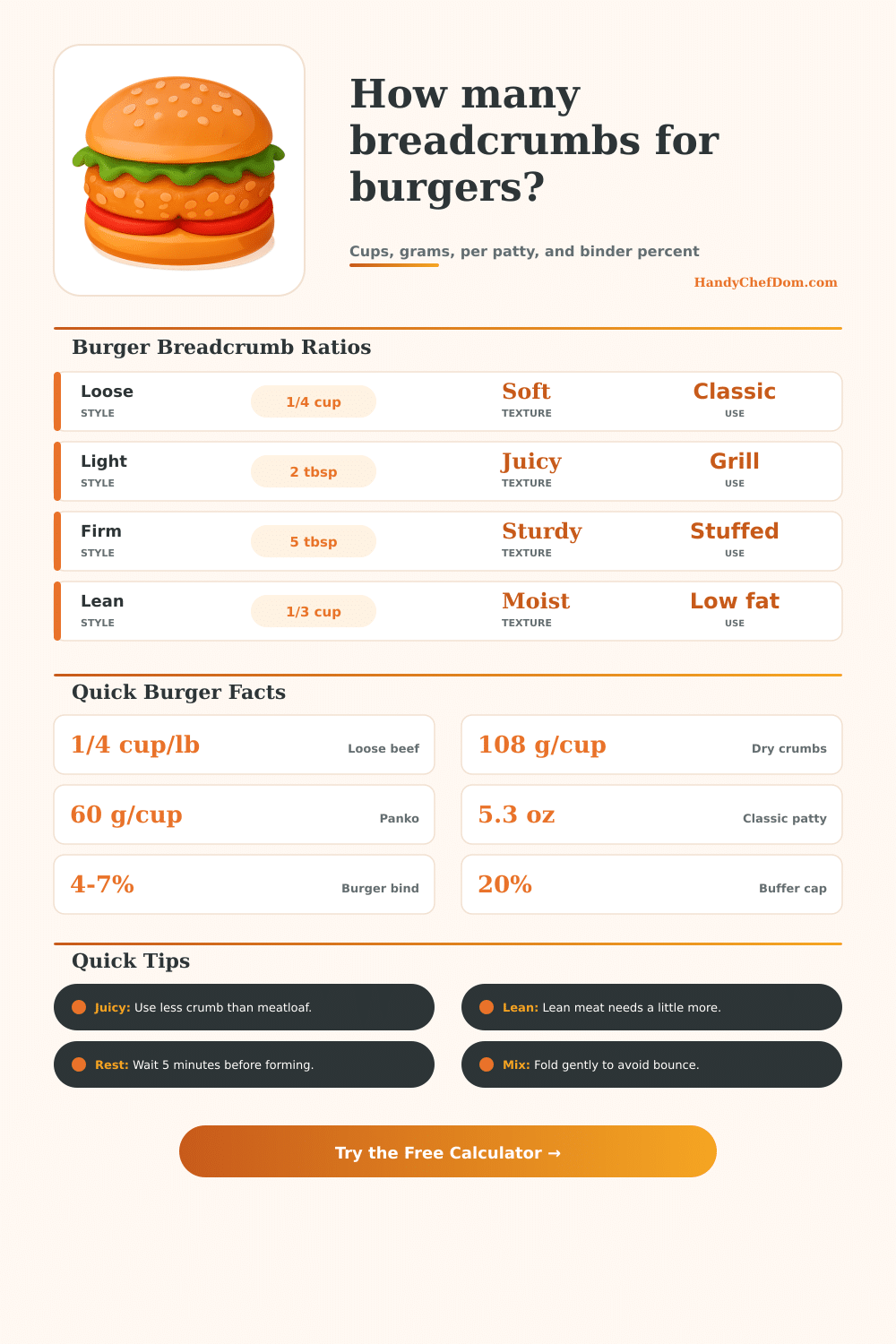
Estimate the right breadcrumb amount for burger patties: cups, grams, per-patty binder, binder percent, and patty yield without drifting into meatloaf texture.
1Quick Burger Presets
2Burger Binder Labels
Ground meat poundsPatty countPatty sizeMeat leannessBinder styleEgg or liquidGrill vs panDesired firmnessAdd-insBatch buffer
3Calculator Inputs
Loose burger mixtures often start near 1/4 cup dry breadcrumbs per pound of ground meat, which is intentionally lower than meatloaf. This calculator adjusts that burger baseline for fat level, crumb type, egg or liquid, cooking surface, firmness, add-ins, and measuring buffer.
Use raw ground meat weight before crumbs, egg, liquid, or add-ins.
Enter the number of patties you want to shape.
Used for yield checks after binder and moisture are added.
Adds a small measuring cushion for bowl loss or uneven scoops.
A short rest helps crumbs absorb egg, milk, broth, or meat juices.
Breadcrumbs
0 cups
0 g total
Per Patty
0 tbsp
0 g each
Binder Percent
0%
of meat weight
Patty Yield
0
target patties
Burger Breadcrumb Breakdown
Raw meat and planned patties2 lb, 6 patties
Base burger crumb ratio0.25 cup/lb
Adjusted ratio before buffer0.25 cup/lb
Crumb type and densityDry fine, 108 g/cup
Leanness, cooking surface, and firmness85/15, grill, balanced
Egg or liquid moisture estimateMilk panade
Add-ins and batch bufferNo add-ins, 5%
Estimated raw mix weight0 oz
Planned patty size check0 oz each
Texture cueReady to mix gently
4Burger Binder Snapshot
1/4 cupclassic loose burger start per lb
2 tbsplight burger binder per lb
108 gdry fine crumbs per cup
4-7%common burger crumb weight range
5Binder Style Comparison Grid
Minimal
1 tbsp
For rich beef patties where breadcrumbs only catch juices and do not define the bite.
Light
2 tbsp
A grill-friendly amount that supports patties while keeping the burger clearly meat-forward.
Classic
1/4 cup
The common loose burger reference per pound, especially with a small egg or milk panade.
Firm
5 tbsp
Best for stuffed, onion-heavy, or very lean patties that need extra structure on the turn.
6Burger Binder Ratios
Binder style
Breadcrumb cups per lb
Approx dry grams per lb
Best burger use
Minimal steakhouse binder
1 tablespoon to 1 1/2 tablespoons
7 to 10 g
Rich beef, pan sear, or a burger where crumb should barely show.
Light burger binder
2 tablespoons
14 g
Juicy grilled patties that need light support.
Classic loose burger mix
1/4 cup
27 g
Common burger baseline; lower than meatloaf-style binding.
Firm burger binder
5 tablespoons
34 g
Lean beef, thicker patties, or patties turned on grill grates.
Stuffed or loaded patties
1/3 cup
36 g
Cheese-stuffed, onion-heavy, or fragile loaded burger mixes.
7Meat Leanness Guide
Ground meat leanness
Crumb adjustment
Binder cue
Handling note
70/30 rich grind
Use less crumb
Fat helps the patty hold and stay juicy.
Do not overwork; rich patties can feel soft before cooking.
80/20 classic beef
Slightly below baseline
Usually needs only a light or classic burger binder.
Great for grill patties when chilled before cooking.
85/15 balanced grind
Baseline
Works well with the 1/4 cup per lb loose burger reference.
Rest after mixing so crumbs hydrate evenly.
90/10 lean beef
Add a little crumb
Lean meat benefits from panade-style moisture control.
Avoid packing tightly; firm shaping can make patties bouncy.
93/7 very lean beef
Add more crumb
Use egg or milk only if the texture still stays burger-like.
Consider a shallow dimple because lean patties tighten more.
96/4 extra lean beef
Highest burger range
Needs binder help, but stop before meatloaf texture.
Best with gentle mixing and a short hydration rest.
8Patty Size Planning Table
Patty style
Raw patty size
Meat-only yield per lb
Breadcrumb cue
Small slider
2 oz
8 patties
Use light binder so the small patty does not turn bready.
Double smash patty
2.5 to 3 oz
5 to 6 patties
Keep crumbs minimal because griddle contact supplies structure.
Classic burger
4 oz
4 patties
Light to classic binder works for most backyard batches.
Firm binder supports filling seams and chunky add-ins.
9Crumb Type Comparison
Crumb type
Approx grams per cup
Volume adjustment
Burger behavior
Dry fine breadcrumbs
108 g
Baseline
Predictable binder with a compact, even texture.
Panko crumbs
60 g
Use more volume
Airier crumb; keeps burgers lighter when not crushed hard.
Fresh soft breadcrumbs
45 g
Use more volume
Softest bite, but needs a short rest to hydrate evenly.
Crushed crackers
85 g
Use slightly less
Salty and sturdy; reduce added salt in the mix.
Gluten-free dry crumbs
100 g
Near baseline
Absorption varies; rest and check texture before shaping.
Quick oats, pulsed
90 g
Slightly more
More rustic texture; best in lean or loaded patties.
10Two Practical Tips
Texture tip: Burgers need far less breadcrumb than meatloaf. If the calculator lands near the high end, mix gently, rest briefly, then stop as soon as patties hold together.
Shaping tip: Add breadcrumbs before the final patty shape, not after. Once the mix feels tacky and scoopable, form loose patties and chill them for cleaner handling.
Kitchen note: Breadcrumb density varies by brand, grind, and how firmly you pack the cup. The gram estimate is usually the most repeatable measurement.
Breadcrumbs are used as a binding agent to hold the meat patty together. Breadcrumbs will perform a variety of chemical function during the cooking process of the patties. Breadcrumbs will absorb the moisture from the meat, cushion the protein strand in the meat, and prevent the fat in the meat from escaping during the cooking process.
Using too few breadcrumbs will cause the meat patty to crack during cooking, while using too many breadcrumbs will create a patty that has the texture of meatloaf rather than a burger. The breadcrumb calculator will help you determine the amount of breadcrumbs that is necessary to cook delicious meat patties based off a few different variable. You must enter the weight of the meat that will be used into the calculator, as well as the number of patties that will be made.
How Many Breadcrumbs to Use in Meat Patties
Additionally, the leanness of the ground beef will impact the amount of breadcrumbs that are necessary. If the ground beef contains 80% beef and 20% fat (an 80/20 grind), the amount of breadcrumbs will be less then ground beef that is 93% beef and 7% fat (a 93/7 grind). The leaner the ground beef, the more breadcrumbs that will be necessary to prevent the patties from drying out during cooking.
Another variable that will impact the amount of breadcrumbs that are necessary is the cooking surface for the patties. If the patties are to be cooked on grill grates, more breadcrumbs will be necessary to ensure that the patties do not break while cooking on the grates. Patties that are cooked on a griddle or cast iron pan will require fewer breadcrumbs because of the support that the cooking surface will provide to the patties.
Because of the different cooking surfaces, the breadcrumb calculator will ask for the cooking surface for the patties. The type of breadcrumbs that you use will also impact the amount of breadcrumbs that are necessary. Fine breadcrumbs will pack together more close than panko breadcrumbs.
Therefore, more panko breadcrumbs will be necessary for the same binding properties of fine breadcrumbs. If you are to use fresh breadcrumbs, more breadcrumbs will be necessary because fresh breadcrumbs contain more moisture than dried breadcrumbs. People will likely try to add breadcrumbs to the meat by feel.
However, this can introduce mistakes when changing the type of meat that is used for the patties or when cooking a large batch of patties. Using the breadcrumb calculator will ensure that cooks and chefs dont have to guess how much breadcrumbs to use in the meat mixture to achieve the desired texture for the patties after they are cooked. The breadcrumb mixture will need to rest for five minute after mixing the meat and breadcrumbs.
All breadcrumbs will absorb some of the moisture from the meat during this resting period. If you do not allow the mixture to rest for five minutes, the breadcrumbs may dry out the meat mixture and the center of the patty may become too loose. The breadcrumb calculator will ask for the rest time for the patty mixture to account for how much moisture the breadcrumbs will absorb.
Other ingredients, such as onions, mushrooms, and cheese, will also impact the amount of breadcrumbs that are necessary for the patties. Grated onions and mushrooms will release moisture into the meat mixture, and the breadcrumbs will need to absorb some of this moisture. Cheese will melt while the patties are cooking and will act as another binding agent for the patties, reducing the amount of breadcrumbs that are necessary.
Bacon bits will also contain fat and salt that will alter the cooking moisture levels of the meat mixture. Because of these variables, no rule regarding breadcrumbs will always be accurate for all recipes. The breadcrumb calculator will help cooks and chefs to determine the correct amount of breadcrumbs to use in the recipe.
The intention for using breadcrumbs in patties is to use the smallest amount possible to keep the meat patty together. It is necessary to use some breadcrumbs to ensure that the patty does not fall apart during cooking, but the amount of breadcrumbs shouldnt be so much that the taste of the breadcrumbs overwhelms the taste of the meat. If cooks and chefs understands the different variables related to breadcrumbs and how they impact the amount of breadcrumbs that are necessary, they will be able to make a logical decision as to how much of the ingredient to use in the meat mixture.
Youll find that breadcrumbs can be actualy tricky to get right if you dont use the right amount of furnitures. It’s important to recieve the right amount of moisture to avoid a dry patty.