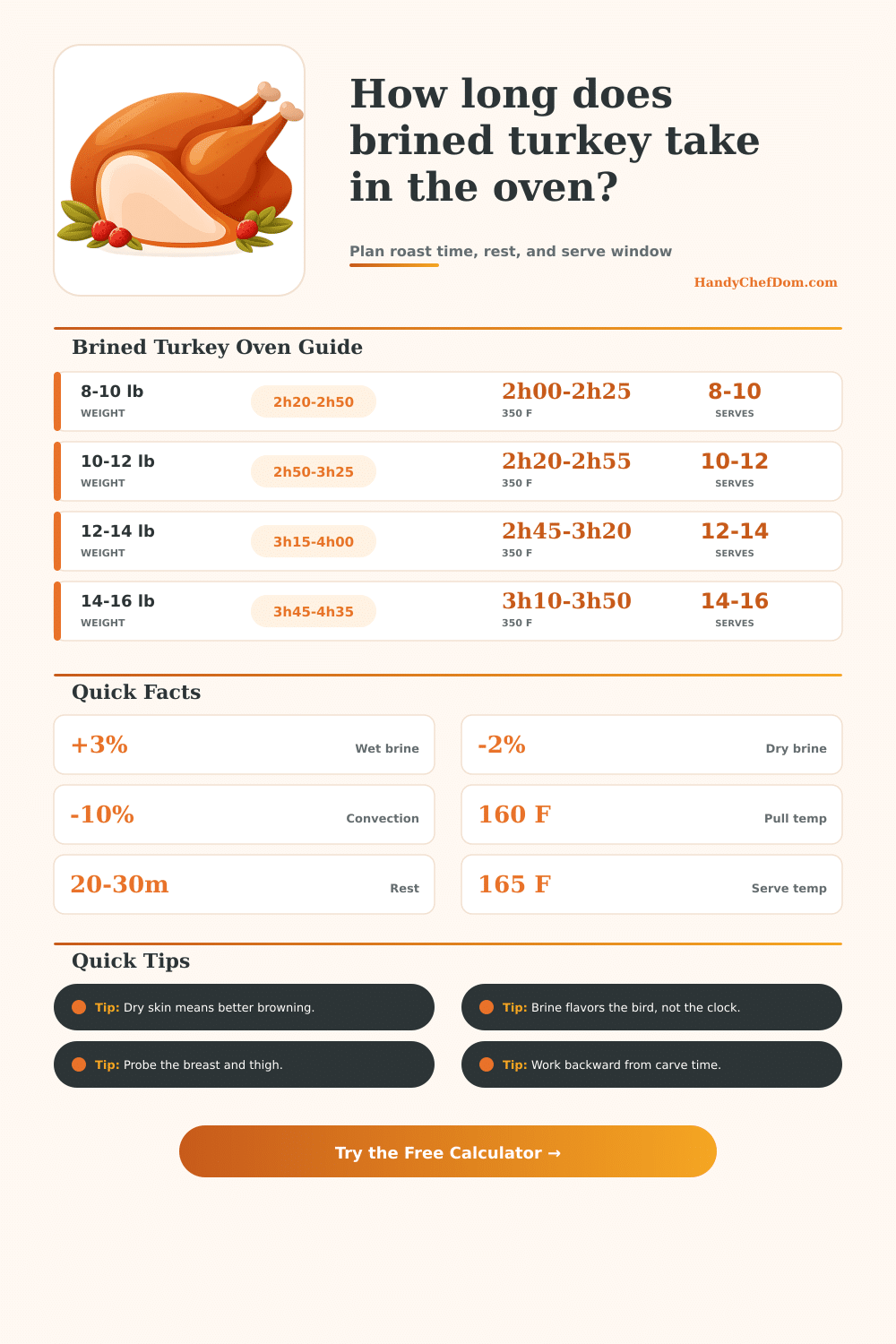
🦃 Brined Turkey Cooking Time Calculator Oven Guide
Plan roast time, resting time, and serve time for wet-brined or dry-brined turkey without guessing the oven window.
Brining changes flavor and surface moisture more than the oven curve, so the calculator only nudges time for brine style, salt intensity, and dry-out time.
| Style | 325 F | 350 F | Pull |
|---|---|---|---|
| Whole turkey | 13-14m/lb | 12-13m/lb | 160 F |
| Wet-brined whole | 13-15m/lb | 12-14m/lb | 160 F |
| Dry-brined whole | 12-14m/lb | 11-13m/lb | 160 F |
| Spatchcock | 10-11m/lb | 9-10m/lb | 160 F |
| Stuffed bird | 15-16m/lb | 13-14m/lb | 163 F |
| Turkey crown | 12-13m/lb | 11-12m/lb | 158 F |
| Bone-in half | 14-15m/lb | 13-14m/lb | 160 F |
| Bone-in breast | 15-16m/lb | 14-15m/lb | 160 F |
| Brine | Time | Dry | Note |
|---|---|---|---|
| Wet brine | 8-18h | 4-12h | Juicy bird |
| Dry brine | 12-36h | 0-24h | Crisp skin |
| Injected | 0-2h | 1-3h | Small shift |
| Store brined | 0h | 0-6h | Check label |
| Kosher salted | 12-24h | 0-12h | Light cure |
| Bold salted | 18-30h | 6-18h | Deep seasoning |
| Weight | Guests | Cooked | Leftover |
|---|---|---|---|
| 8-10 lb | 6-8 | 5.0-6.2 lb | Small extra |
| 10-12 lb | 8-10 | 6.2-7.4 lb | Light extra |
| 12-14 lb | 10-12 | 7.4-8.7 lb | Holiday bird |
| 14-16 lb | 12-14 | 8.7-9.9 lb | Big table |
| 16-18 lb | 14-16 | 9.9-11.2 lb | Buffet crowd |
| 18-20 lb | 16-18 | 11.2-12.4 lb | Leftovers |
| Stage | Whole | Stuffed | Notes |
|---|---|---|---|
| Brine | 12-24h | 12-24h | Season fully |
| Dry | 4-12h | 8-24h | Air-dry uncovered |
| Roast | 12-13m/lb | 13-14m/lb | Probe early |
| Rest | 20-30m | 25-35m | Loosely tented |
| Serve | 165 F | 165 F | Thigh and breast |
Brining turkey is used to add moisture and salt to the turkey, but the most important factor in roasting the turkey is the timing of the roasting process to achieve the bestest meal. The brining process will not impact how the turkey cook, so you will have to calculate how long the turkey should be in the oven based on its size and brining method. Planning the cooking time in advance is necessary to ensure that the turkey will not be either undercooked or overcooked.
Brining add salt to the turkey which draw moisture to the turkeys surface to dissolve into the turkey’s flesh to season the turkey and make the turkey meat more tenderly. If you use a wet brine process, the turkey is soaked in salty liquid. This process takes longer in the oven then dry brining because of the extra water in the turkey.
How Long to Roast a Brined Turkey
Dry brining involves applying salt only to the turkey’s skin. This method cook in less time and the skin crisp better. The salt intensity impacts the flavor of the turkey; however, most people uses a standard salt intensity.
The shape of the turkey will impact how fast the turkey cook. If the turkey is a whole bird, it will roast when breast up with the legs tuck in. If the turkey is spatchcocked, the removal of the backbone allow for faster cooking as the turkey lay flatter.
If the turkey crown is only the breast portion of the turkey, it will cook faster then a whole turkey. If the turkey contain stuffing, the stuffing will cook the center of the turkey more slowly; hence, it will require more cooking time. If using a convection oven, cooking will take less time due to the hot air circulating more aggressive around the turkey.
The starting temperature of the turkey impacts the cooking time. If you allow the turkey to reach room temperature, it will cook faster then one straight from the refrigerator. The weight of the turkey is the primary factor to determine how long the turkey should be roasted in the oven.
An eight-pound turkey may cook in under two hours in a hot oven. However, a fourteen-pound turkey will require approximately three and a half hours of cooking at a lower heat to ensure that the edges of the turkey do not dry out during the cooking process. To calculate the cooking time for the turkey, it is necessary to use the rule of minutes per pound.
The rule state that a turkey should cook for twelve to fifteen minutes per pound. To ensure that the turkey has reached an internal temperature that is safe to eat, you must use a meat probe to measure the internal temperature of the turkey. Using this meat probe, the cook should remove the turkey from the oven when the turkey reach one hundred sixty degrees Fahrenheit.
Due to carryover heat, the turkey will reach one hundred sixty-five degrees Fahrenheit during the resting period of the turkey. The turkey must be allowed to rest for twenty to thirty minutes after being removed from the oven to redistribute the turkey’s juices throughout the meat. Another step in the turkey cooking process is to dry the turkey after the brining process.
This drying process ensure that the skin of the turkey will become crispy when roasted. After brining the turkey with either wet or dry brine, the turkey should be patted dry and then left uncovered in the refrigerator. If the turkey is not dried after the brining process, the skin will be rubbery when roasted.
A wet brine will last between eight and eighteen hours. In contrast, a dry brine can take longer to achieve the same result. Store-bought turkeys may already be pre-brined; therefore, it is necessary to check the labels to determine the turkeys ingredient.
When planning a Thanksgiving meal, it is important to consider how many guests will be attending the meal to purchase a turkey of the correct size. A twelve-pound turkey will serve ten person. To allow for unexpected guests or eating portion of the turkey that are not served to the other guests, an eight percent buffer should be allowed in the food quantities.
During the cooking process, the turkey will lose some of it weight. The cooked weight will be sixty percent of the raw weight of the turkey. There are a few mistake that can be made when roasting a turkey.
One of the most common is using a clock to measure cooking time instead of a meat probe to determine the internal temperature of the turkey. Using a clock to roast a turkey can lead to the turkey being overcooked. Another mistake is crowding the turkey in the roasting pan.
This will prevent the turkey from properly roasting due to the blocked air to the turkey. Finally, the cook should roast the turkey in such a way that they work backward from the desired eating time of the turkey.