🌶 Capsaicin in Cayenne Pepper Calculator
Estimate cayenne capsaicin, heat per serving, Scoville contribution, and dilution-adjusted recipe heat from amount, SHU, form, volume, and batch size.
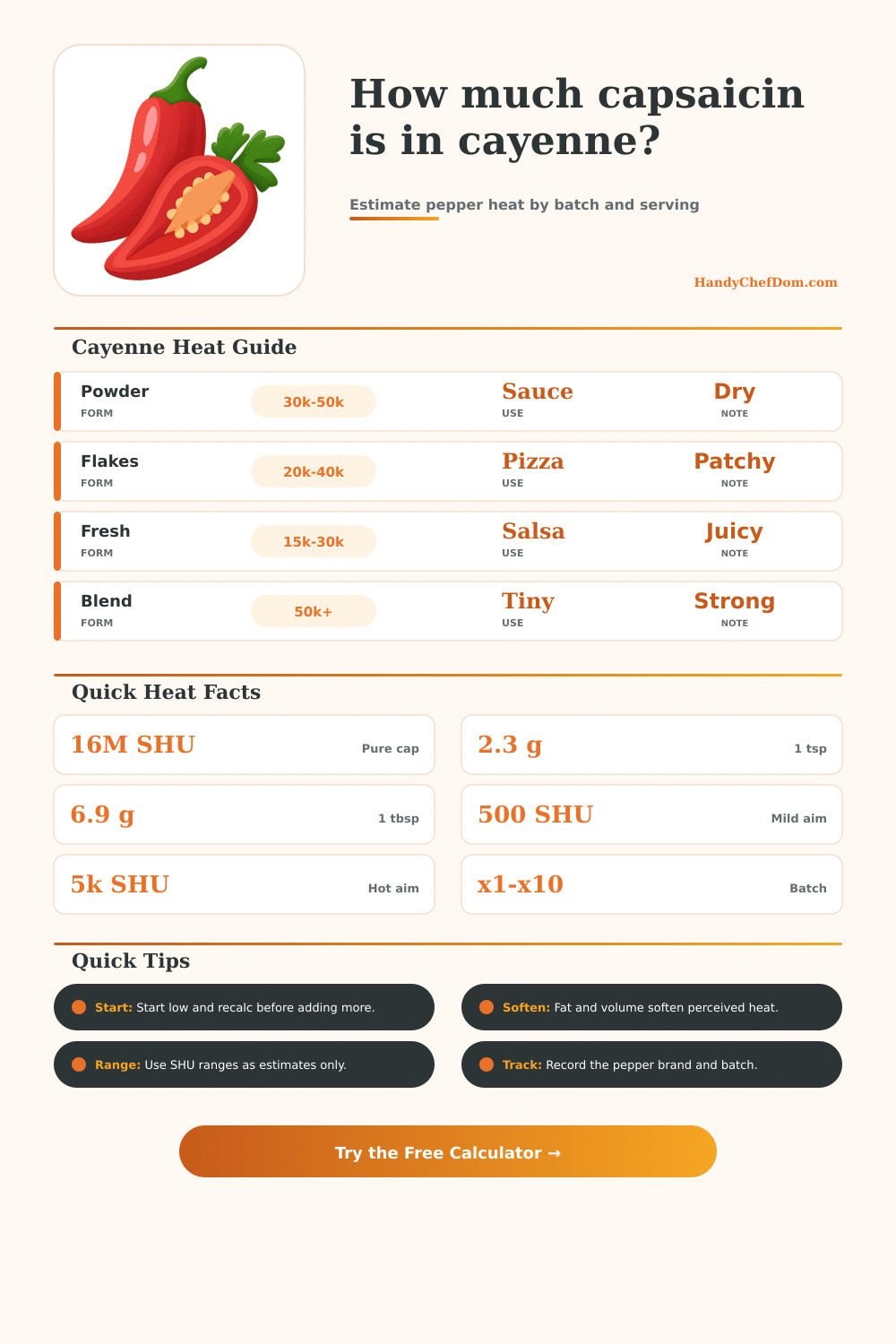
This calculator uses the common estimate that pure capsaicin is about 16,000,000 SHU, so approximate capsaicin mg equals grams multiplied by SHU divided by 16,000,000 multiplied by 1,000. Results are planning estimates because cayenne heat varies by pepper lot, grind, age, and blend.
| Cayenne | SHU Low | SHU High | Kitchen Use |
|---|---|---|---|
| Mild | 15k | 25k | Soup |
| Powder | 30k | 50k | Rub |
| Hot | 50k | 70k | Sauce |
| Blend | 70k | 100k | Drop |
| Extract | 100k | 250k | Tiny |
| Measure | Powder | Flakes | Fresh |
|---|---|---|---|
| 1/4 tsp | 0.6 g | 0.4 g | 0.8 g |
| 1/2 tsp | 1.2 g | 0.9 g | 1.5 g |
| 1 tsp | 2.3 g | 1.7 g | 3.0 g |
| 1 tbsp | 6.9 g | 5.1 g | 9.0 g |
| 10 g | 10 g | 10 g | 10 g |
| Pepper | Low SHU | High SHU | Heat |
|---|---|---|---|
| Paprika | 250 | 1k | Soft |
| Aleppo | 10k | 20k | Warm |
| Cayenne | 30k | 50k | Hot |
| Arbol | 15k | 30k | Sharp |
| Habanero | 100k | 350k | Fire |
| Recipe SHU | Level | Best For | Note |
|---|---|---|---|
| 0-300 | Gentle | Soup | Low |
| 300-700 | Mild | Salsa | Easy |
| 700-1500 | Medium | Chili | Warm |
| 1500-3000 | Bold | Curry | Spicy |
| 3000+ | Hot | Wings | Strong |
Sure, cayenne will add some heat, but how do you manage the heat without ruining the meal? Use a cayenne pepper calculator. It allow you to predict the amount of heat and total capsaicin in each serving. This is based off serving size, volume, fat content, and your own tolerance level.
Why? Different brands has widely varying amounts of cayenne heat. The heat that peppers make you feel comes from capsaicin. While pure capsaicin clocks in at about sixteen million on the Scoville scale, most cayenne powders will be between thirty and fifty thousand. When scaling recipes, this matter. For example: one batch might taste spicier then another because it contains more or less capsaicin itself.
Why You Should Use a Cayenne Calculator
The calculator take the amount you plan to use and converts it to grams. It then calculates how many milligrams of capsaicin are in it before considering other factors. It then calculates how many grams you have, and how many milligrams of capsaicin are in it before considering other factors. It also takes into account serving size. A teaspoon of cayenne is less hot when divided into 4 cups of soup, versus divided into a single cup of sauce.
By considering this, the tool break up the total capsaicin content by number of servings, as well as over the final mixture. This way, you don’t have just a raw total for spiciness that ignores portion size. Instead, you have an estimate of the relative spice each person will experience.
To account for this effect, the calculator has a dilution setting that factors in starches and fats that will diminish perceived heat. For example, the same quantity of capsaicin might feel less strong if diluted with ingredients such as cheese or cream. To compensate for this, the calculator uses a softening factor so the result reflect the final dish rather than just the pepper alone.
Tolerance works in reverse. Regular consumers of spicy foods has higher tolerance levels. They are able to consume more capsaicin before it becomes too much and the tool adjusts its target to match.
The page also includes reference tables comparing various forms of cayenne and what Scoville ranges is common for each. You’ll notice that flakes aren’t distributed uniformly, meaning you could end up with some really hot spots (and other parts not so much). The capsaicin per gram is also lower in fresh cayenne because it have more water. Not something you’d necessarily think about when eyeballing a recipe, but it accounts for your inconsistent experiences with what’s supposed to be the exact same amount.
If you’ve been using set amounts for cayenne (say, 1/4 tsp., 1/2 tsp.), it’s no surprise you sometimes get in trouble. You add what recipe says and still end up with something spicier than expected. With this calculator, you’re nudged to think more about the factors that influence heat instead: How much? What kind of fat or other liquid is around it? Who is going to eat it?
Get all that stuff straightened out, and the numbers doesn’t matter so much. It’s only when you modify an existing recipe that this becomes useful. Can you cut back on the cayenne by half and still have enough heat? Or can you increase the volume without impacting the overall balance of flavors? A little tweak on any of these ingredients will move the outcome farther then most chefs would imagine, so being able to quickly map these trade-offs is worthwhile.