🥕 Carrot Calorie Calculator
Total carrot calories, carbs, fiber, and vitamin A from baby carrots, medium carrots, large carrots, shredded cups, cooked cups, and portion plans.
Choose how the carrots are measured. The calculator converts the amount to edible grams after peel or trim loss, then estimates the main carrot nutrition totals.
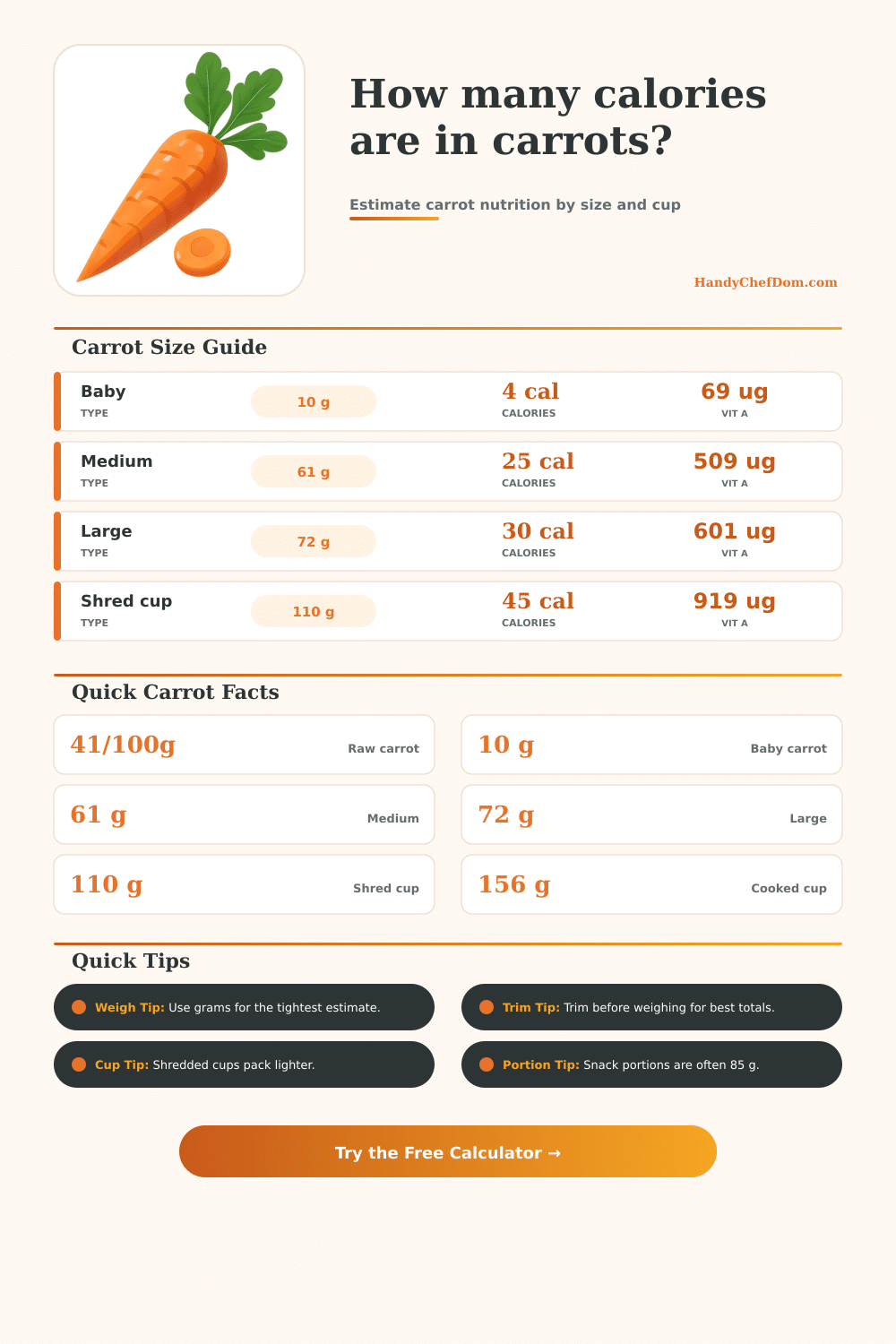
| Carrot Size | Typical Weight | Calories | Best Input |
|---|---|---|---|
| Baby carrot | 10 g each | 4 kcal | Snack counts |
| Medium carrot | 61 g each | 25 kcal | Lunch sides |
| Large carrot | 72 g each | 30 kcal | Meal prep |
| Extra large carrot | 90 g each | 37 kcal | Weigh if unsure |
| Trimmed sticks | 85 g portion | 35 kcal | Snack plate |
| Kids snack | 45 g portion | 18 kcal | Small lunch |
| Cup Style | Grams per Cup | Calories | Nutrition Basis |
|---|---|---|---|
| Raw shredded | 110 g | 45 kcal | Raw carrot |
| Raw chopped | 128 g | 52 kcal | Raw carrot |
| Raw sliced | 122 g | 50 kcal | Raw carrot |
| Cooked sliced | 156 g | 55 kcal | Cooked carrot |
| Cooked mashed | 245 g | 86 kcal | Cooked carrot |
| Packed slaw | 120 g | 49 kcal | Raw carrot |
| Portion Style | Carrot Amount | Calories | Use Case |
|---|---|---|---|
| Snack sticks | 85 g | 35 kcal | Desk snack |
| Stew add-in | 75 g | 26 kcal | Bowl portion |
| Slaw serving | 70 g | 29 kcal | Side scoop |
| Dinner side | 90 g | 37 kcal | Plate side |
| Kids snack | 45 g | 18 kcal | Lunch box |
| Party tray | 60 g | 25 kcal | Tray guest |
| Group Need | Snack Carrots | Shredded Cups | Cooked Cups |
|---|---|---|---|
| 2 people | 170 g | 1.3 cups | 1.1 cups |
| 4 people | 340 g | 2.5 cups | 2.2 cups |
| 6 people | 510 g | 3.8 cups | 3.3 cups |
| 8 people | 680 g | 5.1 cups | 4.4 cups |
| 12 people | 1020 g | 7.6 cups | 6.5 cups |
| 20 people | 1700 g | 12.7 cups | 10.9 cups |
Carrots can have a bad name. They’re seen as something boring, like those sticks of sadness that end up at the bottom of your lunchbox. They are something you don’t eat, but rather just push around to make your meal look nice.
But carrots is a nutrition powerhouse; they are loaded with vitamin A but low in calories. The trick is determining how many carrots you’re getting, because who knows how big your portion is? The carrot calculator does the math for you, all you need to do is input your scenario, and it does the rest. You no longer have to worry about converting and coefficient calculations that tend to screw up diet tracking.
How to Use the Carrot Calculator
You might think that there’s no difference nutritionally between most carrots. You’d be wrong. On average, a medium carrot weigh about sixty-one grams and contains about twenty-five calories. Sounds easy enough, until you begin playing games with volumes (like cups). Depending on how they’re prepared, carrots will contain different amounts of water. A cup of cooked mashed carrots won’t weigh as much than a cup of shredded, raw ones. In fact, a cup of cooked carrot slices is packed at one hundred fifty-six grams while shredded raw carrots are closer to one hundred ten grams per cup.
The calculator automatically takes these changes into account. If you enter volume, it’ll convert that to edible weight before determining the nutritional estimate. This is where folks mess up; they eyeball the volume but track by weight. So they end up massively overestimating their intake. So they end up massively overestimating there intake.
Of all kitchen trimming habits, they are more important then most. If you lop off big chunks of an end when cutting up carrots or remove a lot of mass with a heavy-handed peeler, you’re throwing out food your scale once weighed, and counting against yourself for it. For example, taking a typical medium carrot from the scale from six one-gram increments will land you at sixty-one grams. After a good peel and trim, it’ll be down to fifty-five grams. That’s a net loss of six grams, about two and a half calories; which can add up quickly over the course of weeks and months.
The weight-trimming feature let you account for this lost mass as a percentage. Eight percent is the default setting if you’ve peeled all of the carrot. It adjusts your calorie intake downward so you have a more accurate picture of how much you’re eating. This shows how many calories are actualy going into your stomach instead of just what you put on the cutting board. It’s a small detail, but for those who really need to know, it matters a lot.
Carrots really excel in Vitamin A (as Retinol Activity Equivalents). There are 835 micrograms of retinol activity equivalents per 100 grams in raw carrots. Just a few ounce is over ninety percent of your daily needs! In fact, cooking can make it even better because it breaks down some of the carrot’s cell walls, which makes the vitamins more bioavailable to your body. Go ahead and have carrots cooked as a soft piece in your stew or raw as a stick; either way, you’re still getting a huge bang for your nutritional buck with very few calories. The table on the page spells all this out in different preparations.
Mostly it’s a snacker, though: How many big carrots should I buy? If I’m making several containers of meals in advance, do I have enough with just four large ones? One big carrot weighs around seventy-two grams. All four contain one hundred twenty calories and almost two thousand micrograms of vitamin A.
With the calculator, though, you can enter more than one unit. You can even enter cups of something pre-shredded like slaw, or the number of whole roots for certain vegetables. It’ll spit out a breakdown of how much each serving contains, and divide that across however many servings you want. So instead of wrestling with the math to figure it out in your head, you won’t be mentally tired when it comes time to log.
It doesn’t have to be perfect This isn’t a test of willpower. This is about building habits that allow you to eat more food while staying within your budget, carrots are pretty good at this, so relax. They’re flexible. They go with anything (sweet soup, savory stew, even as a crispy snack). Once you’ve used the tool to get a ballpark estimate, tweak it according to what you’ll actualy do.
If you don’t mind a little extra effort, peel lightly and trim. Want something richer? Cook them down until they’re nice and mushy. This helps your body absorbs all those vitamins. The figures will move around a bit, but the general principle stays intact: You’re eating a big ol’ nutrient package for very few calories.
So, carrot nutrition really isn’t about deprivation at all. It’s just awareness, knowing how many calories you are eating based on how many carrots you eat (i.e., do they make up more or fewer than two servings?). And the calculator makes this translation easy while you sit there chewing, because… well, we want you to be thinking about what you put in your mouth, not counting every single bite.
Next time you grab a handful of something else as a snack, remember that orange crunch: It’s small, it’s sweet, and it’ll do more than you think it should.