🍗 Chicken Wings Per Person Calculator
Estimate wing pieces, whole wings, raw weight, cooked yield, sauce, sides, and fryer or oven batches for any guest count.
Choose the role of the wings, appetite level, wing format, sides, yield, sauce style, and cooking setup. The calculator rounds up so the tray is easier to shop and batch.
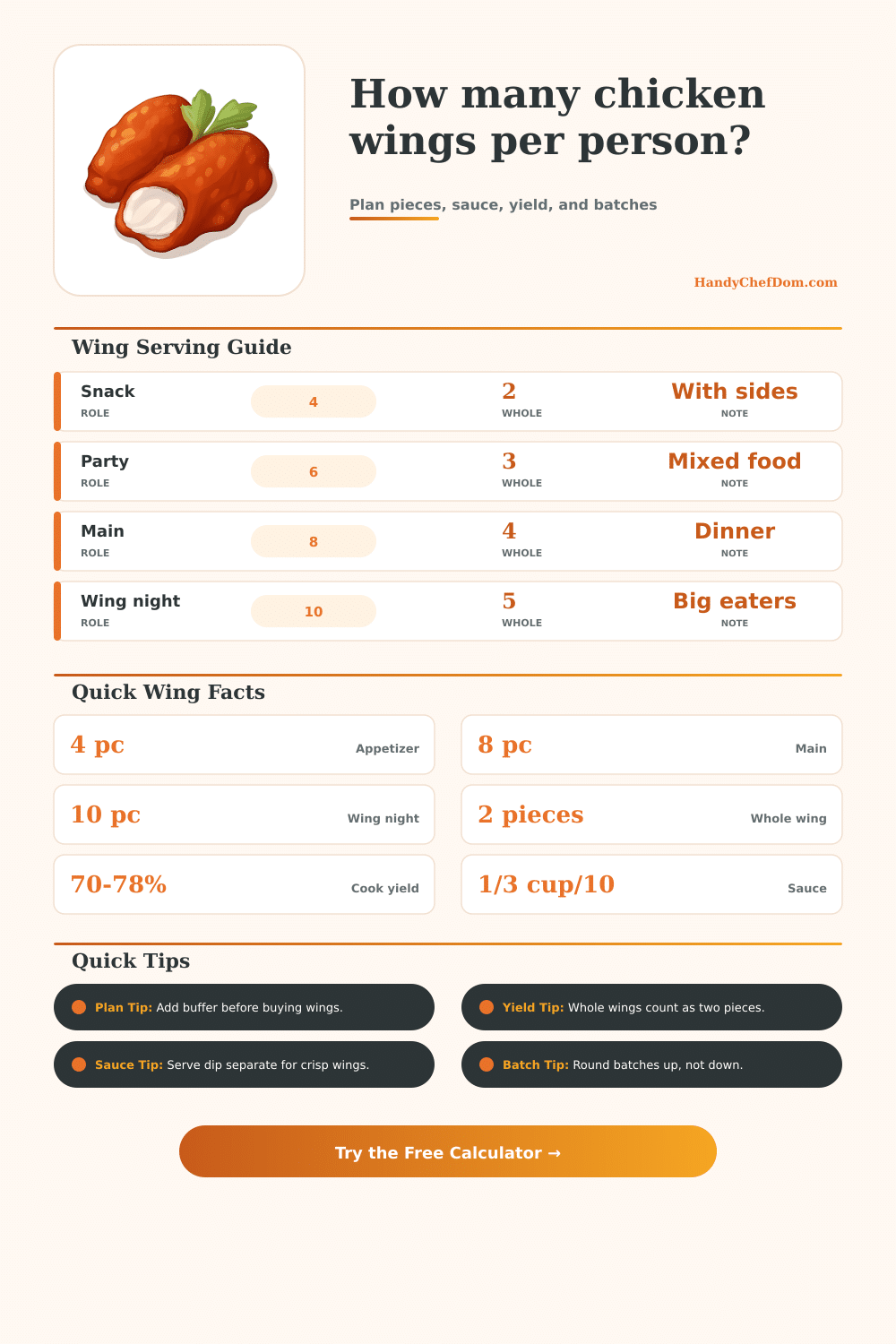
| Serving Role | Pieces Per Person | Whole Wings Per Person | Best Use |
|---|---|---|---|
| Light appetizer | 3 to 4 pieces | 2 whole wings | Before a full meal or as one of many starters |
| Party snack plate | 5 to 6 pieces | 3 whole wings | Game day table with chips, dips, and finger foods |
| Main dish with sides | 7 to 8 pieces | 4 whole wings | Dinner tray with salad, slaw, fries, rice, or bread |
| Wing night centerpiece | 9 to 11 pieces | 5 to 6 whole wings | Wings are the main event and guests expect seconds |
| Kids or light group | 3 to 5 pieces | 2 to 3 whole wings | Smaller appetites or a table with several filling sides |
| Wing Format | Pieces Counted | Raw Weight Estimate | Planning Note |
|---|---|---|---|
| Whole wings | 2 pieces each | 3.2 oz per whole wing | Cut into one flat and one drumette for normal party counts |
| Split mixed wings | 1 piece each | 1.55 oz per piece | The easiest format for trays, toss bowls, and batch planning |
| Mostly drumettes | 1 piece each | 1.7 oz per piece | Heavier pieces, so the same count weighs a little more |
| Mostly flats | 1 piece each | 1.35 oz per piece | Lighter pieces, useful when guests prefer crisp edges |
| Jumbo party wings | 1 piece each | 2.1 oz per piece | Lower the count slightly if sides are heavy and guests are light |
| Small party wings | 1 piece each | 1.2 oz per piece | Increase count when pieces are visibly small |
| Cooking Setup | Typical Yield | Starter Batch Size | Batch Timing |
|---|---|---|---|
| Air fryer baskets | 72% cooked weight | 18 to 24 pieces | 20 to 26 minutes per batch |
| Deep fryer | 76% cooked weight | 24 to 36 pieces | 10 to 14 minutes per batch |
| Oven sheet pans | 74% cooked weight | 30 to 45 pieces | 35 to 45 minutes per batch |
| Grill batches | 73% cooked weight | 24 to 40 pieces | 22 to 32 minutes per batch |
| Smoker racks | 70% cooked weight | 36 to 60 pieces | 90 to 140 minutes per batch |
| Guests | Appetizer | Main Dish | Wing Night |
|---|---|---|---|
| 4 guests | 16 to 18 pieces | 32 to 36 pieces | 40 to 46 pieces |
| 8 guests | 32 to 36 pieces | 64 to 72 pieces | 80 to 92 pieces |
| 12 guests | 48 to 54 pieces | 96 to 108 pieces | 120 to 138 pieces |
| 25 guests | 100 to 115 pieces | 200 to 225 pieces | 250 to 290 pieces |
| 50 guests | 200 to 230 pieces | 400 to 450 pieces | 500 to 575 pieces |
Planning for a wings spread requires that you consider a variety of diffrent variables. The number of wing that you will need to purchase will depend upon a variety of factor. For example, are the wings to be the primary food item at the party, or are they to be an secondary food item?
If the wings are to be the primary food item at the party, then most guest will eat more wings than if the wings are one of the secondary food item at the party. Additionally, you should also consider the appetite of the guests. Guests with large appetites will eat more wings then those with smaller appetites.
How to Plan How Many Wings to Cook for a Party
The type of method that you use to cook the wings will change the number of wings that you can cook at one time. For example, a deep fryer can cook a large number of wings at once, but requires that cook pay alot of attention to the cooking process. An oven allows for the cooking of wings, but it may take longer to cook the wings than with a deep fryer.
Air fryers cook small batches of wings, but require that cooks cook the wings in a series of small batches if a large number of wing are to be prepared. Smokers allow for a large number of wings to be cooked at one time, but require that the wings be cooked over many hour. A calculator can help to determine the number of batches of wings that will be required to cook, as well as the time that will be required to prepare the wings.
The type of wing that will be prepared will change the total count of the wings and the total weight of the wings that is prepared. Wings can be split into flats and drumettes, which reduces the number of wings that guests are required to purchase. Large jumbo wings may require fewer items to satisfy the appetites of the guest at the party.
Small party wings may require more to be purchased to provide the appearance of a complete serving tray. A reference table can be used to determine how many individual pieces of wings will be prepared if wings of different format are to be provided. You must also plan for the amount of sauce that will be needed for the wings.
Wings that are prepared with a dry rub will require less sauce than wings that are to be toss in sauce. Additionally, sauces may be provided in ramekin for guests who would like to dip there wings in sauce, which would also increase the amount of sauce that would be required for the wings. The type of sauce for the wings should be decided upon prior to calculating how many wings will be required for the party.
Finally, the number of side dish that will be served will change the number of wings that you need for your party. If many sides are served, people will eat fewer wings. If few sides are served, people will eat more wings.
Additionally, if there are any children who will be attending the party, fewer wings will be eaten, since children have smaller appetites than adults. If planning to feed many people, you will need to plan the cooking of the batches of wings. Small group may be satisfied by one batch of wings.
However, if cooking for a large group, multiple batch will be required. The cooking of the wings should be planned in such a way that the last batch of wings is not cooked before the first batch of wings is finished cooking. A planning tool can be used to calculate the total time that the wings will take to be cooked.
It is also useful to calculate a buffer percentage of the total number of wings that will be prepared. A buffer percentage allows for the number of wings to account for any additional need of the guests. A ten percent buffer can be used to account for any extra helpings of wings that might be ordered by the guests, as well as for any wings that may get damaged while cooking.
This buffer will ensure that you dont have a shortage of wings prior to the end of your party. Once you have decided on the role of the wings, the appetite of the guests, the cooking methods that will be used, and the type of side dish that will be served, the math behind planning for the wing spread will be simple.