Chocolate Milk Protein Calculator
Compare milk types, chocolate styles, boosters, and dilution to estimate protein per cup, per serving, and per batch.
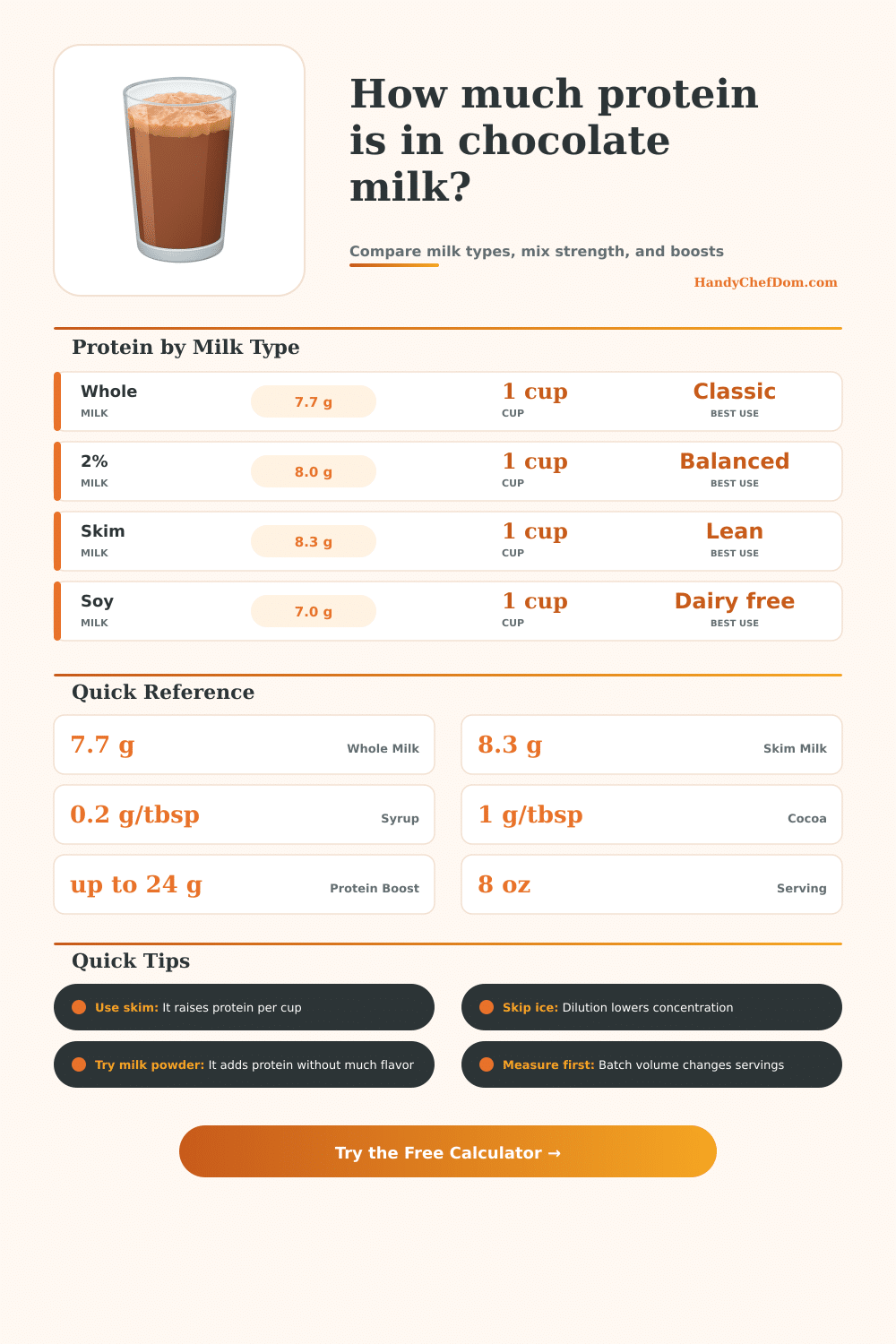
| Milk Type | Protein / Cup | Volume | Notes |
|---|---|---|---|
| Whole milk | 7.7 g | 1 cup | Classic taste |
| 2% milk | 8.0 g | 1 cup | Balanced choice |
| Skim milk | 8.3 g | 1 cup | Leanest dairy |
| High-protein milk | 13.0 g | 1 cup | Protein dense |
| Chocolate Mix | Protein / Tbsp | Cup Volume | Style |
|---|---|---|---|
| Chocolate syrup | 0.2 g | 0.06 cup | Sweet |
| Cocoa powder | 1.0 g | 0.05 cup | Deep cocoa |
| Malted mix | 1.2 g | 0.06 cup | Malty |
| Protein blend | 3.5 g | 0.06 cup | Workout |
| Booster | Protein / 30 g | Volume Hint | Best For |
|---|---|---|---|
| Milk powder | 10.2 g | 1 scoop | Easy boost |
| Whey powder | 24.0 g | 1 scoop | Post workout |
| Pea protein | 22.5 g | 1 scoop | Dairy free |
| Collagen | 27.0 g | 1 scoop | Neutral mix |
| Build | Volume | Protein Range | Use Case |
|---|---|---|---|
| Small glass | 8 oz | 7-10 g | Kid cup |
| Mug | 12 oz | 10-14 g | Breakfast |
| Bottle | 16 oz | 14-20 g | Workout |
| Pitcher | 32 oz | 20-40 g | Batch prep |
Chocolate milk is a beverage that contains protein and, as such, can be utilized as a tool to aid in the nutritional recovery of an athlete or active individuals. While many may consume chocolate milk as a treat, it can also be used as a way to satisfy an individual specific protein requirements. One cup of chocolate milk contain approximately eight grams of protein; however, the amount of protein that is present in chocolate milk can change with the alteration of the type of milk that is used in the chocolate milk or if protein boosters are add to the chocolate milk.
The type of milk that is used in the chocolate milk will have an impact upon the protein content of that chocolate milk. Milk that contains fat, such as whole milk, will contain less protein than milk that has the fat removed, such as skim milk. Since skim milk have less fat than whole milk, less of the space within the milk is taken up by the fat; the remaining space within the skim milk can be occupied by proteins such as whey and casein.
How to Make Chocolate Milk with More Protein
As a result of the higher protein content of skim milk relative to whole milk, athletes often use skim milk as the liquid base for their chocolate milk. Furthermore, the type of milk that is used for those without dairy product will contain varying amounts of protein. For instance, soy milk has a protein content that is similar to that of dairy milk, making it a functional alternative to dairy milk.
In contrast, oat milk has less protein than dairy milk or soy milk, indicating that it is a less desirable option for those that wish to increase there protein intake. The type of chocolate that is added to the milk will also impact the protein content of the chocolate milk. Chocolate powder contains more protein than chocolate syrup; the fat in chocolate syrup reduces the amount of space that can be occupied by protein.
Furthermore, chocolate syrup contains sugar; the addition of sugar to chocolate milk can increase the sugar content of the liquid. In order to even out the difference in protein content between chocolate powder and chocolate syrup, two tablespoons of protein powder or cocoa powder can be add to chocolate milk. Adding these ingredient will increase the total grams of protein that is contained within the chocolate milk.
Various types of boosters can be added to chocolate milk to increase the protein content of the liquid. Two of the most common boosters are whey and pea protein powder; both of these ingredients is soluble in the chocolate milk. Collagen protein powder is another additive to chocolate milk; however, it is often used as a supplement for those increasing there intake of proteins for joint health rather than muscle building.
Additionally, milk powder can be used as a booster for chocolate milk; adding milk powder will boost the protein density of the chocolate milk without adding extra liquid to the chocolate milk. Thus, the addition of protein powder to chocolate milk will increase the amount of protein in the chocolate milk without making the chocolate milk too waterily. An additional factor that can reduce the protein content of chocolate milk is the addition of ice to the chocolate milk.
As the ice melts, the chocolate milk will become diluted. Thus, while the amount of protein in the chocolate milk will remain the same, the volume of the chocolate milk will increase. As a result, the amount of protein per ounce of chocolate milk will decrease with the addition of ice.
Furthermore, when chocolate milk is left in a pitcher, or if any of the chocolate milk are spilled, some of the protein will be lost; this loss of chocolate milk is referred to as batch loss. To account for these variables, those that consume chocolate milk should of aim for a specific size of glass and account for the protein content within that size of chocolate milk. There are various ways that the different populations of individuals can use chocolate milk.
For instance, children may drink chocolate milk that contains ice; when the ice melts, some of the chocolate milk will be lost to dilution. In contrast, adults may heat the chocolate milk, thus avoiding the issue of dilution that result from melting ice. Athletes may use chocolate milk as a recovery liquid after exercise; those athletes may also measure the protein boosters that are added to the chocolate milk in order to ensure that they consume a goal amount of protein.
For those that do not consume dairy products, alternatives like soy milk and pea protein powder can ensure that they obtain adequate amounts of protein from their chocolate milk. Furthermore, many individuals that prepare chocolate milk may make the mistake of adding too much syrup to the chocolate milk; too much syrup increase the amount of sugar that is consumed with the chocolate milk. In these instances, the dry ingredients should be measured prior to the addition of liquid ingredients.
With these various ingredients, chocolate milk can be prepared in a variety of ways. For breakfast, for instance, skim milk, cocoa powder, and milk powder can be used to prepare a liquid with an increased amount of protein. Additionally, large pitchers of chocolate milk with added whey protein powder can be prepared in advance to use throughout the day.
For those that do not consume dairy products, mixing soy milk and pea protein powder will allow for an increased amount of protein to be consumed with the chocolate milk. Finally, the timing of consumption of chocolate milk may be an essential factor in the body’s recovery from exercise. Chocolate milk contains carbohydrates that help to move the amino acids from the protein into the muscles; the sugars in chocolate milk can increase the amount of insulin in the system after exercise, aiding the muscles recovery from that exercise.
Thus, chocolate milk is a beneficial source of protein; however, care must be taken to ensure that chocolate milk does not contain too much syrup. Too much syrup will increase the amount of sugar that is consumed with each cup of chocolate milk. Additionally, replacing chocolate syrup with chocolate powder will reduce the amount of sugar that is consumed with chocolate milk.
Thus, in order to avoid potential mistakes in the preparation of chocolate milk, it is essential to test the recipe and to measure the protein content of the chocolate milk that is prepared. These measurements will allow for the recipe to be create in the same fashion in the future.