☕ Coffee Calorie Calculator
Estimate calories, sugar, fat, and caffeine for hot or iced coffee with milk, cream, sugar, syrup, size, dilution, and serving adjustments.
Enter one drink, then set servings. The calculator estimates per-serving and total nutrition using common coffee and add-in values.
| Coffee Style | Base Size | Calories | Caffeine |
|---|---|---|---|
| Drip coffee | 8 oz | 2 cal | 95 mg |
| Americano | 8 oz | 5 cal | 77 mg |
| Espresso | 1 oz | 3 cal | 63 mg |
| Cold brew | 8 oz | 5 cal | 150 mg |
| Latte base | 8 oz | 6 cal | 75 mg |
| Cappuccino base | 6 oz | 5 cal | 75 mg |
| Mocha coffee base | 8 oz | 35 cal | 85 mg |
| Decaf coffee | 8 oz | 2 cal | 5 mg |
| Add-In | Amount | Calories | Sugar / Fat |
|---|---|---|---|
| Skim milk | 1 oz | 10 cal | 1.5 g sugar, 0 g fat |
| 2% milk | 1 oz | 15 cal | 1.5 g sugar, 0.6 g fat |
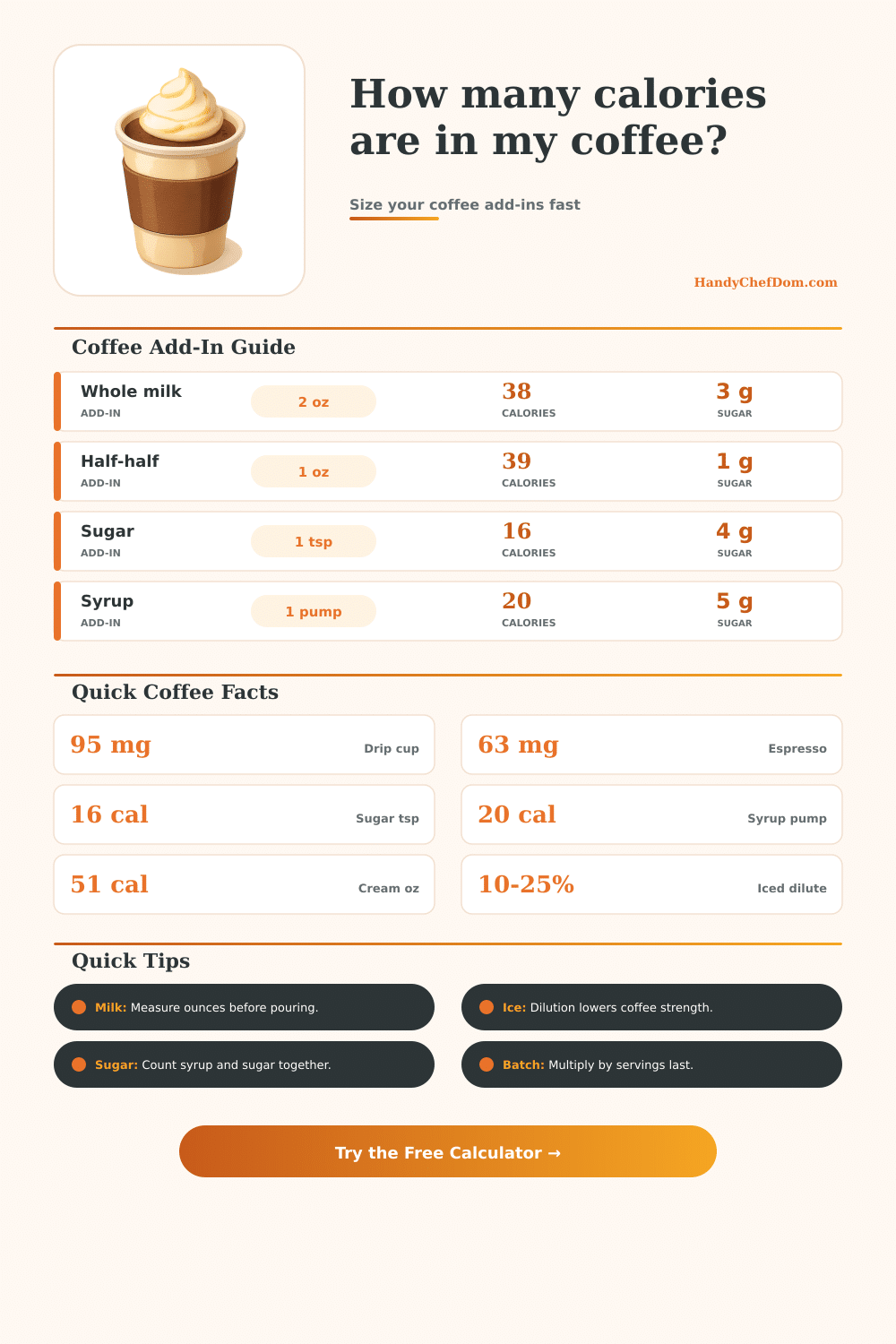
| Whole milk | 1 oz | 19 cal | 1.5 g sugar, 1 g fat |
| Oat milk | 1 oz | 16 cal | 1.1 g sugar, 0.6 g fat |
| Unsweet almond milk | 1 oz | 4 cal | 0.1 g sugar, 0.3 g fat |
| Half-and-half | 1 oz | 39 cal | 1 g sugar, 3.3 g fat |
| Heavy cream | 1 oz | 102 cal | 0.8 g sugar, 10.8 g fat |
| Regular syrup | 1 pump | 20 cal | 5 g sugar, 0 g fat |
| Drink Size | Hot Coffee | Iced Dilution | Good Estimate |
|---|---|---|---|
| Small cup | 8 oz | 5 to 10% | Use 7.5 oz coffee |
| Medium cup | 12 oz | 10 to 18% | Use 10 oz coffee |
| Large cup | 16 oz | 15 to 25% | Use 13 oz coffee |
| Extra large | 20 oz | 20 to 30% | Use 15 oz coffee |
| Pitcher serving | 10 oz | 10 to 20% | Multiply by cups |
| Blended drink | 16 oz | 25 to 35% | More ice volume |
| Preset | Size | Main Add-Ins | Best For |
|---|---|---|---|
| Black Drip Coffee | 12 oz | No add-ins | Simple tracking |
| Cream And Sugar | 12 oz | Cream, sugar | Classic mug |
| Vanilla Latte | 16 oz | Milk, syrup | Sweet cafe cup |
| Iced Caramel Coffee | 20 oz | Milk, syrup, ice | Large iced drink |
| Cold Brew With Cream | 16 oz | Cream | Strong iced cup |
| Iced Coffee Pitcher | 12 oz | Milk, syrup | Multiple servings |
Nutrition values are practical estimates for home tracking. Exact numbers vary by roast, brew strength, milk brand, syrup pump size, and cup fill level.
We all know that black coffee is near-zero-calories. But then there’s your morning latte, man, that thing feels like a meal.
But it isn’t magic. It’s math. When milk and syrup gets added into the mix, most of us greatly under-estimate the calorie accumulation of those add-ins. A “splash” of cream doesn’t seem like much… but when you’re pouring in nearly forty calories per-ounce with half-and-half, suddenly that little bit of cream alter the entire nutritional makeup.
Why Coffee Has More Calories Than You Think
There must be some mechanism to account for these secret variables without turning into a barista accountant. To do that, the calculator I made will break things down precisely into what’s adding up to whatever number you’re at. For example, the drip coffee may only have about five calories, but also almost a hundred milligrams of caffeine, whereas the vanilla syrup have no caffeine, but adds twenty calories and five grams of sugar in just a pump.
So you want to know: Is this drink worth having because it gives me an energy boost? Or is it worth having because it tastes good? What does each part bring to the table (besides calories)? That’s why it breaks the drink into the “base” (drip coffee) and the “toppings” (everything else), since those two will act different on the scale and in your stomach.
Adjust ingredients, temperature, and size as you like and result should be what you actualy drank, not some average based off a database of generic coffee orders. And then there’s this: Dilution. That’s where iced coffee comes into play. Ice melts, and when it does, it become water that takes up space in your mug. By the time you get to the bottom of that twenty-ounce iced coffee, maybe only fifteen of those ounces was good ol’ extra liquids plus coffee. The other five were plain old water.
To compensate for this, the calculator allows you to plug in a dilution percentage, and that way, as ice melts, results reflect your actual cup. Otherwise, you might assume that your big ass iced brew has more calories or caffeine then it really does. It is a small correction, but it keeps the data honest.
Most people don’t think much about their milk choice. But it makes a big difference. An ounce of skim milk save you roughly nine calories. An ounce of unsweetened almond milk? That’s four calories. If you’re pouring half your cup full, those numbers compound pretty fast. And then there’s oat milk, which strikes a balance between creamy richness and not too many calories.
On the page, they provide some helpful reference tables showing these contrasts, making it easy for you to read the fine print and understand the trade-offs. You can have the thick feel of something like heavy cream, but it costs more than a hundred calories and ten grams of fat in that single ounce. Coffee doesn’t come with a free lunch; there are only expensive lunches.
Sugar is the other quiet calorie counter. One teaspoon of white sugar isn’t as much as it sounds; add three teaspoons for sweetening (and there you go… Forty-eight calories and twelve grams of sugar). And then there’s the syrup; each pump is concentrated sugar. Careful with those pumps if you like your drinks flavoured. Use the calculator to enter number of pumps and syrup type, see how many calories you’re getting from that caramel drizzle, and if it’s really worth the metabolic price.
Certain syrups has no sugar at all, good for calorie-counting, but not for the caffeine. Still got your buzz without the sugar spike. That might not matter to you; depends what you want out of it.
When brewing up a big ol’ pot back at the homestead, or whipping something up as a present for your pals, servings is your friend. By multiplying by servings last, you avoid any rounding errors and figure out a sensible amount to cook at one time. It is useful for hosting brunch or meal prepping. You’ll be able to keep tabs on total amount of sugar all those people will consume. And you might be surprised. Simple math lead to bigger awareness.
The point is, coffee’s subjective. There are mornings when all you desire is the clean punch of black espresso, and others when only the familiarity of a sweetened latte will do. So long as you know what you’re drinking, you can indulge in whichever way suits that day. Get familiar with it through the tool, and then enjoy it with purpose.