Pour Over Coffee to Water Ratio Calculator
Dial in pour over brew ratio, coffee dose, bloom water, and yield for cleaner, more repeatable cups.
Start with your target cup size, then tune ratio, brew style, and grind so the final dose lands where your filter and beans need it.
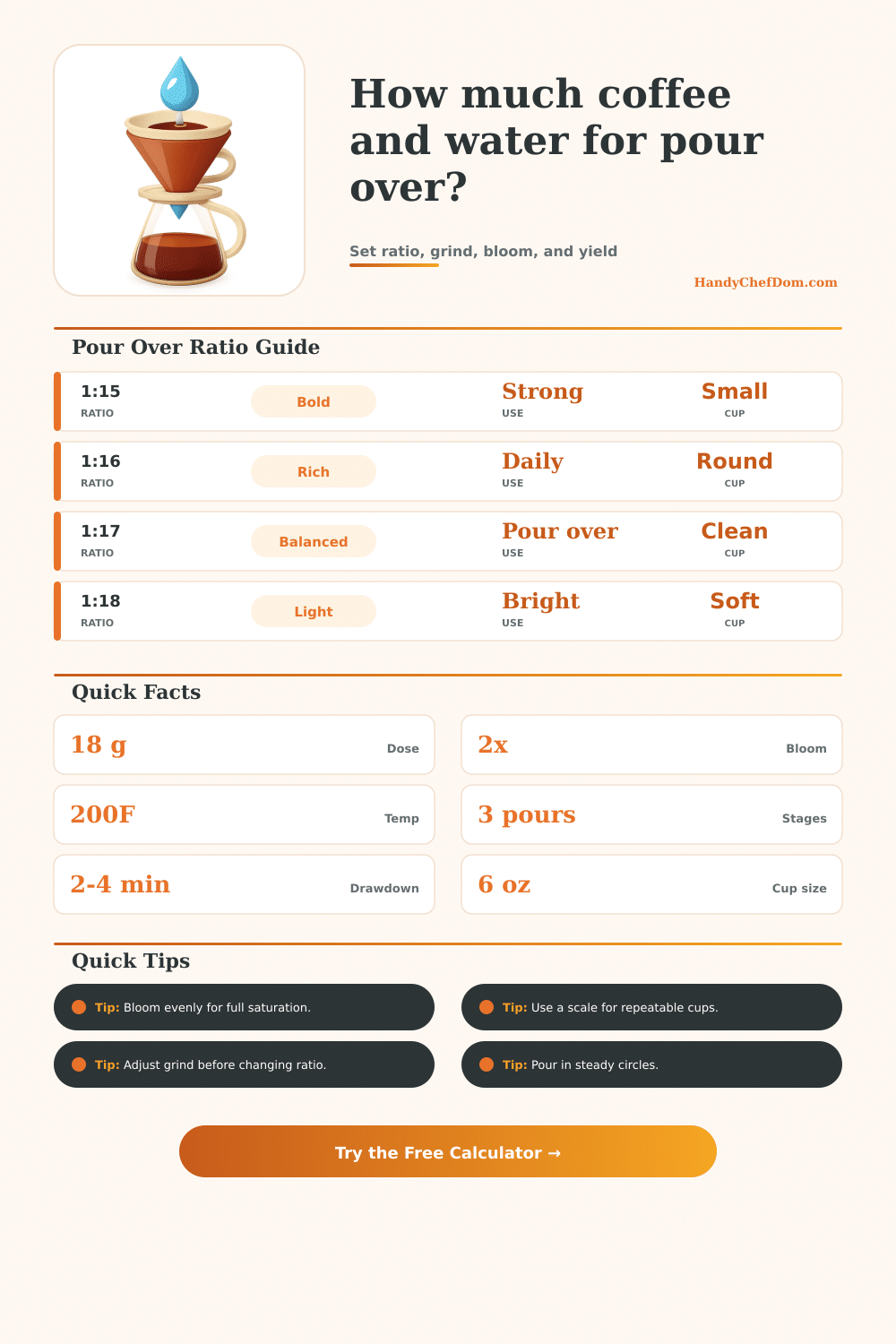
| Ratio | Strength | Use | Profile |
|---|---|---|---|
| 1:15 | Bold | Short cup | Heavy |
| 1:16 | Rich | Daily brew | Round |
| 1:17 | Balanced | Pour over | Clean |
| 1:18 | Light | Bright cup | Soft |
| 1:19 | Brighter | High clarity | Thin |
| 1:20 | Very light | Delicate lots | Lean |
| Grind | Drawdown | Temp | Note |
|---|---|---|---|
| Fine | 2-3 min | 198F | Sharper cup |
| Med-fine | 2-4 min | 200F | Default cone |
| Medium | 3-4 min | 202F | Softer edges |
| Coarse | 4-5 min | 195F | Slower flow |
| Paper | Fast | 200F | Clean finish |
| Metal | Faster | 197F | More body |
| Batch | Yield | Dose | Drinks |
|---|---|---|---|
| 1 cup | 180 ml | 11 g | 1 |
| 2 cups | 360 ml | 21 g | 2 |
| 3 cups | 540 ml | 32 g | 3 |
| Travel mug | 470 ml | 28 g | 1 |
| Server | 700 ml | 41 g | 4 |
| Small pot | 900 ml | 53 g | 5 |
| Style | Time | Body | Note |
|---|---|---|---|
| V60 | 2-3 min | Light | Bright top notes |
| Chemex | 3-4 min | Clean | Smooth clarity |
| Kalita | 2.5-3.5 | Medium | Even extraction |
| Flat bottom | 3-4 min | Round | Stable brew bed |
| Origami | 2.5-3.5 | Bright | Flexible flow |
| Trapezoid | 3-4 min | Soft | Classic filter cup |
Pour over coffee brewing require a ratio of grounds to water to ensure that the flavor of the brewed coffee are the same each time. The ratio is the mathematical relationship between the weights of the coffee grounds that you use and the weight of the water that you use in brewing the coffee. Many individuals seeks to brew coffee without measuring the amount of ground coffee that they use or the amount of water that they use.
Without measuring these variable, the amount of coffee and water will change each time that the individual brew coffee. The standard ratio for pour-over coffee brewing is a ratio of 1:17, meaning that the weight of the coffee grounds is to the weight of the water as 1 is to 17. Coffee that is more stronger than standard pour over coffee can be brewed using a ratio of 1:15, while lighter coffee can be brewed by using a ratio of 1:18.
How to Make Pour-Over Coffee
The coffee grounds will absorb some of the water that is use to brew the coffee. Coffee grounds will hold onto approximately twice their weight in water. Additionally, paper filters will also hold onto some of the water.
Thus, if an individual uses coffee grounds and paper filters, they will need to add to the total amount of water that is used to brew the coffee in order to compensate for the water that the coffee grounds and the paper filters will absorb. Thus, if an individual desires 300 ml of brewed coffee, they will need to add more than 300 ml of water to ensure that the coffee will be as strong and flavorful as possible. The grind size of the coffee grounds have a major impact upon the brewing process.
Coffee grounds that are ground to a fine consistency will allow the water to pass through the grounds more slow. Thus, when using fine ground coffee beans, the extraction of the brewed coffee will occur more quickly. If the coffee is ground to a coarse consistency, the water will pass through the grounds more quickly.
Thus, when using coarse ground coffee beans, the extraction of the brewed coffee will occur more slow. The water temperature also has an impact upon the brewing process. When brewing coffee, typically a temperature of 200 degrees F are utilized.
This temperature allows for the proper extraction of coffee flavors from the coffee grounds without scorching the grounds. If the water temperature is too low, not all of the flavor will be extract from the coffee grounds. The brewed coffee may taste sour.
If the water temperature is too high, the flavors of the coffee may be too intense when brew. The brewed coffee may taste bitter. Below is a description of the blooming process.
Prior to brewing coffee in a pour over brewer, it is important to allow the coffee grounds to bloom. To bloom the coffee grounds, pour an amount of water that is twice the weight of the coffee grounds over the coffee grounds. As the water is poured over the coffee grounds, the gases that are contained within the coffee grounds will be released.
After blooming the coffee grounds, brewing of the coffee can begin. Scales can be used to measure both the coffee grounds and the amount of water that is to be used in brewing the coffee. Using a scale will ensure that the ratio of coffee to water is maintain.
If scales are not used, it is impossible to ensure that the ratio of coffee to water is maintained; any alteration of this ratio will alter the flavor of brewed coffee. Additionally, a timer will be useful in brewing the coffee. Brewing times vary according to the grind size of the coffee grounds and the technique with which the coffee is poured during brewing.
Different brewing tools require different brewing technique. For instance, a V60 brewer has a conical shape and requires ground coffee of a medium-fine grind size in order to allow for even extraction of flavors from the coffee grounds over a period of two to three minutes. A Kalita brewer has a flat bottom that allows for even dripping of brewed coffee over a period of time.
A Chemex brewer use thicker paper filters than other brewing tools, and often takes three to four minutes to brew the coffee. The differences in brewing tools require that the brewing techniques adapts to ensure that the brewed coffee maintains its flavor. Finally, ensure that when adjusting the brewing process for coffee, only one variable is adjusted at a time.
For instance, if the grind size and the water temperature is varied at the same time, it is impossible to determine which of these two variable impacted the flavor of the brewed coffee. Adjust the grind size first, followed by the coffee to water ratio, and lastly the brewing temperature. By adjusting only one variable at a time, the impact of each variable upon the flavor of the brewed coffee can be determined.