Coffee to Water Ratio Calculator
Dial in dose, bloom, and brew yield for drip, pour over, espresso, French press, and cold brew.
Start with your target brew yield, then tune grind, roast, and method one step at a time so the cup stays predictable.
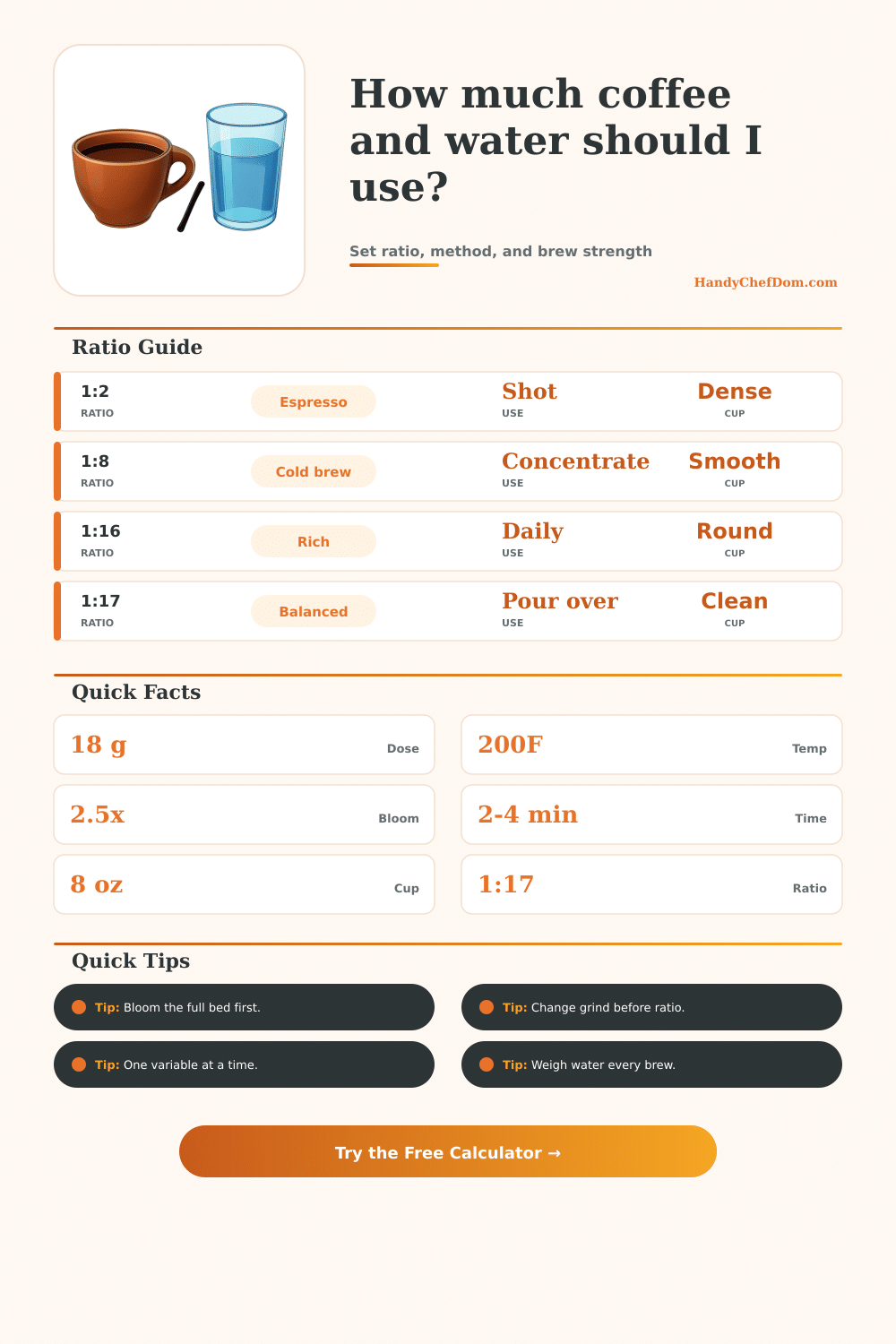
| Ratio | Strength | Use | Profile |
|---|---|---|---|
| 1:2 | Espresso | Shot | Dense |
| 1:8 | Cold brew | Concentrate | Smooth |
| 1:14 | Bold | Strong drip | Heavy |
| 1:15 | Bold | Press brew | Round |
| 1:17 | Balanced | Pour over | Clean |
| 1:20 | Light | Bright cup | Soft |
| Grind | Drip | Press | Note |
|---|---|---|---|
| Fine | Fast | Too much | Sharper cup |
| Med-fine | Best | OK | Default cone |
| Medium | Good | Best | Softer edge |
| Coarse | Slow | Best | Press brew |
| X-coarse | Very slow | Best | Cold brew |
| Paper | Clean | Light | Clear finish |
| Method | Ratio | Time | Body |
|---|---|---|---|
| Drip | 1:16 | 4-6 min | Balanced |
| Pour over | 1:17 | 2-4 min | Clean |
| French press | 1:15 | 4-5 min | Full |
| AeroPress | 1:12 | 2-3 min | Round |
| Cold brew | 1:8 | 12 hr | Mellow |
| Espresso | 1:2 | 0.5 min | Dense |
| Batch | Yield | Dose | Drinks |
|---|---|---|---|
| Single mug | 180 ml | 11 g | 1 |
| Two cups | 360 ml | 21 g | 2 |
| Travel mug | 470 ml | 28 g | 1 |
| Half liter | 500 ml | 29 g | 2 |
| Carafe | 750 ml | 44 g | 4 |
| Gift batch | 900 ml | 53 g | 5 |
Coffee brewing depend on the ratio of coffee to water. The coffee to water ratio is the most important factor in brewing coffee that will deliver a well-rounded flavor to the individual who brews the coffee. The ratio is the mathematical relationship between the weight of the coffee grounds and the weight of the water that is brew.
Using the wrong coffee-to-water ratio will make the brewed coffee either too weak or too strong. To avoid this outcome, calculating the coffee-to-water ratio before brewing the coffee is necessary to ensure the brewed coffee have the same flavor every time. Coffee grounds absorbs the water that is brewed.
How Much Coffee and Water to Use
Coffee grounds also lose water to the coffee filter. Coffee grounds hold a significant amount of water. Therefore, the amount of water that is poured into the coffee grounds will not be the same as the amount of coffee that is brewed and consumed.
Coffee grounds absorb approximately twice their weight in water. Since coffee grounds and coffee filters absorbs water, the losses caused by these two components must be accounted for when calculating the coffee-to-water ratio. The target yield of brewed coffee is the amount of liquid coffee that is brewed.
To calculate the coffee-to-water ratio, start with the target yield of brewed coffee. Using the target yield allows a person to calculate how much coffee is require to achieve that target yield. There are different ratio for different brewing methods.
Each coffee-to-water ratio produces coffee of a different strength. For example, the ratio of coffee to water used for a balanced pour-over method is 1:17. This means that 17 grams of water are used for every 1 gram of coffee.
For a French press brewing method, the coffee-to-water ratio is 1:15. For this brewing method, 15 grams of water are used for every 1 gram of coffee. Using a 1:15 coffee-to-water ratio produces coffee with a fuller body because the grounds for a French press brewing method are coarser.
Coarser grounds allow water to extract more material from the coffee grounds slow. A 1:17 coffee-to-water ratio produces coffee with a lighter body. People can use presets to program their coffee makers to set the coffee-to-water ratio for different brewing methods.
Using these presets, a person can simply select brewing method, grind size, and type of roast for the coffee beans, and the coffee maker will automatically set the coffee-to-water ratio for that brewing method. The grind size of the coffee beans impacts the flow rate of the water. The flow rate of the water impacts the strength of the brewed coffee.
Using fine ground coffee beans causes the water to flow slow through the coffee grounds. Using coffee grounds that release water too slowly can make the brewed coffee taste bitter. Using coffee grounds that are coarse will allow the water to flow quickly through the coffee grounds.
Coffee brewed in this manner can taste sour due to the brief contact between the water and coffee grounds. For example, a medium-fine grind size of coffee beans works best for cone drip brewers. Coffee grounds that are coarse in texture is more appropriate for use in a French press brewing method.
During brewing, coffee goes through what is known as the bloom stage. During the bloom stage, a small amount of water is poured over the coffee grounds. The bloom stage involves pouring twice the weight of the coffee in water.
Additionally, the coffee grounds need to be allowed to swell during the bloom stage. Coffee that is very fresh will release more gas during the bloom stage and will require more water during this stage. After the bloom stage is completed, the remaining amount of water is added.
Water should be added in pulses to allow for even saturation of the coffee grounds. Even saturation of coffee grounds ensures that brewed coffee has even extraction of flavor compounds from the coffee grounds. The temperature of the brewing water affects the extraction of coffee and the flavor of the brewed coffee.
The ideal brewing temperature for medium roast coffee beans is 200 degrees Fahrenheit. For dark roast coffee beans, however, a lower brewing temperature may be desired so that the coffee is not scorched during brewing. For light roast coffee beans, a higher brewing temperature is required to extract the floral notes from the coffee beans.
Brewing temperature is, therefore, a variable that must be controlled in the brewing process. A recipe for brewed coffee may be standardized by changing only one variable at a time. For instance, changing the coffee-to-water ratio and the grind size of the coffee beans at the same time will make it impossible to determine which changed the flavor of the coffee.
By selecting one variable to change and tasting the brewed coffee, it will be possible to determine the impact that the changed variable has on the flavor. To accurately brew coffee according to a set ratio, a kitchen scale should of been used to weigh the water and coffee grounds. Using a kitchen scale ensures that the correct amount of water and coffee are used in brewing coffee.
Additionally, using a kitchen scale allows an individual to repeat the brewing process and achieve the same results every single day.