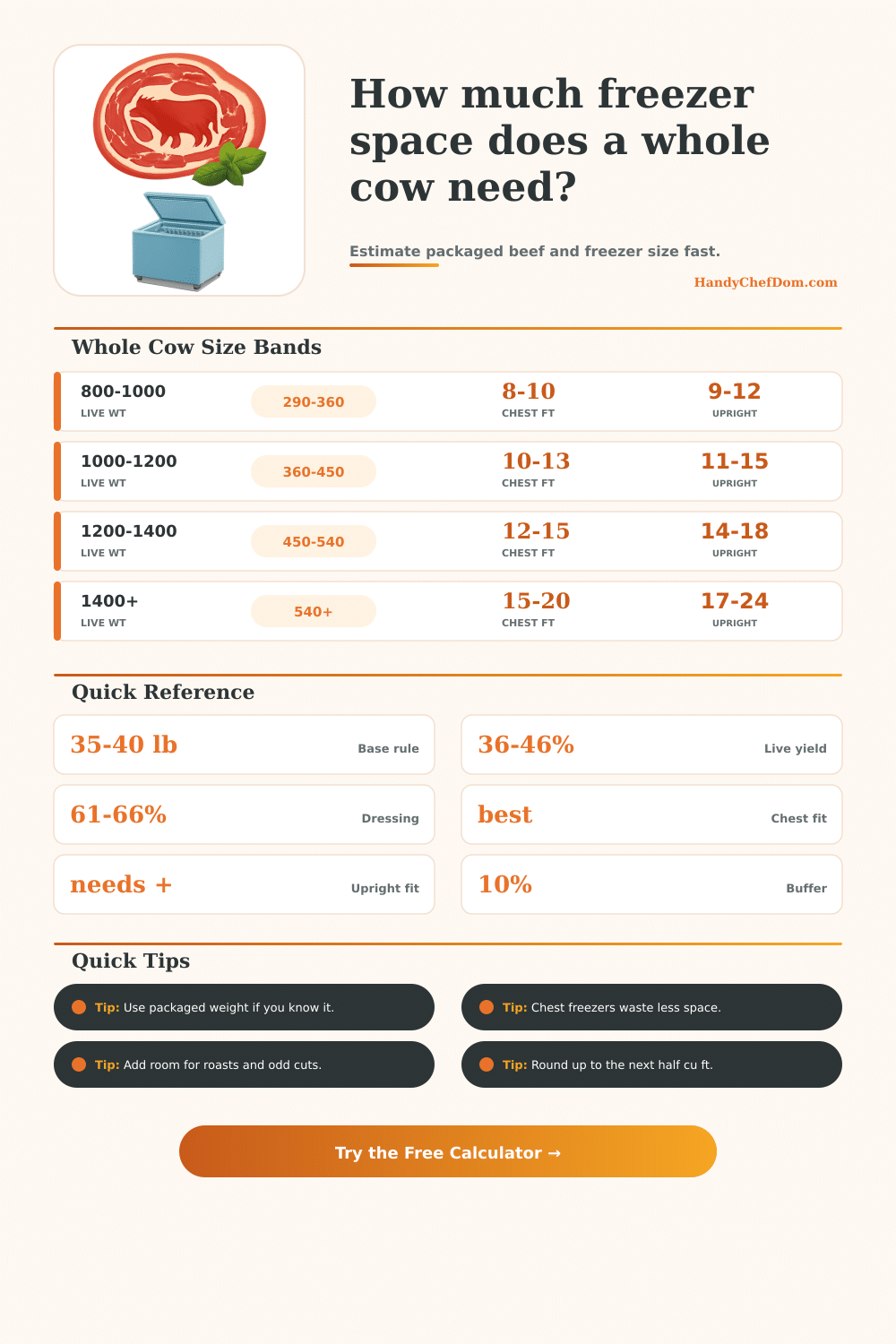
How Much Freezer Space for a Whole Cow?
Estimate packaged beef, compare chest versus upright storage, and size a freezer from live, hanging, or cut-and-wrapped weight.
📌Presets
Each preset loads a realistic carcass style, yield, and freezer fit so you can sanity-check the result quickly.
⚙Whole Cow Inputs
Whole cow freezer snapshot
Enter one known weight, pick the animal style, and compare the chest and upright freezer fit.
📊Storage Factors
📑Reference Tables
| Basis | Typical yield | Packaged from 1,200 | Note |
|---|---|---|---|
| Live wt | 36-46% | 430-550 lb | Best first guess |
| Hanging wt | 50-70% | 375-525 lb | Needs cut plan |
| Packaged | 100% | 500 lb | Direct input |
| Cull cow | 33-42% | 400-500 lb | Lean and leaner |
| Packaged | Chest ft | Upright ft | Practical read |
|---|---|---|---|
| 300-375 | 8-11 | 9-13 | Quarterish load |
| 375-450 | 10-13 | 11-15 | Small whole cow |
| 450-525 | 12-15 | 14-18 | Typical whole cow |
| 525-625 | 14-18 | 16-22 | Large animal |
| Cut style | Factor | Best for | Why it matters |
|---|---|---|---|
| Vacuum | 0.95 | Flat packs | Stacks tight |
| Standard | 1.00 | Mixed cuts | Normal fit |
| Bone-in | 1.08 | Roasts | More air gaps |
| Roast heavy | 1.15 | Odd shapes | Needs headroom |
| Freezer | Factor | Fit | Use case |
|---|---|---|---|
| Chest | 1.00 | Best | Bulk meat |
| Upright | 1.12 | Good | Easy access |
| Frost-free | 1.20 | Roomiest | More loss |
| Small chest | 0.90 | Tight | Very efficient |
💡Tips
When you purchase a whole steer, you must consider the space that the beef will take up in your freezer. Many people finds that they dont have enough space in there freezer to store all of the cuts of beef that they would like to have. The weight of the steer will decrease at several different stages.
The weight of the steer will decrease during slaughter, during hanging, and during the cutting and wrapping process of the steer. Each of these stages will decrease the weight of the steer, so it is important for people to take this into consideration when purchasing an freezer. The first stage at which the weight of the steer will decrease is at the slaughterhouse.
How much freezer space do you need for a whole steer
At the slaughterhouse, the slaughterhouse will have removed the steers hide, its head, its blood and organs. The dressing percentage is the ratio of the hanging weight to the live weight of the steer. For steers, the dressing percentage is typicaly around 60 percent.
Therefore, the weight of the steer after the slaughterhouse will have a weight that is around 60 percent of the live weight. The hanging weight will still contain the bones and the fat from the steer. The final packaged weight will be around 40 percent of the live weight of the steer.
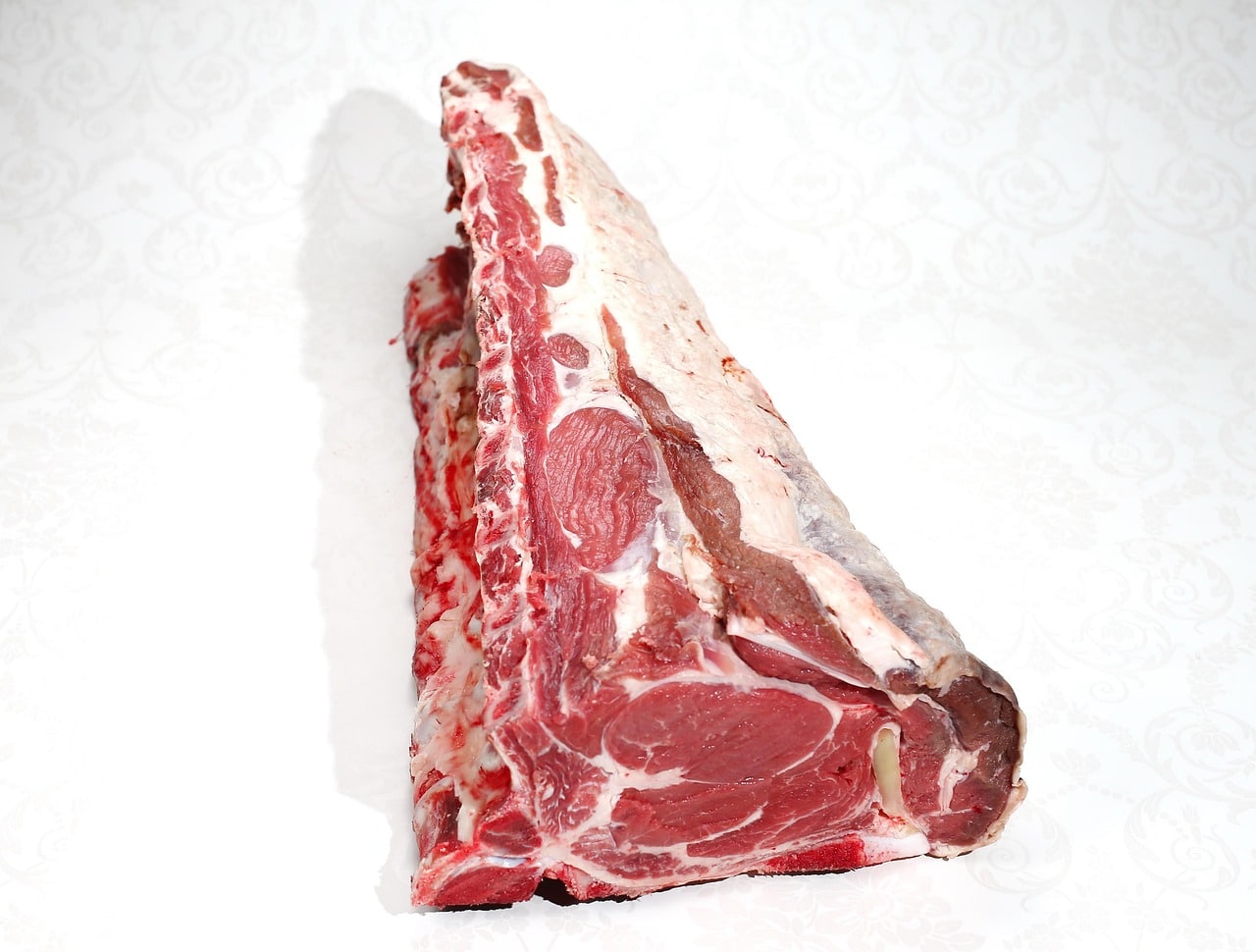
Grass-fed animals and cull cows will have lower dressing percentages, meaning that there will be less packaged beef from these types of cows then from standard beef steers. The cut of the beef will play a role in the space that the packages will take up within the freezer. Vacuum-sealed packages will take up the least amount of space within the freezer due to the even shape of the packages.
However, packages that contain bone-in roasts and brisket will take up more space within the freezer due to the irregular shapes of these packages. Therefore, if the packages become vacuum-sealed, the meat will take up the least amount of space within the freezer. However, if the packages contain bone-in roasts and brisket, they will take up the most space within the freezer.
Additionally, the type of freezer that you use will impact the amount of meat that the freezer will be able to store. Chest freezers will allow you to store the most amount of meat because the packages can be stored in a flat and deep position within the chest freezer. However, upright freezers will waste space due to the doors and shelves.
Additionally, frost-free freezers will require additional space for the meat to dry out. If you do not allow for the meat to dry out, the freezer may frost over. You can use a form of math known as yield math to determine how much space that your freezer will need to store the beef.
A chest freezer can hold between 35 and 40 pounds of packaged beef per cubic foot of the chest freezer. However, if you choose different types of meat, the amount of space that you will need will change. For instance, if you plan on purchasing a mix of different types of meat, the space required will be the same as the weight of the beef divided by 35.
However, if the beef includes roasts, you will need to purchase 15 percent more space for those bulky roasts. For instance, if you know the live weight of the steer, you can expect that your packaged beef will weigh between 36 and 46 percent of the live weight. However, if you know the hanging weight of the steer, you should of calculate the carcass weight rather than the live weight.
Different types of cattle will yield different amounts of beef. For instance, heavy-finish steers will produce 45 percent of their live weight as packaged beef. Dairy beef cross steers will only yield 36 percent of their live weight as packaged meat.
If the family intends to use ground beef, the space that the ground beef will take up in the freezer will be less than roasts, which will take up the most space within the freezer. However, if the family prefers to use roasts, they will need to purchase more space within the freezer. It is important, therefore, to calculate what type of beef will be needed within the family prior to purchasing a meat freezer.
Many people make mistakes when they try to calculate the amount of freezer space that they will need for their beef packages. For instance, many individuals will overestimate the amount of beef that they will recieve from the whole steer. They will not account for the fact that the beef will lose weight from the bones and fat that will be trimmed from the packages.
Additionally, many people will purchase upright freezers due to their convenience in accessing the meats. However, upright freezers will hold 10 to 20 percent less meat than a chest freezer of the same size. Additionally, individuals will not account for the fact that meat packages of items like prime rib or organ meats will take up additional space within the freezer.
Furthermore, individuals will not account for the fact that leaving gaps in the packages of beef will allow for the meat to dry out. Therefore, they will need to allow for this drying of the meat within their calculations. Another factor to consider when purchasing meat is the length of time that the meat will last within the freezer.
Vacuum-sealed packages will contain the meat for one year or more. Additionally, the meat that is packaged in standard wraps will last for approximately nine months within the freezer. After purchasing the beef packages, you should rotate the meats within the freezer so that you consume the oldest meats rather than wasting them.

Additionally, each package of meat should be labeled so that individuals will be able to recognize the type of meat after it has been within the freezer for several months. If you plan to share the beef with your neighbors, you should coordinate what cuts of beef you will receive so that each neighbor will receive the type of beef that they would like to have. When purchasing a whole steer of beef, you will need to measure the amount of space within your freezer in which the packages will reside.
You can choose to purchase a chest freezer or an upright freezer. Additionally, if you know the live weight of the steer that will be butchered, you can calculate the amount of packaged beef that will be obtained. By planning and performing these calculations, you can ensure that the freezer will be able to hold enough packages to last the family for a year of meals without any problems.