Cream Cheese Sodium Calculator
Estimate cream cheese sodium by tablespoons, ounces, grams, regular, light, whipped, flavored, bagel spread, dip, cheesecake filling, serving count, daily sodium limit, and spread thickness.
1Cream Cheese Sodium Presets
2Amount, Cream Cheese Type, Use, and Sodium Inputs
Pick how the cream cheese is measured, choose the closest label style, and set the number of servings. Spread thickness scales the portion for bagels and crackers, while optional package sodium overrides the built-in sodium estimate.
Cream cheese sodium estimate
Adjust the amount, type, use, and spread thickness to estimate sodium.
3Fast Cream Cheese Sodium Cards
4Cream Cheese Type, Measure, and Sodium Grid
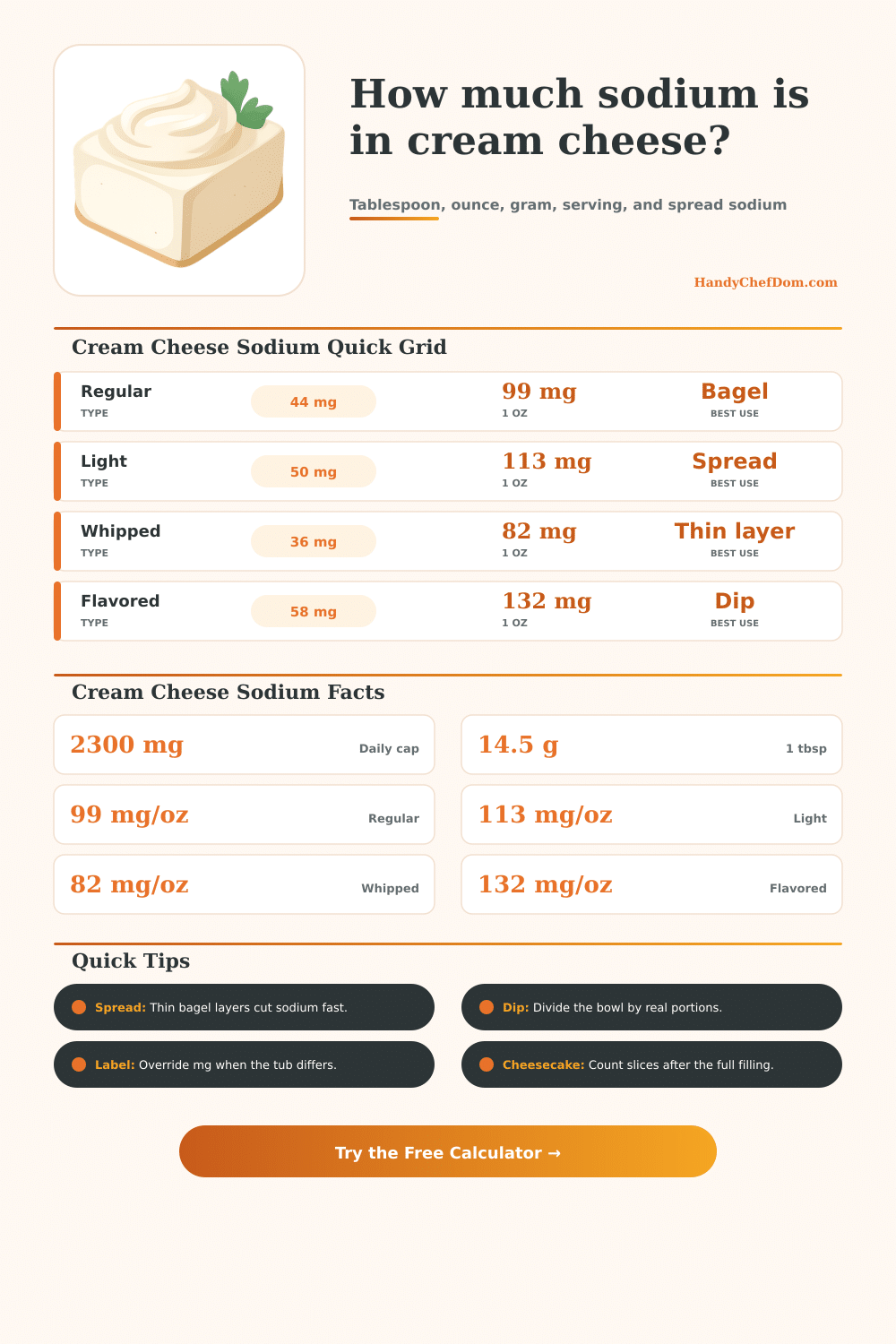
These estimates are practical planning values. Brand labels vary, especially for whipped tubs, savory flavored tubs, sweet tubs, and reduced-fat formulas.
| Cream cheese type | Grams per tbsp | Sodium per tbsp | Sodium per oz | 8 oz block/tub |
|---|---|---|---|---|
| Regular block or tub | 14.5 g | 44 mg | 99 mg | 792 mg |
| Light cream cheese | 14.5 g | 50 mg | 113 mg | 904 mg |
| Whipped cream cheese | 12.5 g | 36 mg | 82 mg | 656 mg |
| Flavored savory tub | 14.5 g | 58 mg | 132 mg | 1056 mg |
| Reduced-fat style | 14.5 g | 53 mg | 120 mg | 960 mg |
| Neufchatel style | 14.5 g | 47 mg | 106 mg | 848 mg |
| Sweet flavored tub | 14.5 g | 46 mg | 104 mg | 832 mg |
| Lactose-free style | 14.5 g | 52 mg | 118 mg | 944 mg |
5Use Preset Guide
| Use | Common amount | Suggested servings | Thickness default | Sodium note |
|---|---|---|---|---|
| Bagel spread | 2 tbsp per bagel | 1 | Standard layer | Bagel sodium is separate and can be much higher than the spread. |
| Toast or cracker spread | 1 tbsp per serving | 1-4 | Light smear | Thin spreading gives the easiest sodium reduction. |
| Dip or cheeseball | 8 oz block | 8-16 | Standard layer | Add seasoning packet sodium separately. |
| Cheesecake filling | 16-32 oz | 8-16 slices | Standard layer | Divide the full filling by finished slices. |
| Frosting batch | 8 oz block | 12-24 | Standard layer | Usually modest per serving unless frosting is very thick. |
| Sauce or soup swirl | 2-4 oz | 4-6 | Standard layer | Broth, ham, bacon, or parmesan may dominate sodium. |
6Daily Limit and Spread Thickness Tables
| Per-serving cream cheese sodium | % of 1500 mg limit | % of 2000 mg limit | % of 2300 mg limit | Planning cue |
|---|---|---|---|---|
| 50 mg | 3.3% | 2.5% | 2.2% | Small smear or thin appetizer portion. |
| 100 mg | 6.7% | 5.0% | 4.3% | About one ounce regular cream cheese. |
| 200 mg | 13.3% | 10.0% | 8.7% | Typical two-tablespoon bagel spread. |
| 400 mg | 26.7% | 20.0% | 17.4% | Large deli layer or salty flavored dip serving. |
| Spread thickness | Multiplier | 2 tbsp regular becomes | Estimated sodium | Best for |
|---|---|---|---|---|
| Whisper thin | 50% | 1 tbsp | 44 mg | Crackers, tea sandwiches, light toast. |
| Light smear | 75% | 1.5 tbsp | 66 mg | Open-face toast or a half bagel. |
| Standard layer | 100% | 2 tbsp | 88 mg | Everyday home bagel spread. |
| Cafe thick | 125% | 2.5 tbsp | 110 mg | Bakery-style bagel or brunch plate. |
| Deli double | 200% | 4 tbsp | 176 mg | Very thick bagel or loaded sandwich. |
7Sodium-Smart Cream Cheese Tips
Maybe you’re staring at an open bagel and wondering whether you should spread on some cream cheese. Maybe you didn’t realize how much sodium was in each scoop. That’s part of the problem: It’s not just the cream cheese, but also the thickness and portion size. If you only use a thin smear, it’ll feel like less of a salty burden… Even if its still salty. If you apply it thickly, then yes, it will be rich, but it will eat up your day’s sodium limit fast.
The calculator above do all this for you after you input the size, eliminating any uncertainty regarding serving sizes and density. Most people don’t realize that a single tablespoon isn’t always the same amount of sodium across different brands, nor do they realize how much salt there is until they change the way they spread their cheese on top.
How to Control Your Sodium Intake with Cream Cheese
First: Not all cream cheeses are created equal when it comes to salt. As a general rule of thumb, regular block cheeses typically come in at 99 mg of sodium/ounce, meaning this will become the benchmark for your daily routine. In many cases, light cream cheeses tend to have slightly higher amounts of sodium than those made with full-fat because they’re trying to replace some of the fat with an ingredient that has consistency of fat (salt). So, if you’re looking to purchase light cheese for both its sodium and caloric impact, you may notice that you get less fat, but more salt. It’s easy to see in the reference table, as the whipped variety tend to be lower-sodium since it’s airy, whereas those savory tubs spiked with flavoring bump up the sodium content.
Most diets go wrong with how much spread they use. Sure, you think you’re applying normal amounts. But do you really just barely spread butter over half an inch of bread? Or do you push down and squish to cover all the surface area? And did you even know you doubled your calories without thinking about it? The tool makes that tangible motion translate into real numbers: from whisper-thin layers up to deli-double coatings. Because sodium limits is cumulative, that’s important.
Say your diet allows two thousand milligrams per day. A hearty layer of cream cheese on your bagel uses almost one tenth of that quota before you’ve added another ingredient, such as capers or smoked salmon!, or even eaten the bagel. And this number grow fast when you account for everything you’ll eat during lunch and dinner.
For bigger dishes such as cheesecakes and dips, where we’re no longer talking about a single serving size but rather a whole recipe, the numbers is also altered. A single 8-ounce block of cream cheese contain almost 800 milligrams of sodium overall, which sounds pretty scary, until you realize you divided that number among sixteen slices of cake. When you think about it that way, the amount per serving are more reasonable…but only if you’re slicing those servings properly. Many times we’ll cut ourselves a big hunk of something but fail to take into account how concentrated all those parts is within it. Pre-set options for dessert fillings and other party dips help us visualize what that cut will look like so we don’t eat half the freaking block at once.
Of all the inputs here, the daily limit is probably the most personal one. The typical general guideline is twenty-three-hundred milligrams; if you’re health conscious, though, maybe you shoot for a stricter limit like fifteen hundred or below. When you change that number, everything shifts. That half-ounce smear may be a trivial two percent of a large limit, but a hefty three-point-three percent of a tighter one. Knowing how much a serving count toward your limit helps you make compromises.
Maybe you use a lot of salty spread on your cream cheese? Pick a less-salty bagel next time, or pass on salty toppings altogether, balance out the equation. Overall, sodium control isn’t about number crunching; it’s more about thinking through volume and density. In other words, you don’t have to weigh your grams. What helps is just having some kind of sense in your head about a serving size, where does it begin and end? Does it look like a light smear on toast or is it like a frosting layer on a cupcake?
Once you get that down, you can appreciate the taste and texture you love while still sticking with your healthy eating plans. So when you go to grab that tub, consider how thick you want to make it, and which cheese will be best. It’s just shifting your thought pattern a little bit, which leads to really being able to control yourself. You should of considered more carefully.