🔪 Cutting Board Size Calculator
Match board footprint to prep style, counter room, and storage limits with a clearer size plan.
The calculator uses board style, available counter space, ingredient pile footprint, and knife sweep room to size the board.
| Board size | Best use | People | Fit note |
|---|---|---|---|
| 12 x 18 | Snack prep | 1-2 | Compact fit |
| 15 x 20 | Daily prep | 2-4 | Most kitchens |
| 18 x 24 | Roasts | 4-8 | Deep clearance |
| 20 x 26 | Dough work | 1-4 | More flour room |
| 24 x 30 | Party prep | 6-12 | Shared station |
| 30 x 36 | Catering | 10+ | Large surface |
| Material | Density | Weight feel | Best use |
|---|---|---|---|
| Maple | 44 lb/ft³ | Solid | All-purpose |
| Walnut | 39 lb/ft³ | Balanced | Service boards |
| Bamboo | 38 lb/ft³ | Light | Everyday use |
| Acacia | 43 lb/ft³ | Firm | Mixed prep |
| Teak | 41 lb/ft³ | Heavy | Moist work |
| HDPE | 35 lb/ft³ | Light | Protein prep |
| Rubberwood | 40 lb/ft³ | Medium | Budget boards |
| End-grain maple | 46 lb/ft³ | Very heavy | Knife-friendly |
| Clearance rule | Typical gap | Why it matters | Best for |
|---|---|---|---|
| Counter edge | 2 in | Prevents slips | Daily prep |
| Sink splash | 1-2 in | Stops wet edges | Wet produce |
| Knife sweep | 1 in | Gives blade room | Chopping |
| Carving drip | 3 in | Catch juices | Roasts |
| Storage drawer | Fits length | Easy stow | Compact kitchens |
| Cabinet shelf | 2 in margin | Safer handling | Heavy boards |
| Thickness | Feel | Benefit | Best use |
|---|---|---|---|
| 1/2 in | Light | Easy store | Quick prep |
| 3/4 in | Balanced | Good control | Everyday tasks |
| 1 in | Stable | Less flex | General use |
| 1 1/4 in | Heavy | Deep knife feel | Carving |
| 1 1/2 in | Very heavy | Extra mass | Dough and roast work |
| 2 in | Bench-top | Maximum stability | Professional stations |
When choosing a cutting board, you must consider the dimension of the cutting board in relation to the task you will perform with it and the available space on your kitchen counter. The cutting board you use must be sized appropriately to allow for stability when cutting and to ensure that the cutting board dont take up too much space on your counters. If the cutting board is too small, you may encounter instability in relation to the cutting board or you may not have enough space for the ingredient that you need to add to the cutting board.
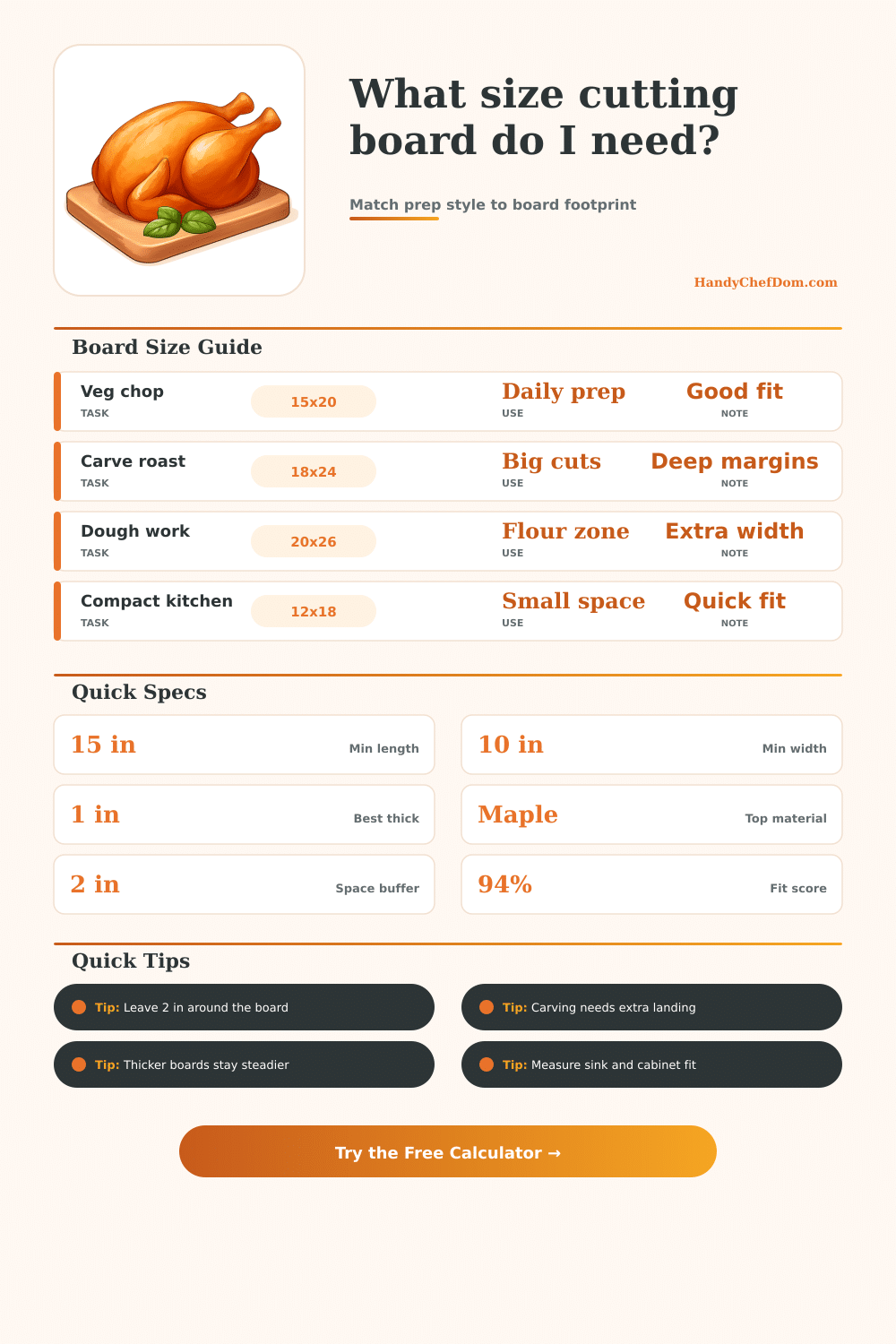
If the cutting board is too large, then the cutting board may not fit on your counter or it may be difficult to move the cutting board. Depending upon the tasks that you will perform with the cutting board, the size of the cutting board will change. For example, if you will be performing task that involve chopping vegetables, you may need a cutting board that is approximately fifteen inches in one dimension and twenty inches in another dimension.
How to Choose the Right Cutting Board
This size will provide enough space for you to place the vegetables on the cutting board as well as enough room for the movement of your knife. However, if you will be carving a roast, you may want to select a cutting board that is eighteen inches in one dimension and twenty-four inches in the other dimension. This size will allow the juices from the roast to land on the cutting board and it will provide space for your carving knife to move.
Additionally, if you will be working with dough, you may want to use a cutting board that is twenty inches in one dimension and twenty-six inches in the other dimension. This will provide sufficient space to roll the dough without it crumbling over the edge of the cutting board. In addition to the tasks that you will perform with the cutting board, you should also consider the dimensions of your kitchen counter.
Depending upon the length and depth of your counter, you will have to leave some space for your cutting board to avoid it wobble against the backsplash of your kitchen sink or counter. You should plan to leave at least two inch of space on each side of your cutting board. Additionally, the area in which you will be preparing your food may limit the space available on your counter.
If you must prepare your food near your sink, for instance, you will have less space for your cutting board. Furthermore, you will have to account for the size of the ingredient pile that will land on the cutting board. If you do not account for these factors, your cutting board may not fit into the usable area of your kitchen countertop.
Beyond the dimensions of the cutting board, the material of that cutting board and its thickness will also affect its performance. Cutting boards made from materials like maple are more denser and will allow the cutting board to stay in place while you are performing your cutting tasks. Cutting boards made from materials like bamboo will be lighter and are useful for tasks that take place more quick in the kitchen, as they are less likely to cause strain in the arms of the chef.
Additionally, cutting boards that are one inch in thickness will be stable while being used in the kitchen. However, tasks involving dough or roasts may require a thicker cutting board. Similarly, cutting boards that are thinner than one inch will be less stable when performing tasks on the cutting board.
There are a few mistakes that many people make when they are purchasing a cutting board. For example, some people purchase oversized cutting boards for their kitchens that they will use for different task, but which may be small in size in their kitchens. Other people may not leave enough space on their countertops for their cutting boards, which may cause the cutting boards to slip from the countertop when they are using very greasy ingredients.
Additionally, people may not select the proper cutting board for there specific cooking and kitchen task. For instance, tasks that involve trimming meat will require a cutting board that is longer than cutting boards that are used for tasks like filleting fish. Finally, people may not consider in what area of the kitchen they will store their cutting boards.
Cutting boards that are large and heavy may require cabinet to store them, while smaller cutting boards may be able to fit into a kitchen drawer. Therefore, people should of consider each of these factor prior to purchasing their cutting boards. Based off these factors, people will be able to purchase a cutting board that best meets there need in the kitchen.