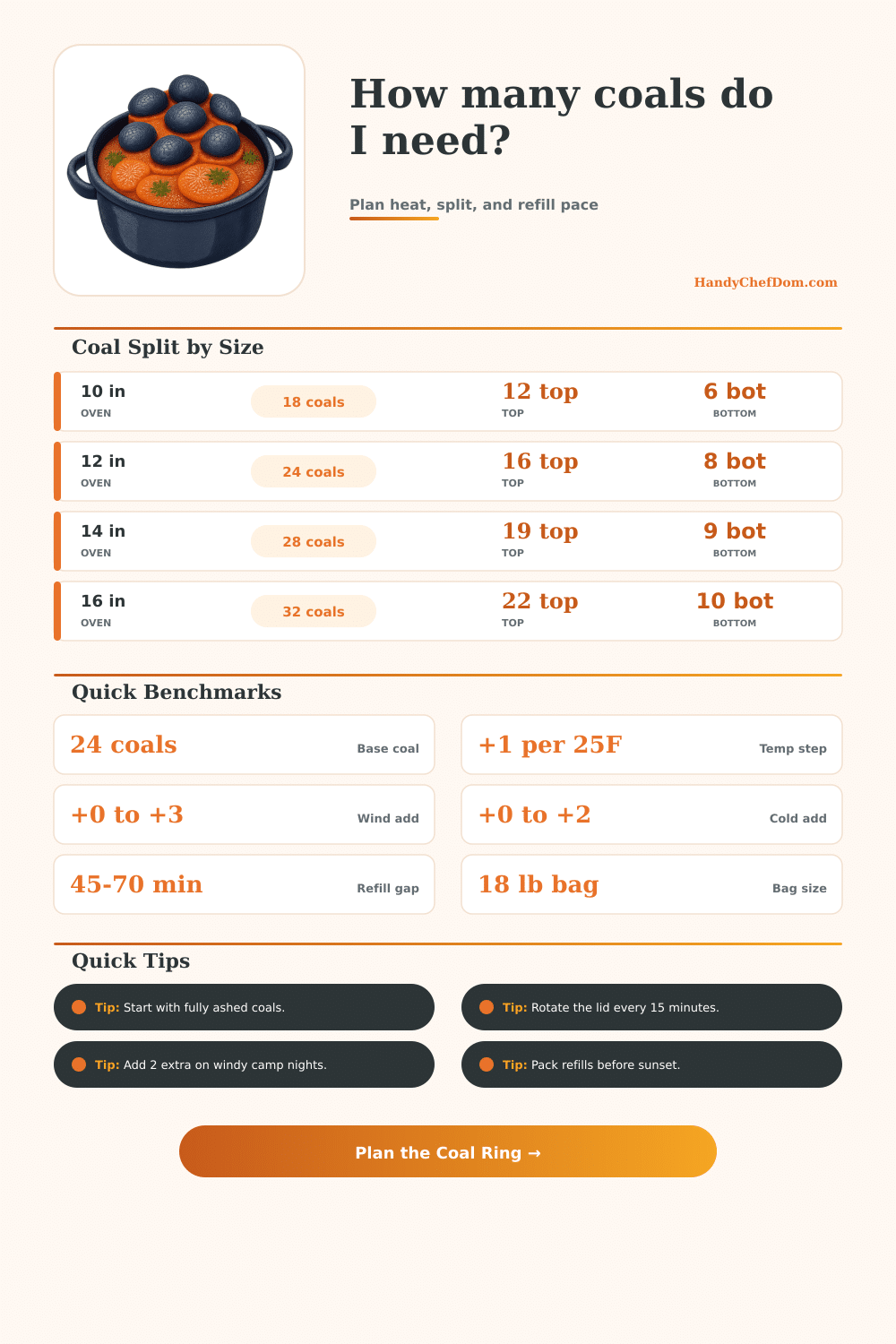
Dutch Oven Charcoal Calculator
Plan coal rings for camp bread, braises, and long simmer pots with temperature, pot size, weather, and cook time in one pass.
Preset Scenarios
Coal Planner Inputs
Use the size and heat table as a starting point, then var the calculator adjust for weather, altitude, fuel type, and the way you actually cook. The result is a practical coal ring instead of a guess.
Size and Coal Baselines
| Size | Base | Bake | Stew |
|---|---|---|---|
| 10 in | 18 | 12 top | 6 bot |
| 12 in | 21 | 14 top | 7 bot |
| 14 in | 24 | 16 top | 8 bot |
| 16 in | 27 | 18 top | 9 bot |
Target Temperature Guide
| Heat | Total | Top | Bottom |
|---|---|---|---|
| 300 F | 22 | 15 | 7 |
| 325 F | 23 | 15 | 8 |
| 350 F | 24 | 16 | 8 |
| 375 F | 25 | 17 | 8 |
Fuel Type Reference
| Fuel | Burn | Shift | Use |
|---|---|---|---|
| Briquette | 55 min | 0 | Even |
| Hardwood | 65 min | +1 | Long |
| Lump | 45 min | -1 | Hot |
| Quick | 40 min | +1 | Fast |
Weather Correction Guide
| Condition | Add | Effect | Note |
|---|---|---|---|
| Calm | 0 | None | Easy |
| Light | 1 | Small | Steady |
| Breezy | 2 | More | Shield |
| Gusty | 3 | Most | Block |
Coal Pattern Comparison
Cooking with an Dutch oven require a person to manage the charcoal briquettes. The charcoal briquettes will act as heat source for the Dutch oven. The charcoal briquettes will release heat in a predictable manner.
If a person use too many charcoal briquette, the heat from the Dutch oven will be too low for cooking. If a person uses too much charcoal briquette, the heat will be too high for the food placed within the Dutch oven and the bottom of the food will scorch. A person must find the correct balance of the numbers of charcoal briquettes to place on the bottom of the Dutch oven as opposed to the lid of the Dutch oven.
How to Use Charcoal Briquettes in a Dutch Oven
The size of the Dutch oven will impact the number of charcoal briquettes that is needed for cooking. A 10-inch Dutch oven is appropriate for preparing small meals, but a person uses a 16-inch Dutch oven for preparing large meals. Additionally, Dutch ovens come in different depth.
The shallow Dutch ovens will distribute the heat of the charcoal briquettes thin over the cooking area, while deep Dutch ovens will concentrate the heat from the charcoal briquettes. Thus, the larger the Dutch oven, the more charcoal briquette that will be required to place around the edges of the Dutch oven so that the food cook evenly without any gap in the heat ring. The cooking method will impact the distribution of charcoal briquettes to the lid and the bottom of the Dutch oven.
For baking foods, a person should place most of the charcoal briquettes on the lid to provide even heat to the top of the food. For stewing foods, a person should distribute most of the charcoal briquettes to the bottom of the Dutch oven to heat the food and keep the liquid simmer. For roasting foods, the charcoal briquettes should be distributed even between the bottom and the lid of the Dutch oven to roast the food without undercooking or overcooking any of the food.
The weather outside of the Dutch oven will impact the rate at which the charcoal briquette burn. If the weather contain wind or if the temperature is low outside of the Dutch oven, the body will lose heat more fast. Thus, if the weather is particularly windy or cold, a person will need to add addition charcoal briquettes to the Dutch oven.
Additionally, not all