Earl Grey Caffeine Calculator
Estimate caffeine in classic, decaf, green, loose leaf, tea bag, and London Fog style Earl Grey from dose, steep, temperature, servings, and time window.
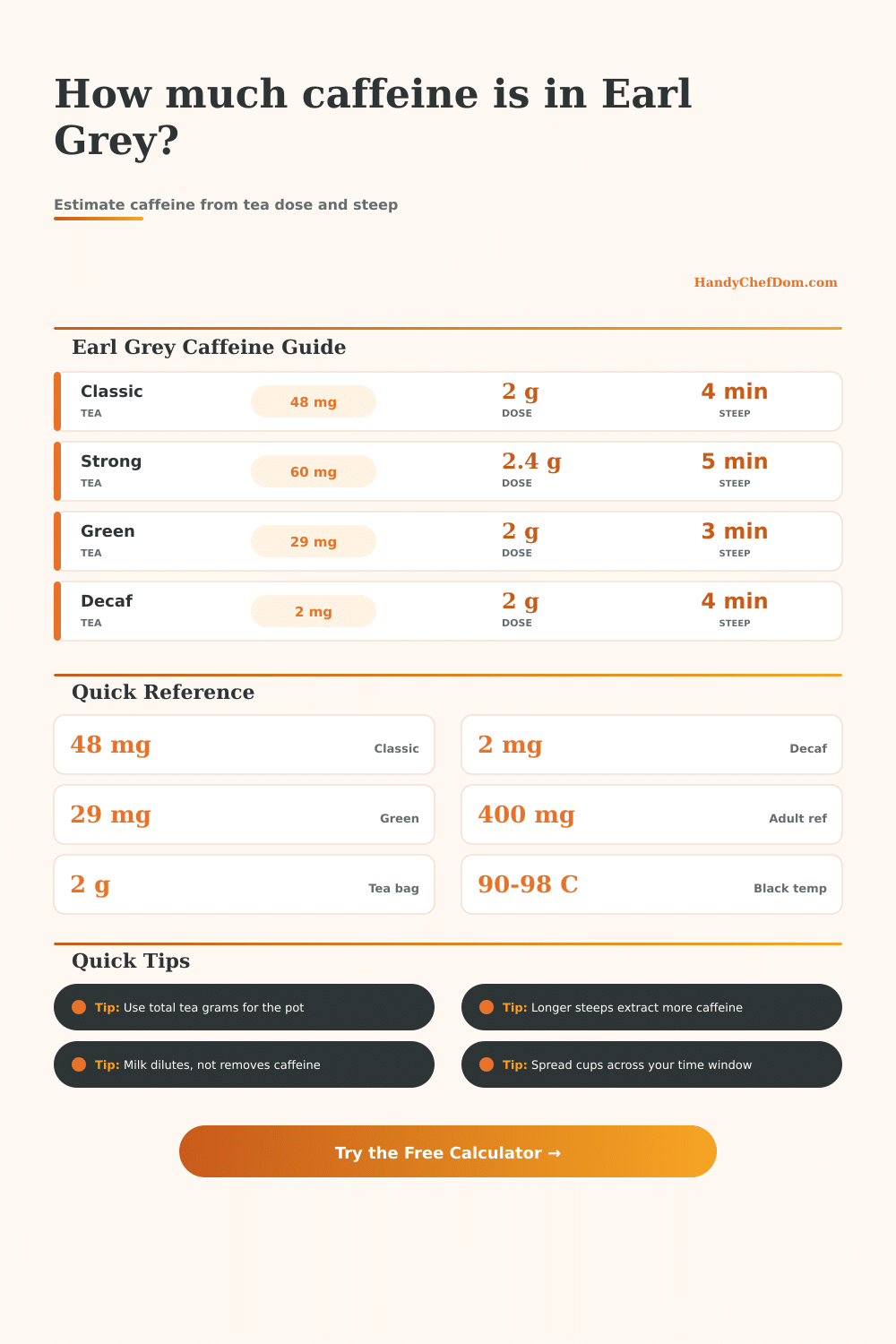
| Tea Base | Reference Cup | Typical Dose | Best Use |
|---|---|---|---|
| Classic Earl Grey Black | 48 mg per 8 fl oz | 2 g leaf or 1 bag | Standard hot cup |
| Strong Breakfast Earl Grey | 60 mg per 8 fl oz | 2.4 g leaf or strong bag | Higher-caffeine mug |
| Green Earl Grey | 29 mg per 8 fl oz | 2 g leaf | Lighter tea base |
| Decaf Earl Grey | 2 mg per 8 fl oz | 2 g leaf or 1 bag | Low-caffeine cup |
| Rooibos Earl Grey | 0 mg per 8 fl oz | 2.5 g herbal blend | Caffeine-free style |
| Variable | Lower Caffeine | Reference | Higher Caffeine |
|---|---|---|---|
| Leaf dose | 1.5 g per cup | 2 g per cup | 2.5-3 g per cup |
| Tea bags | 1 bag for 12 oz | 1 bag for 8 oz | 2 bags for 8 oz |
| Steep time | 2 minutes | 4 minutes | 5-6 minutes |
| Serving style | London Fog | Plain hot tea | Concentrate |
| Water Temp | Approx Factor | Tea Match | Caffeine Effect |
|---|---|---|---|
| 175°F / 80°C | 0.78x | Green Earl Grey | Gentler extraction |
| 185°F / 85°C | 0.88x | Light black tea | Moderate extraction |
| 195°F / 91°C | 0.96x | Black tea low end | Near reference |
| 205°F / 96°C | 1.00x | Classic Earl Grey | Reference extraction |
| 212°F / 100°C | 1.03x | Strong black tea | Slightly higher |
| Total Caffeine | 1 Hour | 3 Hours | 6 Hours |
|---|---|---|---|
| 48 mg | 48 mg/hr | 16 mg/hr | 8 mg/hr |
| 96 mg | 96 mg/hr | 32 mg/hr | 16 mg/hr |
| 192 mg | 192 mg/hr | 64 mg/hr | 32 mg/hr |
| 400 mg | 400 mg/hr | 133 mg/hr | 67 mg/hr |
| Serving | fl oz | mL | 8 oz Cups |
|---|---|---|---|
| Small teacup | 6 | 177 | 0.75 |
| Standard mug | 8 | 237 | 1.00 |
| Large mug | 12 | 355 | 1.50 |
| Travel tumbler | 16 | 473 | 2.00 |
The amount of caffeine in tea depend heavily on how you brew it, making it difficult to plan when and what to drink. For example: Do you want the taste of Earl Grey without the jitters? Or do you want a pick-me-up but don’t want to go over your daily allowance by lunchtime? While coffee is standardized, that’s not the case for tea, meaning that each cup contain a different amount of caffeine depending on the way it was brewed.
Many people believe caffeine is naturaly part of the tea leaf, but “The Tea Log” says that is a misunderstanding of how it is extracted. It doesn’t magically appear in your mug. You need to extract it and you do so through time and heat.” That’s where the calculator comes in (above). Input your unique set of brew variables, such as adding an extra minute of steep time if you wonder if that makes a difference. The calculator will then do the math for you, and yes most often it will.
How to Control Caffeine in Tea
From there, your starting point is the kind of tea used as the foundation. A classic black Earl Grey comes in at roughly forty-eight milligrams per an average eight-ounce cup, safe middle-ground territory. Because green Earl Grey are processed differently (and the leaves is structured differently), it clocks in with around twenty-nine milligrams. The decaf versions has nearly two milligrams. Which sounds like not much, but remember: That’ll still keep some sensitive drinker up for hours if they drink three pots before bedtime. For people who just wanna smell the citrus but don’t want any caffeine in their beverage: rooibos blends come in at zero milligrams.
But it’s not just about the leaf. It’s about how much of it (volume) and at what temperature (water). Water that’s hotter accelerate extraction. That’s why green teas often recommend lower brew temps to avoid releasing too many bitter-tasting compounds from the leaves. And keep this in mind if you’re brewing up a London Fog latte: Milk won’t strip out any of the caffeine that has been extracted into your tea base; it will simply dilute it.
The most common mistake home brewers make is with steep time. For the same number of leaves, soaking for only two-minutes will result in far less caffeine different than, say, soaking for six-minutes. You can use the calculator to fine tune it based off your desired steep time, and realize just how much that afternoon pick-me-up might be costing you in stimulants. A lot of folks leave bags to steep for a full ten minutes by default… Getting a stronger-than-desired (and usually more-bitter) cup as a result.
The numbers also get thrown way off by the serving size… Whether it’s in ounces or cups. For example, using two bags to make two, eight-ounce cups has less total caffeine than filling one sixteen-ounce travel mug with just one bag. The difference here is due to surface area, which affects extraction efficiency. It’s a detail that catches people who drink this stuff every day off guard; they expect the caffeine amount to scale directly with the volume. If you’re brewing up a full pitcher of iced tea or making enough for a crowd, the size of the entire batch will be the dominant factor when estimating how much caffeine you’ll end up consuming.
But beyond these useful features, the drinking window feature lends a certain practical realism that most guides don’t give. The half life of caffeine is about 5 hours, so if you have a cup at three in the afternoon it’ll still be doing something by eight at night. And tracking the milligrams you’re getting per hour will help you space them out throughout the day and prevent any late night insomnia. It gives you a timeline for your day of static data that can be used.
In conclusion, for delicate energies, accuracy trumps guessing. You do not need a lab; you just need to understand how various variables alter your cup. That’s where the tool comes into play. It presents those trade-offs in an organized way and removes the guesswork from enjoyment. This gives you a clear picture of a process that has been left to experience alone for far too long, it would of been better with help. From the first to last sip, your next cup will be exactly as you expect with this tool by your side.