🥚 Egg Boiling Time Calculator
Dial in soft, jammy, medium, or hard eggs by size, altitude, and starting temperature, then chill them for cleaner peeling.
Use the default values as a starting point, then fine-tune for pot size, altitude, and how easy you want the shells to peel.
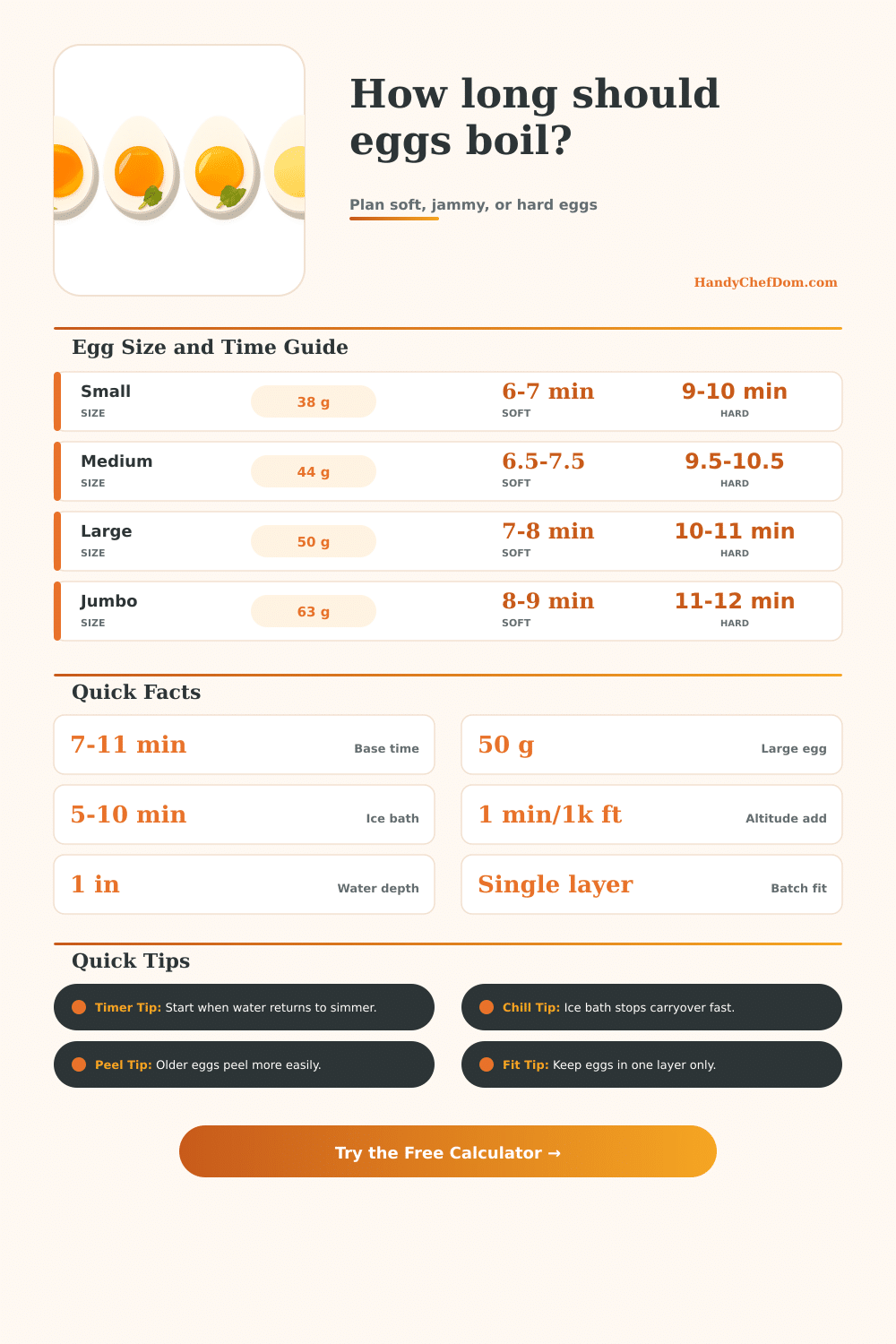
| Egg Size | Weight | Soft | Hard |
|---|---|---|---|
| Small | 38 g | 6-7 min | 9-10 min |
| Medium | 44 g | 6.5-7.5 | 9.5-10.5 |
| Large | 50 g | 7-8 min | 10-11 min |
| Extra-Large | 56 g | 7.5-8.5 | 10.5-11.5 |
| Jumbo | 63 g | 8-9 min | 11-12 min |
| Start | Method | Delta | Note |
|---|---|---|---|
| Fridge | Cold start | +0.5 | Most common |
| Room | Hot drop-in | 0.0 | Fastest path |
| Cool | Cold start | +0.25 | Mid-ground |
| Warm | Hot drop-in | -0.25 | Shorter simmer |
| Any | Steam | -0.75 | Clean finish |
| Elevation | Add | Texture | Note |
|---|---|---|---|
| 0-999 ft | 0.0 | Normal | Sea level |
| 1000-1999 | 0.25 | Stable | Small bump |
| 2000-2999 | 0.5 | Lean firm | Watch heat |
| 3000-3999 | 1.0 | Set slower | Common hike |
| 4000-5999 | 1.5 | Gentler | Mountain cook |
| 6000+ ft | 2.0 | Very gentle | High altitude |
| Egg Age | Ice Bath | Peel Score | Note |
|---|---|---|---|
| Fresh | 8-10 min | 2/5 | Needs longer chill |
| 1 Week | 6-8 min | 4/5 | Sweet spot |
| Older | 5-6 min | 5/5 | Easy peel |
| No Chill | 0 min | 1/5 | Carryover stays |
| Cold Rinse | 3-4 min | 3/5 | Light stop |
Boiling egg requires an understanding of the effects of heat on egg protein. Boiling eggs also requires an understanding of various environmental variable. Many people finds boiling eggs to be a difficult process due to the need to cook the eggs for a precise length of time.
If people cook eggs for too long, the yolks will develop a green ring and emit a sulfurous smell from teh eggs. If people do not cook the eggs for long enough, the yolks will remain too liquid for the desired use of those eggs. The texture that one desire the boiled eggs to have will determine the length of time that the eggs must be boiled.
How to Boil Eggs Correctly
Boiled eggs can be prepared in various ways such as soft boiled, jammy, medium boiled, or hard boiled. Soft boiled eggs has whites that are fully set and yolks that are still runny. Jammy eggs have yolks that is thick and custardy but not entirely liquid.
Medium boiled eggs have yolks that are a creamy and easily sliced. Hard boiled eggs have yolks that are fully set and firm. Depending on the texture that one desires, the cook will have to adjust the boiling time.
The starting temperature of the eggs will also impact the boiling time required to achieve the desired texture. If people take the eggs from the refrigerator, they are cold to the touch. Cold eggs require more time to cook than eggs that are at room temperature.
If the eggs are left out at the room temperature, they will cook faster than eggs that is directly out of the refrigerator. Additionally, placing the eggs directly into boiling water will cook the eggs more faster than placing the eggs into cold water and bringing the water to a simmer. The altitude at which one is cooking the eggs will also have an impact on the boiling process.
The higher the altitude, the lower the boiling point of the water. At higher altitudes, the eggs will take longer to cook than those that is boiling at sea level. In high altitude, the boiling time for eggs has to be increased to achieve the same results as those that are boiling at sea level.
The size and age of the eggs will also impact the boiling time. Large eggs will take longer to cook than small eggs due to the greater mass of the larger eggs. Additionally, the age of the eggs will also impact the boiling process.
Fresh eggs have a membrane that is more tightly adhere to the shells of the eggs making them more difficult to peel once cooked. In comparison, older eggs have a membrane that is loosely adhered to the shells of the eggs making them more easy to peel. To stop the boiling process of the eggs at the time required, you should use an ice bath.
An ice bath consists of water and ice. Using an ice bath will allow for the eggs to be cooled rapid. If eggs are boiled but not immediately placed in an ice bath, the residual heat within the eggs will continue to cook the eggs.
Using an ice bath will allow the eggs to reach the desired doneness and prevent overcooking of the eggs. One last factor that may impact the boiling process is the equipment that is used to boil the eggs. The material of the pot in which the eggs are boiled will impact the cooking process of the eggs.
Additionally, the size of the pot will impact the boiling process. The eggs should be arranged in a single layer within the pot to allow for even cooking. The water should cover the eggs by at least one inch.
Enough water must be used to ensure that the eggs boil in a consistent temperature. Finally, the timer should start only when the water begins to simmer because the heat of the simmering water will measure the length of time that the eggs are cooked.