Flavor Pairing Calculator
Match ingredients by body, acidity, sweetness, salt, umami, and aroma, then choose the bridge that makes the pairing feel complete.
The calculator compares flavor structure, then adjusts the result for method, cuisine, season, and your pairing goal.
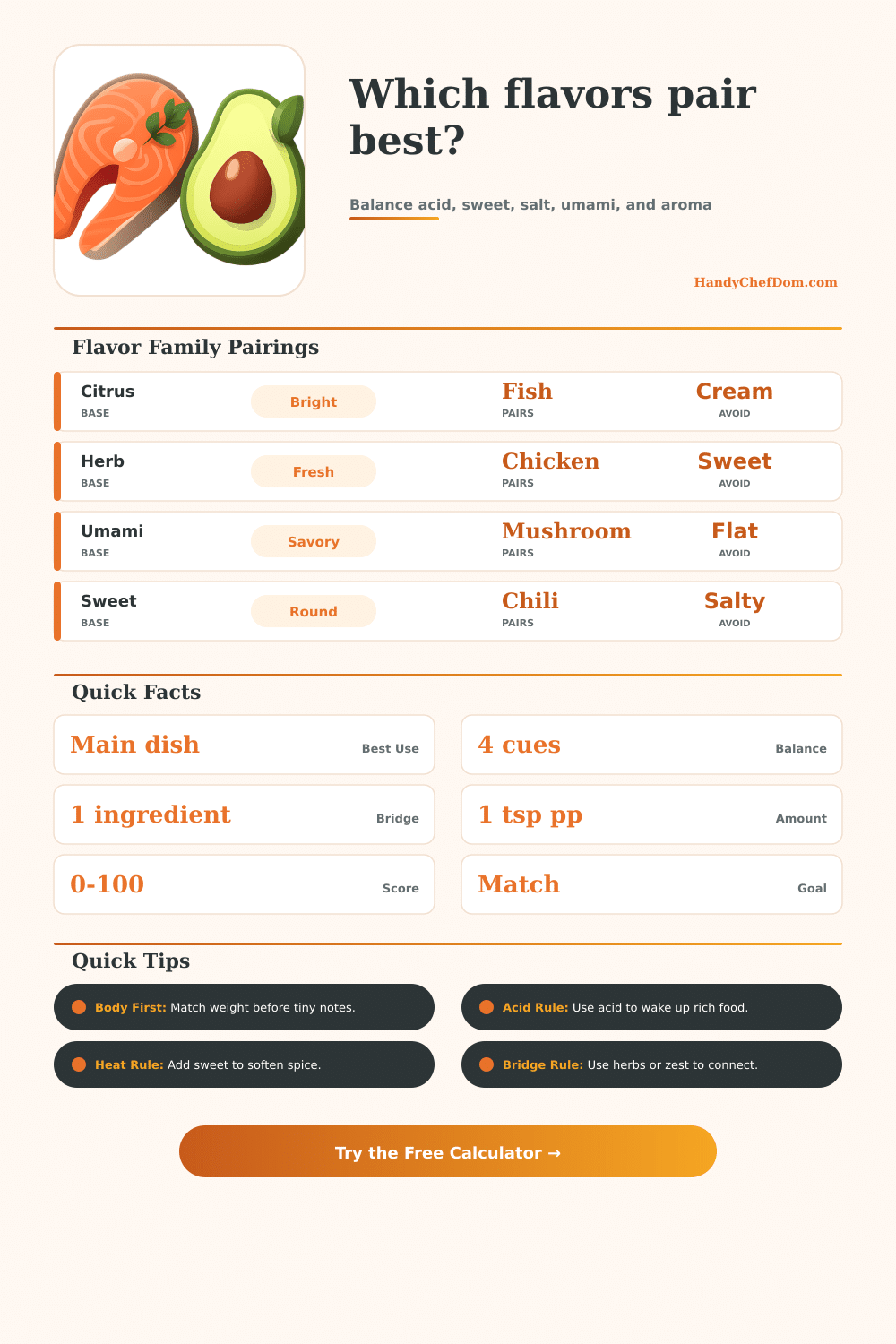
| Family | Signal | Best With | Avoid |
|---|---|---|---|
| Citrus | Bright | Fish | Cream |
| Herb | Fresh | Chicken | Sweet |
| Umami | Savory | Mushroom | Flat |
| Sweet | Round | Chili | Salty |
| Smoke | Deep | Beef | Light |
| Earth | Grounded | Root veg | Thin |
| Bridge | Best Use | Example | Effect |
|---|---|---|---|
| Zest | Bright | Lemon | Lifts fat |
| Herbs | Roast | Thyme | Freshens |
| Sweetness | Heat | Honey | Softens |
| Salt | Flat | Parm | Boosts |
| Acid | Rich | Balsamic | Clears |
| Fat | Sharp | Coconut | Rounds |
| Method | Best Cue | Pair Move | Finish |
|---|---|---|---|
| Raw | Fresh | Acid | Herbs |
| Roast | Caramel | Body | Smoke |
| Grill | Char | Umami | Citrus |
| Braise | Deep | Roundness | Herbs |
| Bake | Sweet | Balance | Spice |
| Smoke | Bold | Acid | Fresh |
| Fix | Add | Reduce | Use When |
|---|---|---|---|
| Too rich | Acid | Fat | Heavy sauce |
| Too sharp | Sweet | Acid | Thin flavor |
| Too flat | Salt | Water | Dull plate |
| Too hot | Dairy | Heat | Spice wins |
| Too smoky | Herb | Smoke | Grill heavy |
| Too sweet | Acid | Sugar | Dessert lift |
Flavor pairing is an art of selecting ingredient that enhance and work well with each other. Flavor pairing is the process of selecting ingredients that works well with each other, as compared to flavors that may work against each other and create a dish with strong contrast between ingredients. To create a well-flavored dish, the ingredients need to be balanced to each other.
Each ingredient contain certain signals that will impact the flavor of that ingredient when it is consumed. For instance, acid can provide lift to a dish, fat can add body to a dish, sweetness can round out sharp flavor, and salt and umami can add savoriness to a dish. If the weights of the ingredients isnt matched to each other, the dish will not be balanced to the palate.
How to Pair Flavors
For instance, a light herb will be lost in a pot with heavy beef, as the beef flavor will overwhelm the flavor of the herb. In this way, the cook should first match the weights of the ingredients before making a decision about the contrast or the harmony of the flavors in the dish. The cooking method for the ingredients will also impact the flavors of the ingredients.
For instance, roasting will extract the umami and body of the ingredient. Thus, roasting mushrooms will add to the savory flavor of the dish, making it work well with garlic. However, grilling mushrooms will create smoke flavor in the mushrooms, which may make it necessary to incorporate citrus into the mushrooms to balance the flavors.
Thus, the cooking methods of the ingredients will have an impact on the flavor of the ingredients, and any flavor pairing decision must consider the cooking methods of the ingredients. In creating flavor pairings in a recipe, there are several different flavor pairing goal. One goal may be to create contrast between ingredients, such as a bright acid flavor to a rich fat ingredient.
For instance, the acidity of lime juice can pair well with the briny flavor of shrimp. Another goal may be to bridge the gap between flavors that are distant from each other in flavor. For instance, thyme can connect the flavor of chicken with the roasted edges of the chicken.
Another flavor goal may be to echo some of the flavors in a dish. For instance, using basil will echo the umami flavor of a ripe tomato. Other flavor goals may be to provide lift to ingredients or to adjust the strength of flavors to accommodate the number of guest that will taste the dish.
The structure of flavors can be used to improve the instinct that some chef have for creating well-flavored dishes. For instance, ingredients with body, such as beef, should be paired with ingredients that do not drown in the savoriness of the beef; acid can be used to wake up the beef. Thus, the cook can use balsamic vinegar with pork to wash out the savoriness of the pork.
Additionally, sweetness can be used to neutralize the heat of ingredients; honey will neutralize the heat of chili pepper. Finally, ingredients with umami elements can be used to bridge flavors of different ingredients; using miso to pair with sweet potatoes will work due to the umami of the miso and earthiness of the sweet potatoes. Common flavor pairing trap include creamy ingredients that overpower the brightness of citrus ingredients, or ingredients that are too flat in flavor and require salt to enhance the flavors.
Bridges can be created with ingredients that connect flavors that are otherwise distant to each other. For instance, citrus zest can be used to add lift to fat ingredient, and herbs can be used to add freshness to roasted ingredients. For instance, if the flavor of the dish is too rich, acid can be added to the dish; if the flavors of the dish are too sharp, sweetness can be added to the dish.
If there is too much smoke flavor to the dish, herbs can be added to the dish. These flavor pairings are created due to the way that taste bud naturaly function in the human body; taste receptors for acid are naturally drawn to flavors that contrast fat flavors, and taste receptors for umami naturally amplify salt flavor. Common mistakes in flavor pairing include adding aroma to a dish before the body of the ingredients are paired to the aromas, and ignoring the cooking method that will be used for the ingredients.
For instance, braising fish will make the fish too soft if that fish is a light texture. Umami ingredients are good for savory dish, but sweet ingredients can act as buffers to spicy ingredients. Additionally, if cooking for a large group of people, use more bolder flavors to the dish so that each guest will taste the flavors of the dish.
There are several different tools that can be used to assist in flavor pairing. Flavor pairing comparisons can be made between ingredients to determine flavor score. One flavor pairing score can indicate the reliability of the flavor pairing, and the higher the score, the more seamless the flavors will be.
Additionally, a breakdown of the flavor pairing score can indicate the reasons that the flavors work well with each other. These flavor pairing tools can be used to test a chef’s hunches about flavor pairings. For instance, the flavor pairing tools can be used to test if pork and apple will work well with each other.
Although a chef’s nose may be able to determine some flavor pairings, it is better to always use the structure of flavor pairing as a chef’s first priority; flavor pairings should always be followed.