Freezer Cubic Feet Calculator
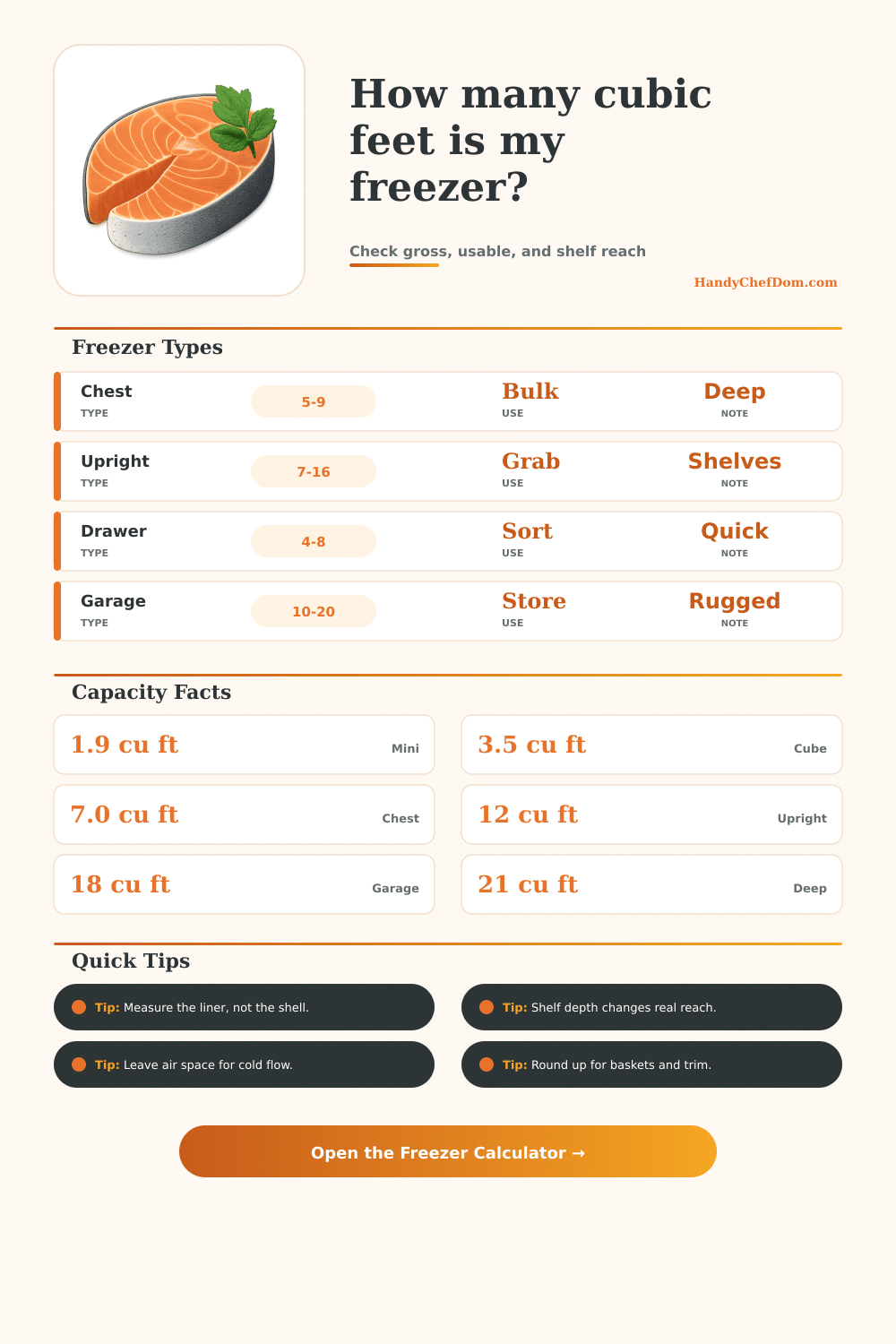
Compare gross cabinet volume, usable freezer space, and shelf reach before you size a chest, upright, or garage-ready unit.
Measure the inside liner, not the outer shell. The calculator trims real space by your usable factor, then compares shelf reach, basket stack, and reserve room.
Compact freezer, easy to tuck into small spaces.
| Type | Gross | Use | Note |
|---|---|---|---|
| Compact | 1.5-4.0 | Small | Short floor |
| Chest | 5.0-9.0 | Bulk | Deep stack |
| Upright | 7.0-16.0 | Grab | Shelves |
| Garage | 10.0-20.0 | Store | Tough shell |
| Depth | Reach | Best | Note |
|---|---|---|---|
| 12 in | Shallow | Snacks | Fast pull |
| 15 in | Lean | Meals | Easy sort |
| 18 in | Mid | Boxes | Solid fit |
| 21 in | Deep | Bulk | Wide lane |
| Zone | Share | Store | Note |
|---|---|---|---|
| Top | 20% | Small | Quick grab |
| Middle | 35% | Daily | Main stack |
| Lower | 30% | Bulk | Cold hold |
| Reserve | 15% | Ice | Headroom |
| Volume | L | Quart | Use |
|---|---|---|---|
| 2 cu ft | 57 | 8 qt | Mini |
| 5 cu ft | 142 | 20 qt | Small |
| 10 cu ft | 283 | 40 qt | Mid |
| 15 cu ft | 425 | 60 qt | Large |
Measure from the liner walls, then subtract trim, baskets, and any lip that steals space near the top edge.
Keep a little air above the top layer so the lid closes cleanly and cold air can move around the stack.
When you are choosing a freezer for your kitchen, it is essential to understands the differance between gross cubic feet and usable liner space in a freezer. The gross cubic feet are the total amount of space that the manufacturer will show you for the appliance. However, the usable liner space is the actual square footage within the appliance.
Many individuals will make the mistake of focusing on the total cubic feet that the freezer will offer. However, this does not accounts for the space that the shelves and freezer walls will take up. The best way to measure it would of being to measure the inside liner of the freezer to account for the thickness of the insulation.
How to Measure Freezer Space and Pick the Right Freezer
Chest freezer and upright freezers are the two primary types of freezers that is available in the market today. Each of these freezers come with different methods of helping you store your food. Chest freezers are typically a deep basin that will open from the top of the appliance.
These appliances are often used for items like whole chicken to store in one area. An upright freezer will have a door on the side of the appliance that will open like a refrigerator. These freezers will use the shelves within the fridge to store the items that you need to keep at eye level.
These appliances are beneficial if you are looking to quickly accessing the food that you need. However, because of the door and shelves on the side of the appliance, there will typically be less usable space within an upright freezer than in a chest freezer. To determine how much usable space will be in the appliance, you can calculate the gross cubic feet of the appliance by multiplying the width, the height, and the depth of the inside liner of the freezer.
You must ensure the depth is measured in inches. To find the cubic feet, divide the total number of cubic inches by 1728. You must also account for the usable factor of the appliance.
Many manufacturers will state that the usable factor are 80% of the total space by volume. This 80% figure is necessary because of the rounded corners of the appliance and the space required for air circulation. You can also use the total cubic feet to determine how much food can be stored within the appliance.
Air circulation within the freezer is essential to ensure that your food does not sit in warm spot within the appliance. If you pack your freezer too tight, you could potentially block the air circulation throughout the appliance. This will cause the refrigerator to have hot spots within the machine, as it will have to work to compensate for the lack of air circulation.
This could ultimately increase the amount of energy that you use to power the appliance to cool the food. You should make sure to leave eight percent of the space within your freezer for headroom for air circulation for even temperature distribution. Depending on the depth of the shelves within your upright freezer, you will have different option for the kind of food that you will store.
If the shelves are shallow, they will be better suited for storing small items. If the shelves are deeper than other, you will have to use baskets to store your food within those areas. Items that you use within the kitchen on a daily basis should be stored on the middle shelves in the refrigerator to make them easily accessible.
Items that you use less often can be stored on the bottom shelf or in the back of the fridge. Depending on the kind of environment in which you will place the freezer, you may require a specific kind of freezer. For instance, if you plan to place the freezer in a garage, it may have to be rated to stand up to extreme heat or cold.
If you live in a small apartment, an upright freezer may be better for you because it will take up less space then a chest freezer. If you would like the ability to organize your food within a file-cabinet fashion, you can always purchase a drawer freezer that will allow you to add food to the different layers of the appliance. Knowing how much food you would like to store in your freezer can also help you purchase the best appliance for your kitchen.
Five cubic feet of usable space in a freezer will allow for 40 quart of food. This number can be helpful when you know how many quarts of food that you have in your kitchen. This will allow you to purchase the best freezer that will allow your food to remain frozen properly and your freezer to work efficient for you in the kitchen.