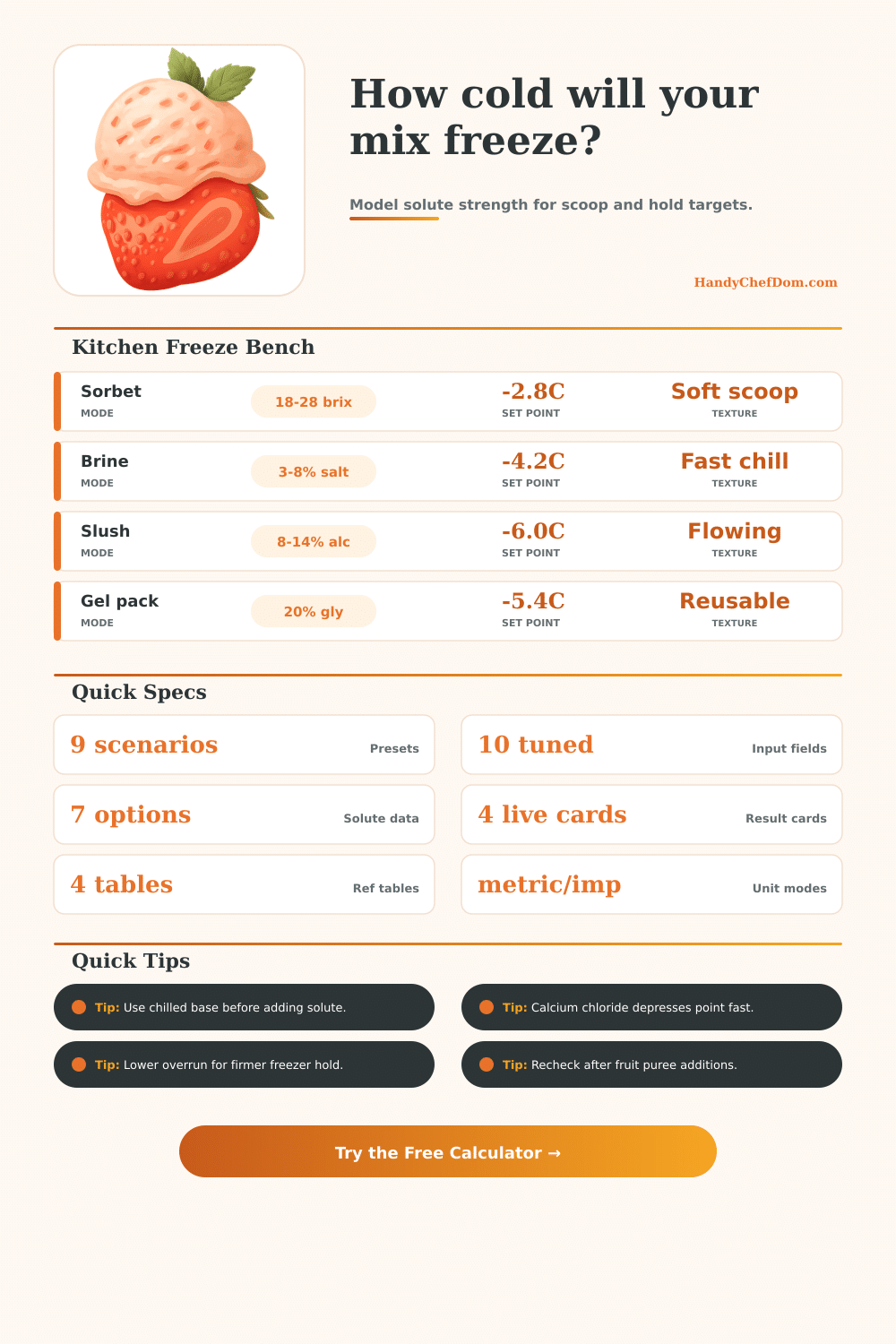
Freezing Point Depression Calculator for Kitchen Mixes
Predict first-freeze temperature, slush zone, and hold target from real solute chemistry. Switch units, compare scenarios, and print a stable production sheet for service or storage.
Model uses cryoscopic constant for water, solute dissociation factor, and activity multipliers. Scenario profile and process settings tune practical kitchen texture behavior.
| Solute | Molar mass | Van't Hoff i | Practical note |
|---|---|---|---|
| Sucrose | 342.30 g/mol | 1.0 | Sweet profile, moderate depression |
| Glucose syrup solids | 180.16 g/mol | 1.0 | Stronger depression per gram |
| Sodium chloride | 58.44 g/mol | 2.0 | Fast ionic depression in brines |
| Calcium chloride | 110.98 g/mol | 2.7 | High-performance chilling medium |
| Ethanol | 46.07 g/mol | 1.0 | Strong slush control in cocktails |
| Glycerol | 92.09 g/mol | 1.0 | Low-sweetness freezing control |
| Texture target | Start freeze C | Hold range C | Use case |
|---|---|---|---|
| Soft scoop | -1.5 to -3.0 | -8 to -11 | Gelato and plated desserts |
| Firm scoop | -3.0 to -4.5 | -12 to -16 | Packaged retail scoops |
| Granita crystals | -2.0 to -5.5 | -10 to -14 | Fork-scrape frozen drinks |
| Flow slush | -5.0 to -8.5 | -8 to -10 | Frozen beverage machines |
| Rapid brine | -4.0 to -9.0 | -6 to -10 | Seafood and service chilling |
| Batch size | Sorbet solids | Cocktail solids | Brine salts |
|---|---|---|---|
| 1 kg base | 180 to 260 g | 80 to 150 g | 40 to 90 g |
| 2 kg base | 360 to 520 g | 160 to 300 g | 80 to 180 g |
| 5 kg base | 900 to 1300 g | 400 to 750 g | 200 to 450 g |
| 10 kg base | 1800 to 2600 g | 800 to 1500 g | 400 to 900 g |
| Process shift | Depression shift | Texture trend | Operator cue |
|---|---|---|---|
| +10% overrun | +0.06x effective | Softer bite | Lower hold temp slightly |
| -10% overrun | -0.06x effective | Denser body | Raise hold temp slightly |
| +5% retention | +0.02x effective | Improved scoop | Watch sweetness balance |
| Dual solute blend | Broader response | Smoother set curve | Recalculate every reformulation |
Freezing point depression are a chemical process in which adding a solute to water will lower the temperature at which the water will freeze. If you add a solute to water, such as sugar, salt, or alcohol, the solute will lower the freezing point of the water. This is important in industries where food products need to remain soft and scoopable when frozen, such as the ice cream industry.
If you add too little of the solute to the water, the solution will freeze into a solid block of ice. However, if you use the correct amount of the solute, the product will remain soft. The effect that freezing point depression will have on water will depend upon the amount of solute that are added to the water, as well as the behavior of that solute when it is dissolved in the water.
How Salt, Sugar and Alcohol Lower the Freezing Point of Water
Some solutes have a more greater effect upon the freezing point of water than others. For instance, solutes like sodium chloride will split into two particles for every molecule of sodium chloride that dissolve in water. Calcium chloride, in contrast, will split into nearly three particles for every molecule of calcium chloride that dissolves in water.
As a result, calcium chloride will have a stronger effect upon the freezing point of water than sodium chloride, even if the weight of each of the chemicals are equal. Such effects can be calculated using a calculator for freezing point depression. One of the main reason for which it is important to understand freezing point depression is in relation to the texture of food products.
Many food products contain required textures that are created at specific freezing points. For instance, gelato will have a different freezing point than retail pint ice cream, which is required to remain frozen in a display case for extended period of time. A calculator that calculates freezing point depression can provide three critical measurement.
First, it can calculate the freezing point of the mixture. Second, it will calculate the slush window for the mixture. Third, it will calculate the hold target for the mixture, which is the freezing point that the product should be held to maintain its texture.
These three values can allow the cook to determine if the freezing point of the mixture should be adjusted according to the requirements of the food product in question. Freezing point depression can be used in a variety of different way in the kitchen, beyond the preparation of desserts. For instance, brines used in preparing poultry or seafood will use salt to lower the freezing point of the liquids so that they remains in liquid form at low temperatures.
Cocktail granitas contain ethanol, which depresses the freezing point of the water, allowing the ethanol to create a flowing crystal structure. Additionally, reusable gel pack may contain glycerol, which depresses the freezing point of the water without adding sweetness to the product. Each of these applications of freezing point depression rely upon the relationship between the solute and water.
An error that can be made is assuming that each solute will have the same effect upon the water when using a gram of that solute in each recipe. For instance, a gram of sucrose will not have the same effect as a gram of glucose. Each of these substances has a different molecular weight.
Calculators that attempt to calculate freezing point depression account for these difference in molecular weight. Additionally, overrun and solids retention can change the texture of frozen dessert. Overrun is used to describe the amount of air that is whipped into the mixture during the creation of the dessert.
The more air that is whipped into the mixture, the more that the concentration of the solutes will be diluted. Solids retention is a value that describes how much of the solid material is retain within the recipe. The higher the level of solids retention, the more concentrated the solutes will be within the solid.
Both of these variables have an impact upon the freezing point of a dessert, so they are represented within the calculator for freezing point depression. It may be necessary to recalculate the recipe in which you intend to use freezing point depression. For instance, if the recipe contains fruit purees, the amount of water and sugar in the fruit may change the freezing point calculation.
Additionally, if the batch contains meltwater from previous batches, the water will dilute the solute and raise its freezing point. In these cases, it is necessary to perform a recalculation after adding new ingredients to the batch. Additionally, the adjustment selector within the calculator account for variations in mechanical energy.
For instance, high-shear mixers will delay the formation of ice crystals due to the mechanical energy that is applied to the mixture. Dense mixtures that contain many particulates will have the same effect as a solute that has a higher concentration of solutes than the amount that is actualy add to the water. The nutrition of a product will change if solutes are added to a mixture.
For instance, if glycerol or ethanol are added to a product, the calorie and alcohol content of the product will change. Calculators of freezing point depression will provide a nutrition snapshot for the recipe. This snapshot will update itself according to the solute that is select for the recipe.
This information will be important to relay to the customer that is being serve the product. To use this calculator effectively, each variable should be changed one at a time. Each variable can be swapped for a different value, the overrun for the recipe can be changed, or the storage temperature can be changed.
By changing each of these variables one at a time, the chef or cook will be able to understand how each of these variables can impact the specific recipe that is being prepared. Freezing point depression is essential to understanding how to control the texture of the products that are prepared in the kitchen. By understanding how each type of solute can impact the water within the recipe, cooks will be able to prepare products of the texture that they require.