🍚 Glycemic Load Calculator
Estimate meal glycemic load, net carbs, and serving-level impact from the carb count, fiber, GI score, and prep style.
✨Preset Meals
The presets cover common breakfast, lunch, and dinner patterns so you can compare a quick guess against a realistic meal setup.
⚙Meal Inputs
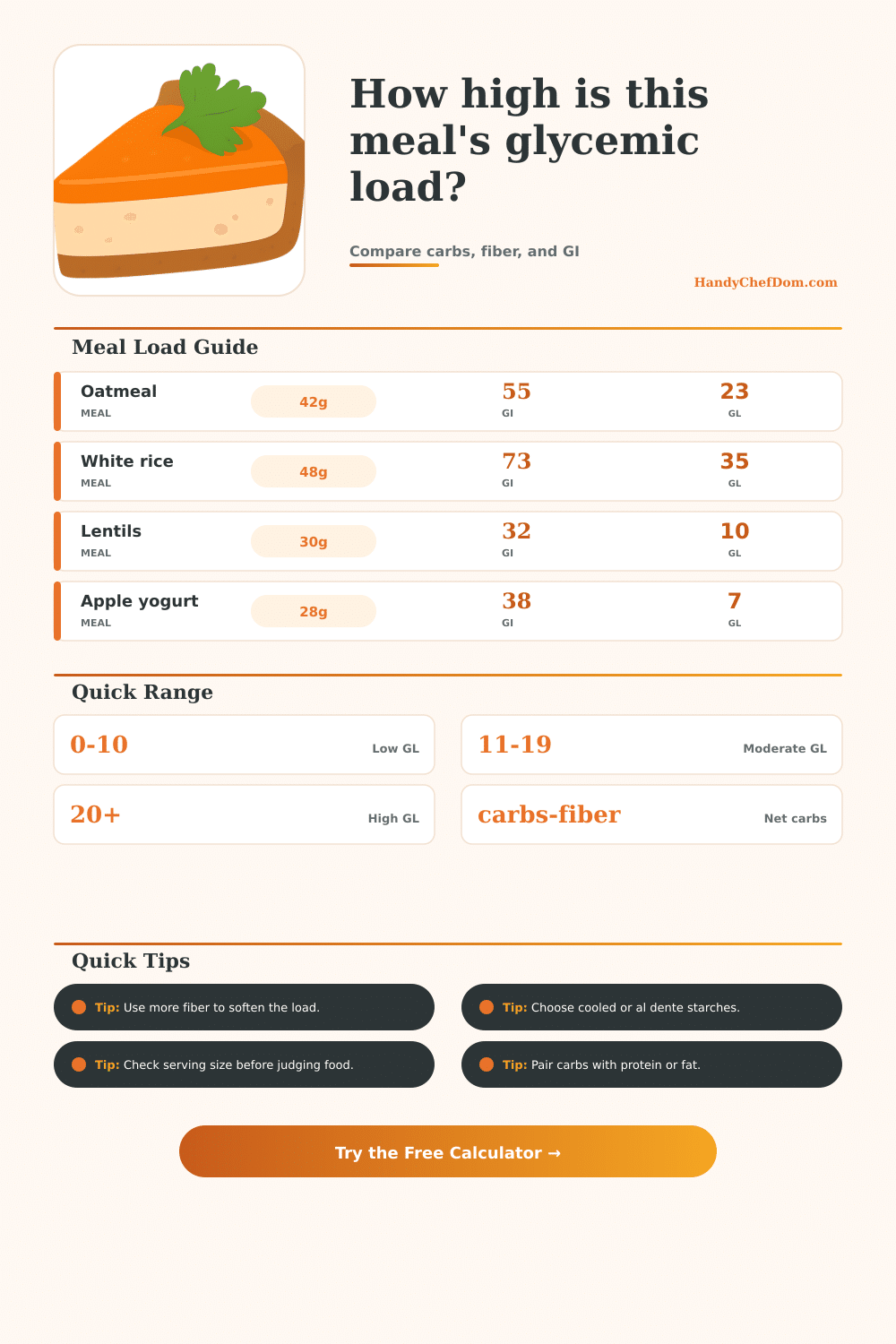
Meal glycemic load snapshot
Load a preset or enter your own meal to see how the carbs, fiber, and prep style change the estimate.
📑Reference Tables
| GL band | Load | Read | Meal note |
|---|---|---|---|
| Low | 0-10 | Steadier | Usually easier on blood sugar |
| Moderate | 11-19 | Middle ground | Watch the serving size |
| High | 20+ | Fast hit | Usually needs a buffer |
| Very high | 30+ | Heavy load | Best split into smaller portions |
| Food | Typical serving | Carbs | Approx GL |
|---|---|---|---|
| Steel-cut oats | 1 cup cooked | 27g | 15 |
| White rice | 1 cup cooked | 45g | 33 |
| Apple | 1 medium | 25g | 7 |
| Lentils | 1 cup cooked | 40g | 11 |
| White bread | 2 slices | 24g | 14 |
| Fiber booster | Serving | Fiber | Effect |
|---|---|---|---|
| Chia seeds | 1 tbsp | 5g | Helps blunt the spike |
| Beans | 1/2 cup | 7g | Raises satiety fast |
| Veg mix | 1 cup | 4g | Adds volume with little load |
| Nuts | 1 oz | 3g | Slows the meal down |
| Prep style | GI shift | Read | Best for |
|---|---|---|---|
| Al dente | -10 | Firmer texture | Pasta and noodles |
| Cooled | -8 | More resistant starch | Rice and potatoes |
| Mashed | +10 | Faster digestion | When texture is soft |
| Sweetened | +15 | Faster carb hit | Breakfast bowls and drinks |
📊Meal Pattern Grid
💡Tips
Glycemic load is a measurement of how much a specific food or meal will raise the blood sugar levels within the body. Many individuals experiences drops in there energy levels during the afternoon, which is the result of fluctuations in their blood sugar levels after consuming meals that are high in carbohydrate. Glycemic load is a more accurate measurement of the glycemic impact of food than counting the carbohydrates in the food.
To understand glycemic load, it is first important to understand the concept of glycemic index. The glycemic index ranks the various foods in relation to how quickly they raises the blood sugar levels in the body, with glucose being the standard food with a score of 100. Foods like white bread have high glycemic index scores, while foods like lentils has low glycemic index scores.
What Glycemic Load Is and How to Manage It
However, glycemic index does not take into account how much of a food is consumed, which is why people calculate glycemic load. You can calculate glycemic load by multiplying the glycemic index of a food by the amount of carbohydrates within a serving of that food, and then dividing the resulting number by 100. Thus, a large portion of a food with a low glycemic index can have a higher glycemic load than a food with a high glycemic index that is consumed in small portion.
The component of food that can have the biggest impact upon glycemic load is fiber. Fiber content within food can cause the food to take longer to digest, and thus leads to a slower release of sugar into the bloodstream. All foods contain some fiber, but increasing the fiber content of a meal can reduce the glycemic load of that meal.
The preparation methods for food can also impact its glycemic load. For instance, cooking pasta until it is firm to the bite, or al dente, will result in a lower glycemic index of the pasta compared to if the pasta had been cooked until it was soft. Cooling rice overnight allows the rice to contain resistant starch, which functions in the same way as fiber.
Mashing potatoes will decrease the glycemic index of the food, as it is easier for the body to digest the potatoes if they are mashed. Another critical factor in determining the glycemic load of food is portion size. Intuition would suggest that splitting one large portion of a food into two smaller portion would result in half the glycemic load of that food being consumed with each meal.
Food portions at restaurants are often larger than portions prepared at home, leading to higher glycemic loads from restaurant foods. Glycemic load scores range from 0 to 100. Glycemic load scores between 0 and 10 are considered steady with blood sugar levels.
Glycemic load scores between 11 and 19 are considered a middle ground for foods, but you should control portion sizes. Glycemic load scores of 20 or higher will cause the blood sugar levels to spike quick, thus those foods should be paired with fiber or protein to moderate the glycemic load of the food. Certain food combinations can be used to manage glycemic load throughout the day.
For instance, oats contain a moderate glycemic index, but adding berries and nuts to the oats will help to manage the glycemic load of the meal. Adding vegetables to a rice bowl will increase the fiber within the meal, which will lower the glycemic load of the rice. Lentil soup naturaly has a low glycemic load due to the high amount of fiber in lentils.
Additionally, eating foods high in carbohydrates with protein or fat, like eating eggs with toast, will slow the digestion of the meal and reduce the glycemic load of the food. Common mistakes when trying to manage glycemic load include avoiding foods with a low glycemic index. Many individuals who avoid foods with a low glycemic index will experience high glycemic loads with the foods they consume due to the portion sizes of those foods or the amount of sugar content within them.
For instance, a grain bar may have a low glycemic index, but if the portion size is very large or the bar contains a high amount of sugar, that food will have a high glycemic load. Additionally, high protein and fat content within meals can help to even out the glycemic load of meals. Though glycemic load scores focus upon carbohydrates, protein and fat content within meals can slow the absorption of sugar in the body.
Glycemic load scores can be read more easily with the use of reference bands. Foods with glycemic load scores between 0 and 10 are considered steady with blood sugar levels, and are thus friendly to blood sugar levels. Foods with glycemic load scores between 11 and 19 are a middle ground for glycemic load, and you should monitor the portion sizes of the foods.
Foods with glycemic load scores of 20 or higher will have an impact upon blood sugar levels, and should be paired with fiber or protein in meals. Foods with glycemic load scores of 30 or higher should be avoided, or eaten in smaller portions or replaced with another food altogether. For various reasons, individuals may exhibit different response to the same glycemic load scores for a food.
Factors like physical activity, sleep patterns, and stress levels can impact an individual’s glycemic load responses. For instance, an individual who is frequently running or performing other physical activity may be able to consume more food with a high glycemic load than an individual who is largely sedentary during the day. Individuals with conditions like prediabetes may have to be more careful in the foods that they consume with high glycemic loads.
Overall, glycemic load does not need to be eliminated from the diet entirely. Instead, you can modify foods with high glycemic loads in certain ways (such as the addition of fiber) to allow individuals to maintain steady levels of energy throughout the day. You should of focused on these small changes to see the most benefits.
Actually, most people dont realize how much impact portion size has on there results. Its a moddern problem with how alot of food is served today.