🥛 Grams to ML Cream Converter
Instantly convert grams ↔ millilitres for any cream type using accurate density values
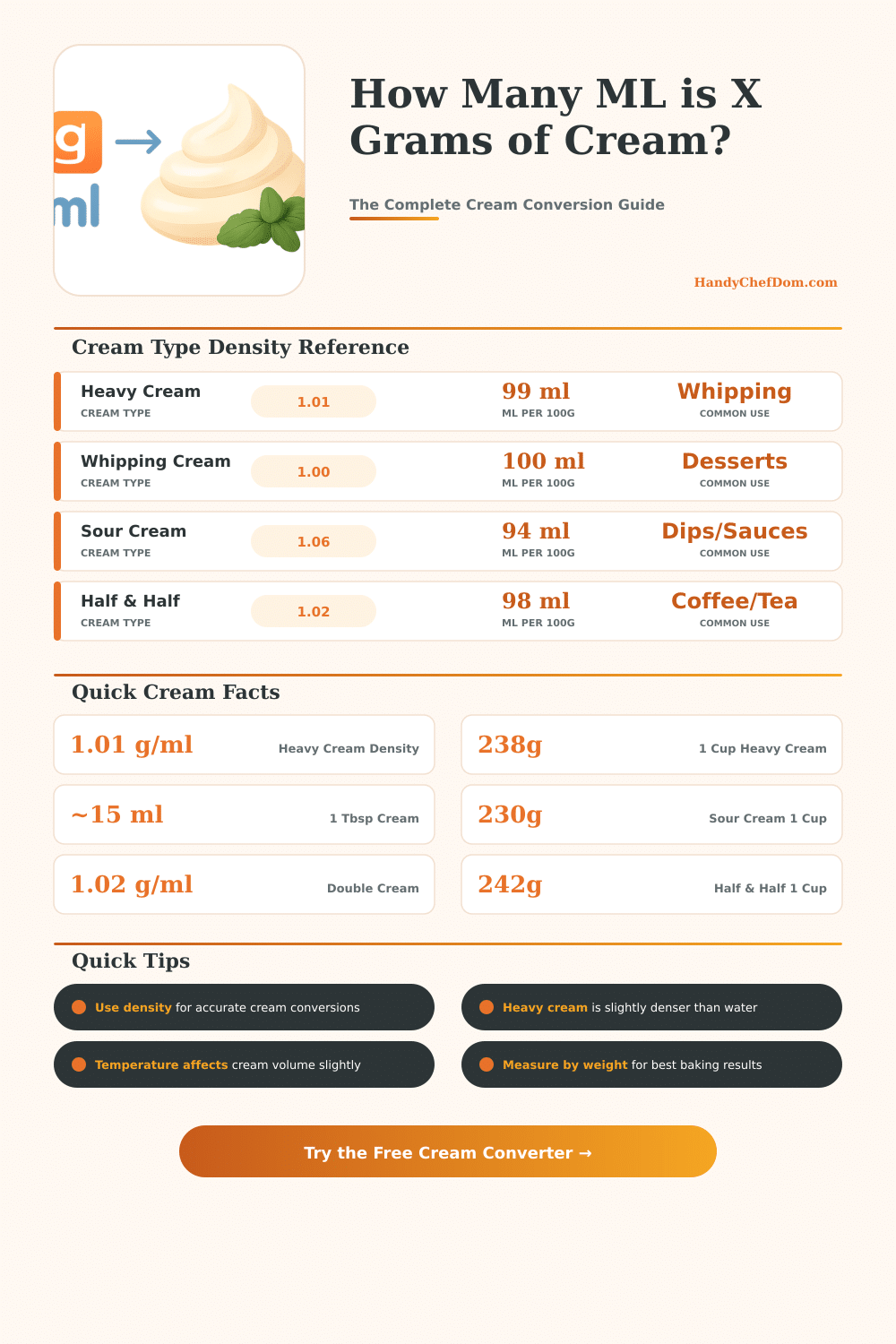
| Cream Type | Density (g/ml) | Fat % | 100g = ML | 100ml = Grams |
|---|---|---|---|---|
| Heavy Cream | 1.01 | 36–40% | 99.0 ml | 101 g |
| Whipping Cream | 1.00 | 30–36% | 100.0 ml | 100 g |
| Double Cream | 1.02 | 48%+ | 98.0 ml | 102 g |
| Sour Cream | 1.06 | 18–20% | 94.3 ml | 106 g |
| Half & Half | 1.02 | 10–18% | 98.0 ml | 102 g |
| Light Cream | 1.01 | 18–30% | 99.0 ml | 101 g |
| Coconut Cream | 0.93 | 20–25% | 107.5 ml | 93 g |
| Clotted Cream | 0.90 | 55–60% | 111.1 ml | 90 g |
| Measure | ML | Heavy Cream (g) | Sour Cream (g) |
|---|---|---|---|
| 1 Teaspoon (tsp) | 5 ml | 5.1 g | 5.3 g |
| 1 Tablespoon (tbsp) | 15 ml | 15.2 g | 15.9 g |
| 1 Fluid Ounce (fl oz) | 29.6 ml | 29.9 g | 31.4 g |
| 1/4 Cup | 59 ml | 59.6 g | 62.5 g |
| 1/2 Cup | 118 ml | 119.2 g | 125.1 g |
| 1 Cup (US) | 237 ml | 239.4 g | 251.2 g |
| 1 Pint (US) | 473 ml | 477.7 g | 501.4 g |
| 500 ml | 500 ml | 505 g | 530 g |
| UK Name | US Equivalent | Fat % | Density (g/ml) |
|---|---|---|---|
| Double Cream | Heavy Whipping Cream | 48%+ | 1.02 |
| Whipping Cream | Heavy Cream | 35% | 1.00 |
| Single Cream | Light Cream | 18% | 1.01 |
| Clotted Cream | No US Equivalent | 55–60% | 0.90 |
| Crème Fraîche | Sour Cream (approx) | 28–30% | 1.04 |
Cream is a fat product that you get from the thick parts of milk removed from the top before you mix it well The butterfat that is light rises and you remove it; that you call gravity cream. In factories you use spinning machines to separate the cream.
Cream separates from milk, so it mostly has fat, an important nutrient for energy that gives many calories. Although it has a bit of minerals from milk, the servings are so small that they do not have a big impact. A cup of heavy cream has 809 calories, 85.9 g of fat and 6.8 g of protein.
Cream: Types, Calories and Uses
Because of that you use small servings of heavy cream and best moderately. Only one spoon of it already has 51 calroies.
Various kinds of cream have different fat levels. Light cream has around 10, 15 % of fat and you sell it also as table cream. Half-and-half is an equal mix of milk and cream with 10, 12 % of fat.
Whipping cream has between 30 and 36 % of fat. Above 36 % until 42 % it is heavy cream or heavy whipping cream.
Cooking cream are stable whipping cream or heavy cream used in Europe, especially in Italy and Spain. It comes in little TetraPaks like juice boxes. Without sugar, you can use it for all dishes.
Culinary cream, as that of Minor’s, works well in stores and big kitchens. It helps sauces from cream stay longer and works well for egg dishes on buffet lines. It also keeps mashed potatoes fresh, with good texture and colour in warm boxes, and saves costs of heavy cream and butter.
Pasteurized heavy cream that was not overheated whips better and stays whipped longer than ultra-pasteurized. About freezing pastry cream you say no, but it can work if you freeze it in a silicone mold before it sets and later melt in the refrigerator.
Sour cream has its own nutritional character. A cup serving has around 258 mg of phosphorus, almost 26 % of the daily standard. A normal two-spoon serving has approximately 10. 20 mg of cholesterol.
Cream cheese existed first as a product. Smooth and soft versions make it easy to cook, for instance turkey in a cream sauce. If a recipe requires a cup of cream, you commonly choose heavy whipping cream.
Reducing normal cream until it thickens is another good method in the kitchen.