🧀 Heavy Cream for Mac and Cheese Calculator
Size the cream, milk, cheese coverage, and bake buffer for creamy mac and cheese without guessing the sauce balance.
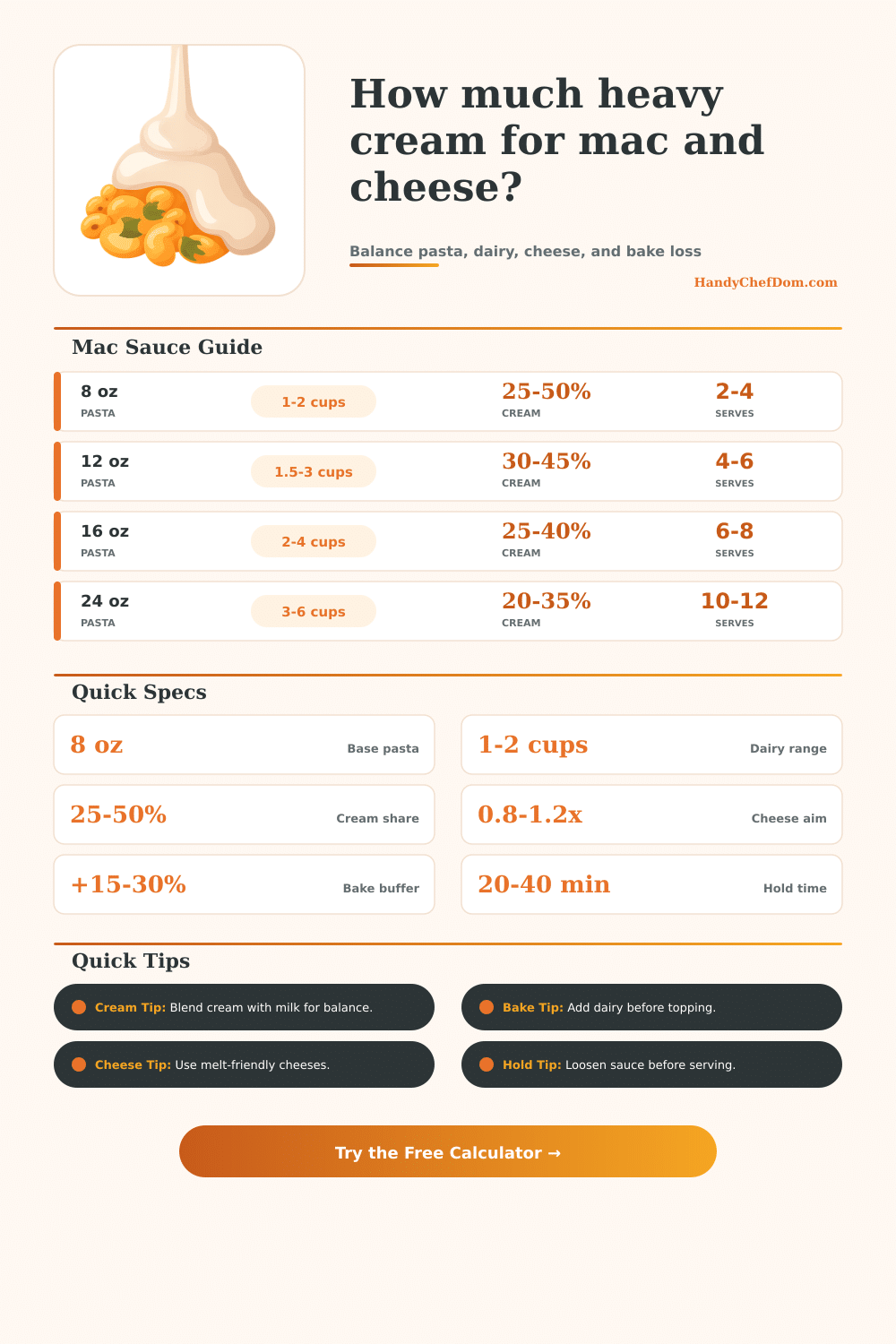
Mac sauce commonly lands around 1 to 2 cups total dairy per 8 oz dry pasta. Use heavy cream as part of that dairy when you want more richness, then add extra liquid for baking, toppings, and long holding.
| Dry Pasta | Typical Servings | Dairy Range | Cheese Range |
|---|---|---|---|
| 8 oz | 2 to 4 servings | 1 to 2 cups dairy | 6 to 10 oz cheese |
| 12 oz | 4 to 6 servings | 1.5 to 3 cups dairy | 9 to 15 oz cheese |
| 16 oz | 6 to 8 servings | 2 to 4 cups dairy | 12 to 20 oz cheese |
| 24 oz | 10 to 12 servings | 3 to 6 cups dairy | 18 to 30 oz cheese |
| 32 oz | 14 to 16 servings | 4 to 8 cups dairy | 24 to 40 oz cheese |
| Sauce Goal | Total Dairy Per 8 Oz | Heavy Cream Share | Best Use |
|---|---|---|---|
| Light but creamy | 1.25 to 1.45 cups | 15% to 25% | Weeknight stovetop mac |
| Classic creamy | 1.45 to 1.7 cups | 25% to 40% | Balanced family dinner |
| Rich and glossy | 1.7 to 2 cups | 35% to 55% | Shells, elbows, and cavatappi |
| Baked casserole | 1.6 to 2.2 cups | 20% to 40% | Pan mac with topping |
| Extra thick roux | 1.2 to 1.55 cups | 20% to 35% | Firm spoonable portions |
| Cheese Style | Coverage Target | Cream Pairing | Sauce Note |
|---|---|---|---|
| Sharp cheddar base | 0.8 to 1.1 oz per pasta oz | 25% to 40% cream | Bold flavor, needs enough milk to stay smooth |
| Cheddar plus Jack | 0.75 to 1 oz per pasta oz | 20% to 35% cream | Melts easily and keeps a softer pull |
| Gruyere blend | 0.65 to 0.9 oz per pasta oz | 25% to 45% cream | Rich flavor, use moderate cheese coverage |
| American blend | 0.55 to 0.8 oz per pasta oz | 15% to 30% cream | Very stable, useful for hold time |
| Parmesan accent | 0.1 to 0.25 oz per pasta oz | 30% to 45% cream | Use as part of the blend, not the full base |
| Thickness Choice | Target Dairy | Roux Effect | Adjustment Cue |
|---|---|---|---|
| Loose and glossy | About 1.9 cups per 8 oz | Use a lighter roux or no roux | Good when serving right away |
| Classic creamy | About 1.6 cups per 8 oz | Standard roux holds the sauce | Best default for mixed groups |
| Thick and clingy | About 1.35 cups per 8 oz | Roux can be slightly firmer | Add a splash if it sits too long |
| Sliceable baked | About 1.2 cups per 8 oz | Roux and cheese both set | Add bake buffer before topping |
Macaroni and cheese will be richer and creamier with cream than most home chef imagine. Milk keeps dish light and clean. The cream give it body, which sits heavily on tongue after each bite. It’s the cream that allow the sauce to cling to the macaroni’s every turn and nook and cranny.
Use too little and the dish are dry; use too much and it will be overly rich. The amount of cream you need depends off what else goes into macaroni and cheese, such as how much cheese and pasta you use or if you bake it in oven. You will need just enough or perhaps to much cream to get result you want.
How to Use the Macaroni and Cheese Calculator
After you plug in how much pasta you’re making, what type of cheese you’ll use, and what proportion of cream you prefer, the calculator (above) does the rest: What will be relative amounts of sauce? How rich is that ratio? It shows any extra dairy needed for baking absorption or long holds, and lets you adjust based on your cheese weight. All are important: They turn cooking choices into measurable goals, not just a hunch that this will be creamy enough.
If you aim for a moderate amount of cream on weeknights (as most folks do on the stovetop), for example, you know it’s probably best just to eat it immediately. But if you’re baking the casserole, you would of want to account for fact that pasta will continue soaking up sauce while whole thing bakes. The same goes for the bread crumbs you may intend to scatter over the top which will pull in some liquid. Plus, cooling cheese will also get firmer. A little safety margin before pan hits oven makes sure finished meal isn’t too tight or dry.
The cream percentage is where cheese choice interact in an easily overlooked way. With too little dairy, a sharp cheddar tighten the sauce; you want to go milder, because those cheeses melt easier and allow you to get away with less cream while maintaining a glossy shine. Use the calculator to dial in weight of cheese and you can play around with different varieties to see how much they cover up or down.
There’s also a lever in evaporated milk. Using some evap instead of regular milk add smoothness, and helps sauce resist breakage over time in a long hold situation. You’ll have a touch of sweetness, which pairs nicely in casseroles but can be at odds with a simple stovetop bowl of sauce. A taste-test with a small batch will tell you if this suit your palate before scaling up.
It’s most often because people think of cream as just an easy upcharge instead of one element in a ratio. A dash at the end won’t save a tightened-up sauce. Avoiding the issue before it dissapears means starting with enough total dairy and the appropriate amount of cream. This holds true when you scale up recipe for more diners. Just doubling the quantity of pasta doesn’t equal doubling the cream, especially if amount of cheese has changed or you plan to hold food for longer.
The trick is knowing how to read your finished sauce, pre-table. It should be glossy but still loose on the spoon. It is probably in balance. Yet sometimes it will stick to your spoon as thick ropes; or coat the spoon with a film. In those cases, some adjustments might be necessary when you use it again.
The beauty is that once you get used to how each parameter affects something in the real world, it stops being a black box. It starts to feel like a fast tool to double-check whether your gut feeling are heading down the correct path.