🍷 Homebrew Wine Alcohol Calculator
Calculate ABV from gravity readings — supports specific gravity & Brix. Imperial & metric.
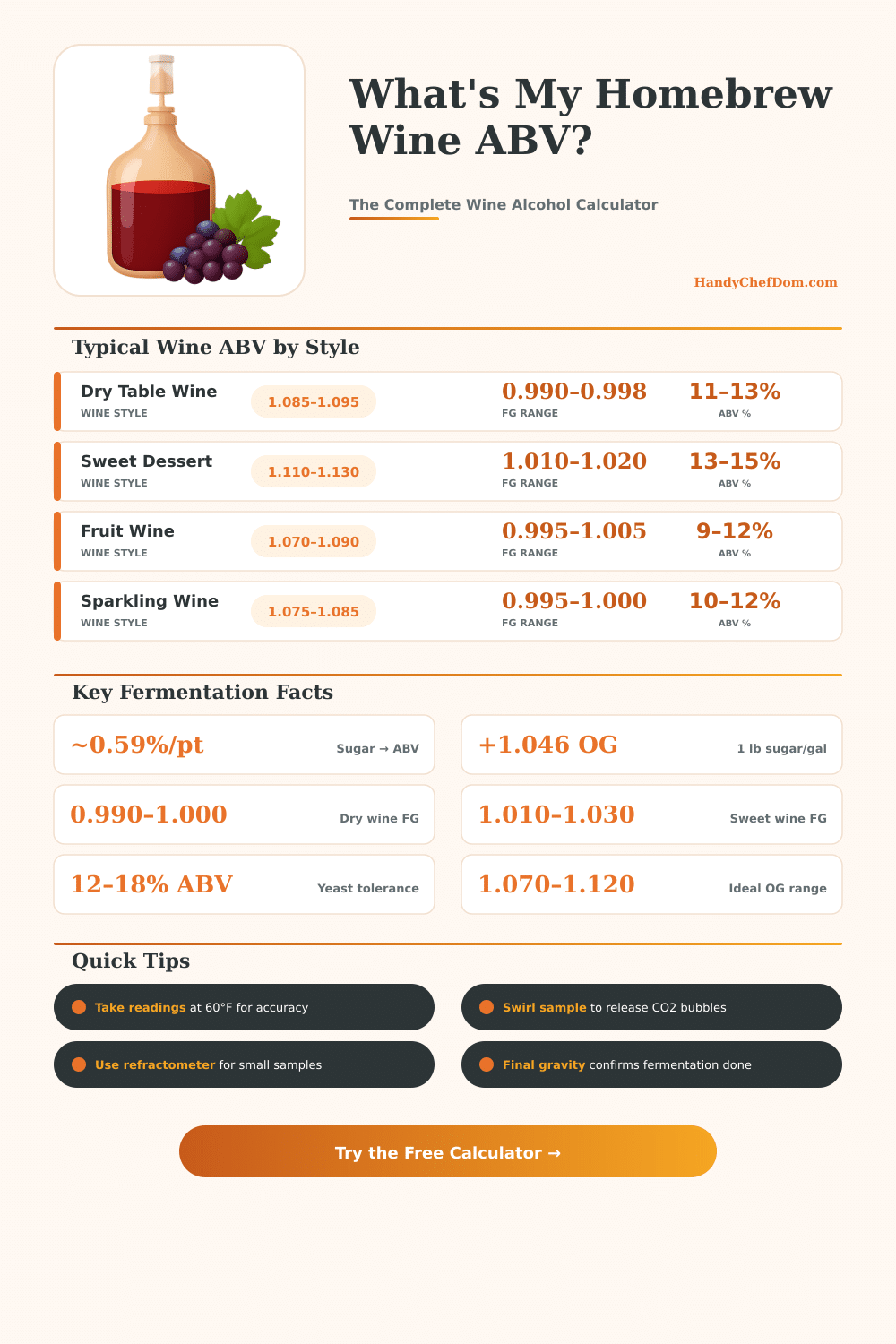
| Wine Style | Typical OG | Typical FG | ABV % | Sweetness |
|---|---|---|---|---|
| Dry Red Wine | 1.085–1.095 | 0.990–0.998 | 11–13% | Dry |
| Dry White Wine | 1.075–1.090 | 0.990–0.996 | 10–12.5% | Dry |
| Semi-Sweet White | 1.080–1.095 | 1.002–1.008 | 9.5–11.5% | Semi-sweet |
| Rosé Wine | 1.080–1.090 | 0.992–1.000 | 10.5–12% | Dry–Off-dry |
| Fruit Wine | 1.070–1.090 | 0.995–1.005 | 9–12% | Varies |
| Country Wine | 1.075–1.095 | 0.995–1.005 | 10–13% | Off-dry |
| Sparkling Wine | 1.075–1.085 | 0.995–1.000 | 10–12% | Dry |
| Dessert Wine | 1.110–1.130 | 1.010–1.025 | 13–15% | Sweet |
| Port Style | 1.100–1.130 | 1.020–1.040 | 17–20%* | Very Sweet |
| Light Mead | 1.060–1.090 | 0.995–1.005 | 8.5–11.5% | Dry–Semi |
| Specific Gravity | Brix (°Bx) | Sugar g/L | Sugar lb/gal | Potential ABV |
|---|---|---|---|---|
| 1.040 | 9.99 | 105 | 0.88 | 5.2% |
| 1.055 | 13.59 | 143 | 1.19 | 7.2% |
| 1.070 | 17.05 | 181 | 1.51 | 9.2% |
| 1.080 | 19.33 | 206 | 1.72 | 10.6% |
| 1.090 | 21.59 | 231 | 1.93 | 11.8% |
| 1.100 | 23.77 | 256 | 2.14 | 13.1% |
| 1.110 | 25.89 | 281 | 2.35 | 14.4% |
| 1.120 | 27.96 | 306 | 2.55 | 15.7% |
| 1.130 | 29.96 | 331 | 2.76 | 17.0% |
| Sample Temp (°F) | Sample Temp (°C) | Correction (Cal. 60°F) | Correction (Cal. 68°F) |
|---|---|---|---|
| 50°F | 10°C | –0.002 | –0.003 |
| 60°F | 15.6°C | 0.000 | –0.001 |
| 68°F | 20°C | +0.001 | 0.000 |
| 77°F | 25°C | +0.003 | +0.002 |
| 86°F | 30°C | +0.006 | +0.005 |
| 95°F | 35°C | +0.010 | +0.009 |
Do homebrew wine are one of those enjoyments that surprisingly matches to many others; it entertains, costs little for the purse and are much more cheap than sports like golf. During the harvest season, if you buy fresh grapes or juice, the whole process becomes almost free.
Here is something what commonly surprises folks: wine ferments, do not prepare like beer. Beers and ale? They prepare from cereal.
How to Make Wine at Home
Strong drinks distill. Here the details for those, that deeply engages by means of that. Even so, most folks always call it homebrewing of beer from custom, although it does not match.
Everything depends on the grapes self, so choose the best available genuinely matter. For produce around 3 until 5 gallons of finished wine, you require about 40 until 50 pounds of grapes. When fresh grapes are not available, many homebrew stores offer pre-pressed juice, that works well.
There is also a fatser mode, use concentrate to do it easily and cheaply. Simply pour the concentrate in a fermenter, add water, mix fermentation and follow the other directions, and you are ready.
So here are more basic access, using only sugar, freezing juice of focus and fermentation, with nothing more fancy than big gallon pot, latex balloon and rubber edge. As real fermenter, you require big bottle, gallon pot or big container, either way, something, what has at least 1.4 gallons, so that the wine and the bubbles have space too move.
What pleases about fresh ingredients, are that never two batches result the same. Maybe the sugar amount in the fruit a bit ranges, or the temperature during fermentation affects more then one expects. Always you end with something entirely different.
When the fermentation ends, the wine rests and matures to develop his taste and smell. Traditionally one uses oak barrels, but for home winemakers glass carboys and demijohns are more practical and budget friendly. Many start humbly by means of sets for 6 gallons or even only 1 gallon.
Tools for winemaking usually give six gallons, while those for domestic brewing commonly reach five gallons. Some kits mean to do wine from Cabernet Sauvignon in only four weeks, what is genuinely thrilling.
But here comes the truth: prepare wine, that matches to that from stores, are more hard than do beer or others fermented drinks home. For reach precious result, it can happen two years or even more. You likely will spend around 50 until 100 dollars for basic gear.
Fruit wines also are wonderful (from mango), lemon, persimmon, blackberry or raspberry. All of them are popular for domestic preparation. The simple version with only four ingredients from fruit occasionally call mountaineer-wine.
Taste during the process not only pleases, but also instructs, what genuinely happens in the fermentation. Standard bottle has 750 ml, but you find also 375 ml and 1.5 liter variants. For normal serving one pours around five units, while fortaste it are two until three units.