🧊 Ice Cube Tray Calculator
Plan tray cavities, cube volume, drink ice, melt buffer, freezer batches, chilling time, and cooler space for parties, picnics, and everyday drinks.
Enter the tray you actually own, how many drinks you want to serve, and how much freezer space you can dedicate per freeze cycle.
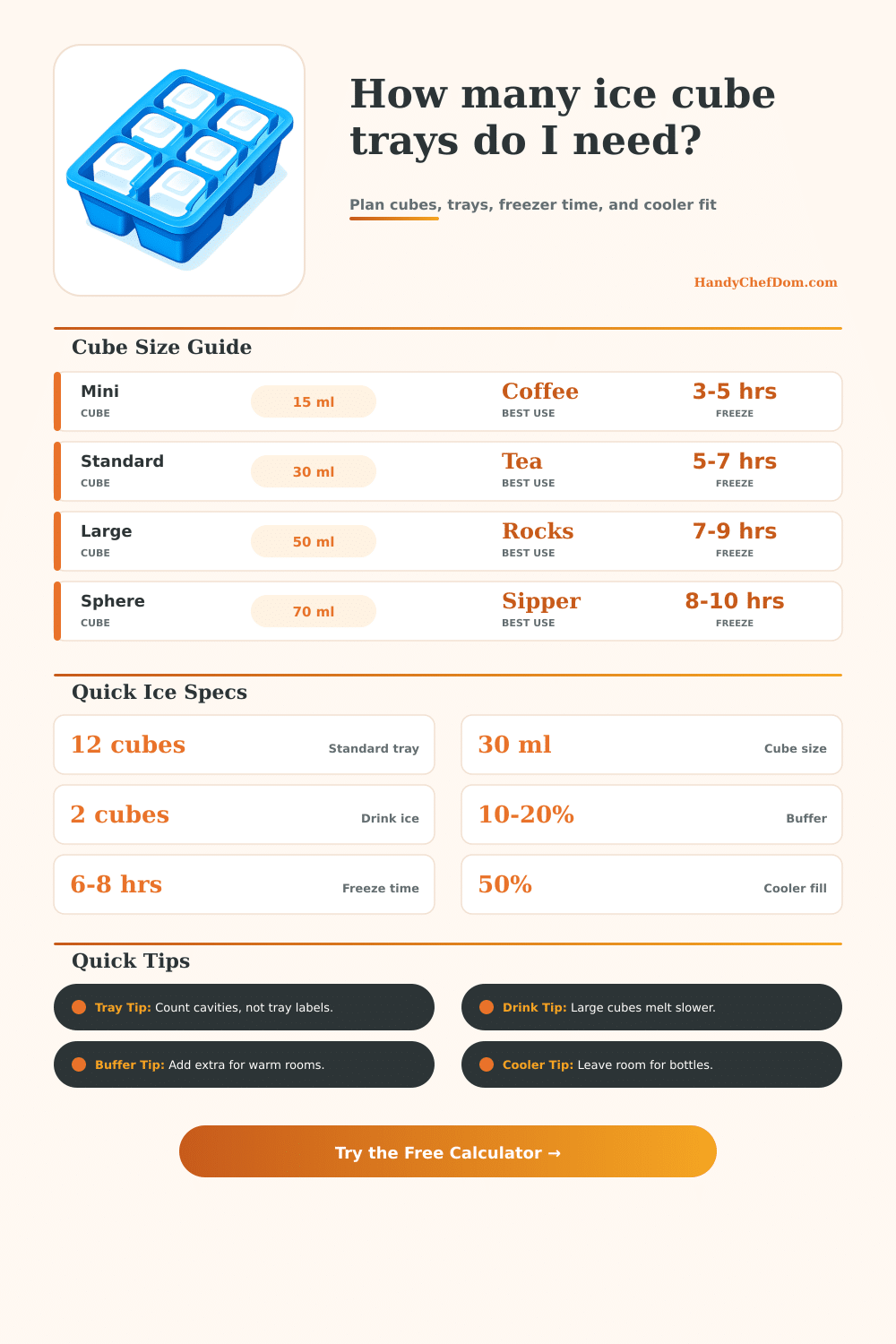
| Tray Type | Cavities | Cavity Size | Best Use | Typical Freeze |
|---|---|---|---|---|
| Mini coffee cube tray | 16 to 24 | 10 to 18 ml | Iced coffee and juice cubes | 3 to 5 hours |
| Standard plastic tray | 12 to 16 | 25 to 35 ml | Tea, lemonade, daily glasses | 5 to 7 hours |
| Stacking silicone tray | 12 to 14 | 30 to 40 ml | Family drinks and batch prep | 6 to 8 hours |
| Large rocks tray | 6 to 8 | 45 to 65 ml | Cocktails and slow sippers | 7 to 9 hours |
| Sphere mold | 4 to 6 | 60 to 90 ml | Low-dilution glasses | 8 to 10 hours |
| Cooler block mold | 2 to 4 | 120 to 250 ml | Cooler packs and punch bowls | 10 to 14 hours |
| Drink Style | Cubes Per Drink | Preferred Cube | Melt Buffer | Planning Note |
|---|---|---|---|---|
| Iced coffee | 2 to 3 mini cubes | 15 to 25 ml | 10% | Use smaller cubes when refills are quick. |
| Iced tea | 2 standard cubes | 25 to 35 ml | 15% | Good baseline for pitchers and tumblers. |
| Lemonade | 3 standard cubes | 25 to 35 ml | 20% | Outdoor cups usually need extra ice. |
| Rocks cocktail | 1 large cube | 45 to 70 ml | 10% | One large cube can replace several small cubes. |
| Highball | 4 narrow cubes | 20 to 30 ml | 15% | Tall glasses need more pieces for stacking. |
| Cooler cans | Bulk fill | Any size | 25% | Loose volume matters more than cube count. |
| Freezer Setup | Trays Per Batch | Likely Timing | Best For | Reminder |
|---|---|---|---|---|
| Small freezer shelf | 1 to 2 trays | 6 to 8 hours | Weeknight drinks | Freeze in flat, level stacks. |
| Apartment freezer bin | 2 to 3 trays | 7 to 9 hours | Brunch and pitchers | Leave airflow around tray edges. |
| Full freezer drawer | 4 to 6 trays | 8 to 10 hours | Parties and coolers | Rotate trays after the first batch. |
| Chest freezer zone | 6 to 10 trays | 8 to 12 hours | Event prep | Use labels for batch order. |
| Large block molds | 1 to 4 molds | 10 to 14 hours | Cooler blocks | Start a day earlier than cubes. |
| Cooler Space | Usable Ice Fill | Approx Loose Ice | Drink Scenario | Fit Note |
|---|---|---|---|---|
| 5 L lunch cooler | 40% | 2 L | Small picnic cups | Best for one tray plus packs. |
| 12 L picnic cooler | 45% | 5.4 L | Family drinks | Fits several standard trays. |
| 25 L party cooler | 50% | 12.5 L | Cans and mixers | Plan extra for warm patios. |
| 45 L event cooler | 55% | 24.8 L | Large gatherings | Mix cubes with block ice. |
| Punch bowl insert | 30% | Varies | Serving table | Large cubes melt more slowly. |
An ice cube tray calculator is a tool that will help you to plan for how much ice you need for the gathering that you are having. Many people does not plan for ice, but then find that they do not have enough ice for the drinks after the guests has begun to arrive. An ice cube tray calculator will help you to consider your available ice tray and how much ice they will hold, the size of those trays, how long it will take for the ice to freeze in the trays, how long the ice will last, and how many batch of ice you can make in your available freezer space.
The calculator will ask for the number of ice cube cavities in each tray. Each cavity will hold one cube of ice. The number of cavities are not the same as the number of ice cubes that may be printed on the ice tray box.
Plan How Much Ice You Need for Your Event
The size of the cavity will impact the number of ice cubes that will melt in the drink. Large ice cubes will melt slow and will not dilute the drink too quickly. Small ice cubes will melt quickly, which will dilute the drink.
The calculator will ask for the size of the ice cubes that you would like to produce. The calculator will also ask for how long it takes for one batch of ice trays to freeze. Standard ice tray may require six or seven hours to fully freeze.
However, large molds may require twelve hour to fully freeze. If you have limited space in your freezer for the trays to sit, you may need to make several batches of ice. The longer that it takes for the trays to freeze, the more lead time you will have to ensure that there is enough ice to last your event.
Another feature of the calculator will be the melt buffer percentage. This number can change based off where the drinks will be served. For example, if you serve the drinks outside on a hot sunny patio, they will melt at a faster rate than if they were serve in an air-conditioned building.
The melt buffer percentage will help account for these differing temperature. Additionally, the calculator will ask for how many ice tray that you own, and how many ice trays can fit in one cycle in your freezer. You may not be able to fit all of your ice trays into the freezer at the same time.
Another feature of the calculator will help you to determine whether you will use narrow ice cubes, which will only fit into tall glasses, or large ice cubes, which will melt slower and cause less dilution of the drink. However, large ice cubes will take longer to freeze than narrow ice. This feature will calculate how many trays and how much lead time will be required for each type of ice cubes.
People often do not realize that they need to purchase enough ice to fill their cooler until they have already made the ice. The loose ice cubes will take up more volume in the cooler than if the ice were in the form of a solid block. To account for this, the calculator will ask for the number of ice cubes that will be needed to fill the cooler.
This will ensure that you dont have to worry about the ice from taking up too much space in the cooler in comparison to the volume that the drinks will take up. There are also reference tables within the calculator that will display information about the type of ice trays that you own, and the type of drinks that you may be producing. These tables can help you determine if you already own the type of ice molds that you need for the event, or if you will need to purchase new molds.
Additionally, some type of drinks will require a different number of ice cubes than others. For instance, a rocks cocktail may require a different number of ice cubes than a pitcher of lemonade. Some of the most common mistake with ice cube trays are people only purchasing one batch of ice.
It is likely that one batch will not be enough to provide ice for all guests at your event. You should also account for guests who would like to refill their drinks. Additionally, people may drink extra ice cubes beyond the number that they are provided with their drinks.
The calculator considers these factor so that you can determine how many batches you will need to make in order to account for all guests. Not all ice cubes are created equal. Small ice cubes are often used to chill coffee.
However, large ice blocks are used to keep the temperature of the cans of soft drinks cold. Large ice blocks hold the temperature much longer, but they take more time to freeze. The calculator will ask for the specific use case for the ice that will be produced to help determine the best way to produce the ice.
The calculator will also ask for the length of the event. For short event, fewer ice cubes will melt than for long event. The number of hours that the ice will be served will impact the lead time for the ice production.
For example, if your event will last for ten hours, you may require more ice than if the event was for only five hours. The calculator will ask for the start and end times of the event. This will allow it to calculate the total number of batches of ice that will need to be produced.
The goal of this calculator is to ensure that you have enough ice for the guests at the event that you are having, without using too much of your freezer space.