Imperial to Metric Cooking Conversion Calculator
Convert cups, grams, ounces, and milliliters with ingredient-aware kitchen conversions that stay accurate for baking, sauces, and meal prep.
Pick the ingredient, set the scale and buffer, then convert between the imperial and metric systems in one pass.
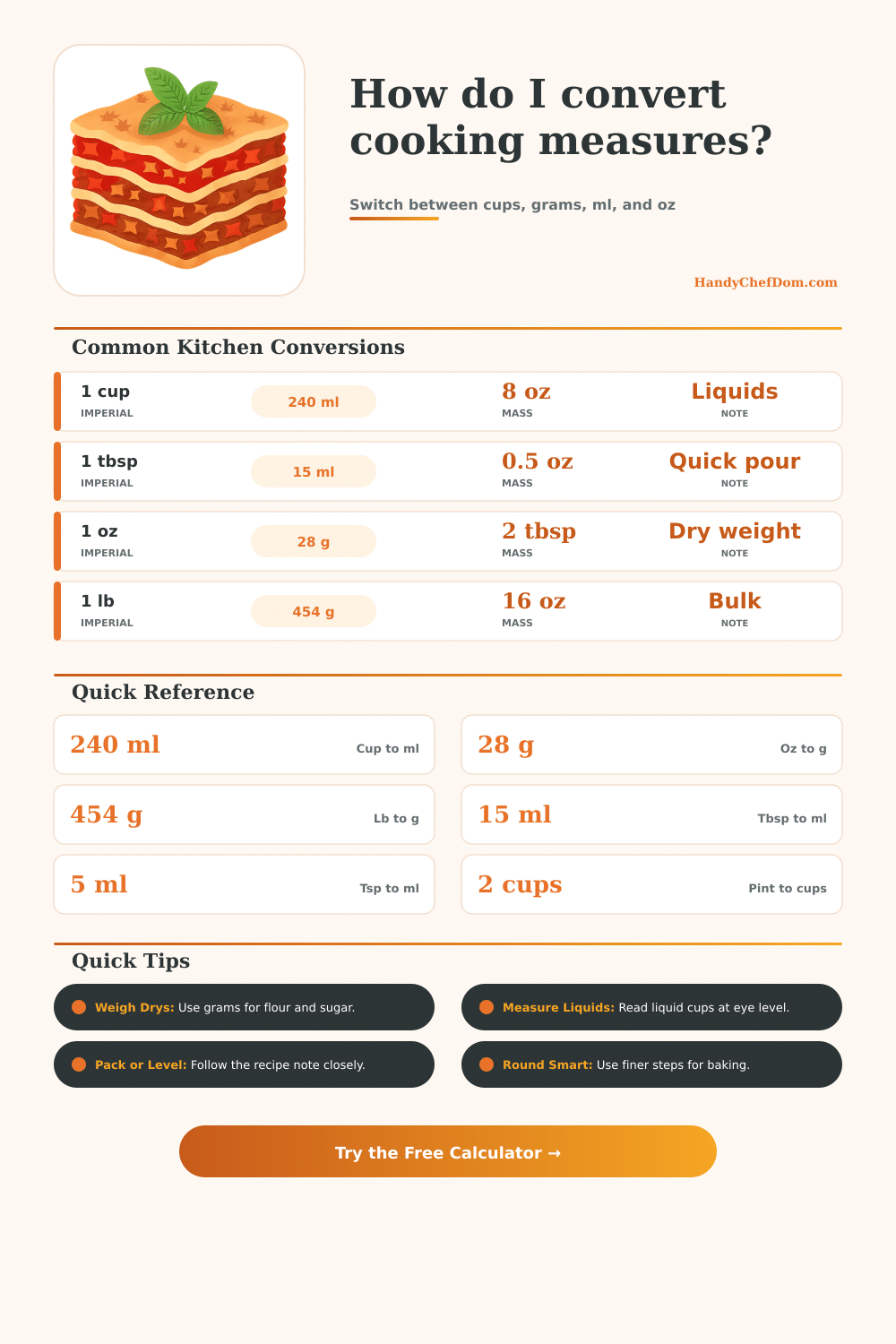
| Imperial | Metric | Mass | Note |
|---|---|---|---|
| 1 tsp | 5 ml | 0.18 oz | Small spoon |
| 1 tbsp | 15 ml | 0.5 oz | Quick measure |
| 1 cup | 240 ml | 8 oz | Kitchen standard |
| 1 pint | 473 ml | 16 oz | Two cups |
| 1 quart | 946 ml | 32 oz | Four cups |
| 1 gallon | 3.8 L | 128 oz | Large batch |
| Weight | Grams | Ounces | Kitchen use |
|---|---|---|---|
| 1 oz | 28 g | 1 oz | Small weight |
| 1 lb | 454 g | 16 oz | Pantry pack |
| 100 g | 100 g | 3.5 oz | Recipe unit |
| 250 g | 250 g | 8.8 oz | Test batch |
| 500 g | 500 g | 17.6 oz | Half kilo |
| 1 kg | 1000 g | 35.3 oz | Bulk prep |
| Ingredient | g/cup | State | Note |
|---|---|---|---|
| Flour | 120 | Sifted | Light and airy |
| Sugar | 200 | Standard | Granulated base |
| Brown sugar | 220 | Packed | Moist and dense |
| Butter | 227 | Standard | Two sticks/cup |
| Rice | 185 | Leveled | Uncooked grain |
| Honey | 340 | Standard | Dense liquid |
| Conversion | Metric | Imperial | When to use |
|---|---|---|---|
| 1 cup flour | 120 g | 4.2 oz | Baking |
| 1 cup sugar | 200 g | 7.1 oz | Sweetening |
| 1 cup butter | 227 g | 8 oz | Pastry |
| 1 cup rice | 185 g | 6.5 oz | Dry grain |
| 1 cup honey | 340 g | 12 oz | Dense syrup |
| 1 cup milk | 245 g | 8.6 oz | Liquid base |
Converting between imperial and metric measurement involves an understanding of the difference between volume and mass. The volume of an ingredient is the amount of space that the ingredient will occupy in an ingredient list or recipes. The mass of an ingredient is the weight of that ingredient.
Many people uses cups to measure the volume of ingredients, but many use grams to measure the mass of an ingredient. Because volume does not correspond to the weight of an ingredient, the weight of an ingredient will change based off how the ingredient is measure. For instance, packing flour into a cup will result in a heavier cup of flour than if you spooned the flour into the cup.
Why weight is better than cups
If the flour is packed too tight into the cup, however, the mass of that ingredient will be too great for the recipe to handle, and the recipe will fail. The concept of density is the reason for the inconsistencies in volume measurement. Density is the relationship between the mass of an object and the volume that it take up.
Because different ingredients has different densities, they will have different weights when measured by volume. For instance, because water has a consistent density, one cup of water will always weigh approximately 237 grams. Honey, however, has a more higher density than water.
Therefore, one cup of honey will weigh approximately 340 grams. Because honey is denser than water, one cup of honey will weigh more than a cup of water. These differences in density between ingredients must be accounted for when converting between volume and mass measurements.
If these difference are not accounted for, the mass of the ingredients will not be accurate. Because baking involves a high level of precision, it is best to use mass measurements rather than volume measurements. The ratio of ingredients to each other will determine the texture of the baked good.
Using too much flour will create a tough baked good, while using too little will cause the baked good to collapse. The mass of flour, for instance, can range from 110 gram to 140 grams per cup, depending upon how tightly the flour is pack into the cup. Therefore, measuring flour with a cup can lead to inaccuracies in the mass of the ingredient.
Using a scale to measure the mass of ingredients, however, is the most accuracy method. It is also important to distinguish between dry ingredients and liquid ingredients. Dry ingredients, like flour, lose their density if they are compressed.
Therefore, it is difficult to accurately measure dry ingredients with volume measurements. Liquid ingredients, like water, do not change their density. Therefore, they are easier to measure with volume measurements.
The exception to this rule, however, is liquids with different densities from water. For instance, olive oil and sesame oil has different densities from one another. Therefore, the mass of one cup of either oil will not be the same.
When scaling a recipe up or down in size, each ingredient in the recipe should be measured according to the same conversion factors. If a recipe is to be doubled, the cook should double the mass of each ingredient, as well. If the masses of the ingredients are not doubled correctly, the ratio of the ingredients will change, and the outcome of the recipe will not be as expected.
A recipe conversion tool can be used to scale recipes. These recipe conversion tools accounts for the density of the ingredients, and calculate the correct mass of each ingredient to be used in the recipe. Because baking is a process that requires precision in the measurements of ingredients, it is best to use mass measurements rather than volume measurements.
If the cook measures the mass of the ingredients with a scale that measure in grams, for instance, the actual substance of the food will be measured. Measuring the substance of the food will prevent error in the recipe. Using a scale will allow for precision in the recipe, and being precise in the measurement of ingredients will allow for accuracy in the steps to follow the recipe.
Therefore, mass measurements should be used for all dry ingredients and for all liquid ingredients that are to be measured for accuracy.