Volume of Jar Calculator
Estimate jar capacity, usable fill, headspace, and batch counts from shape-based measurements
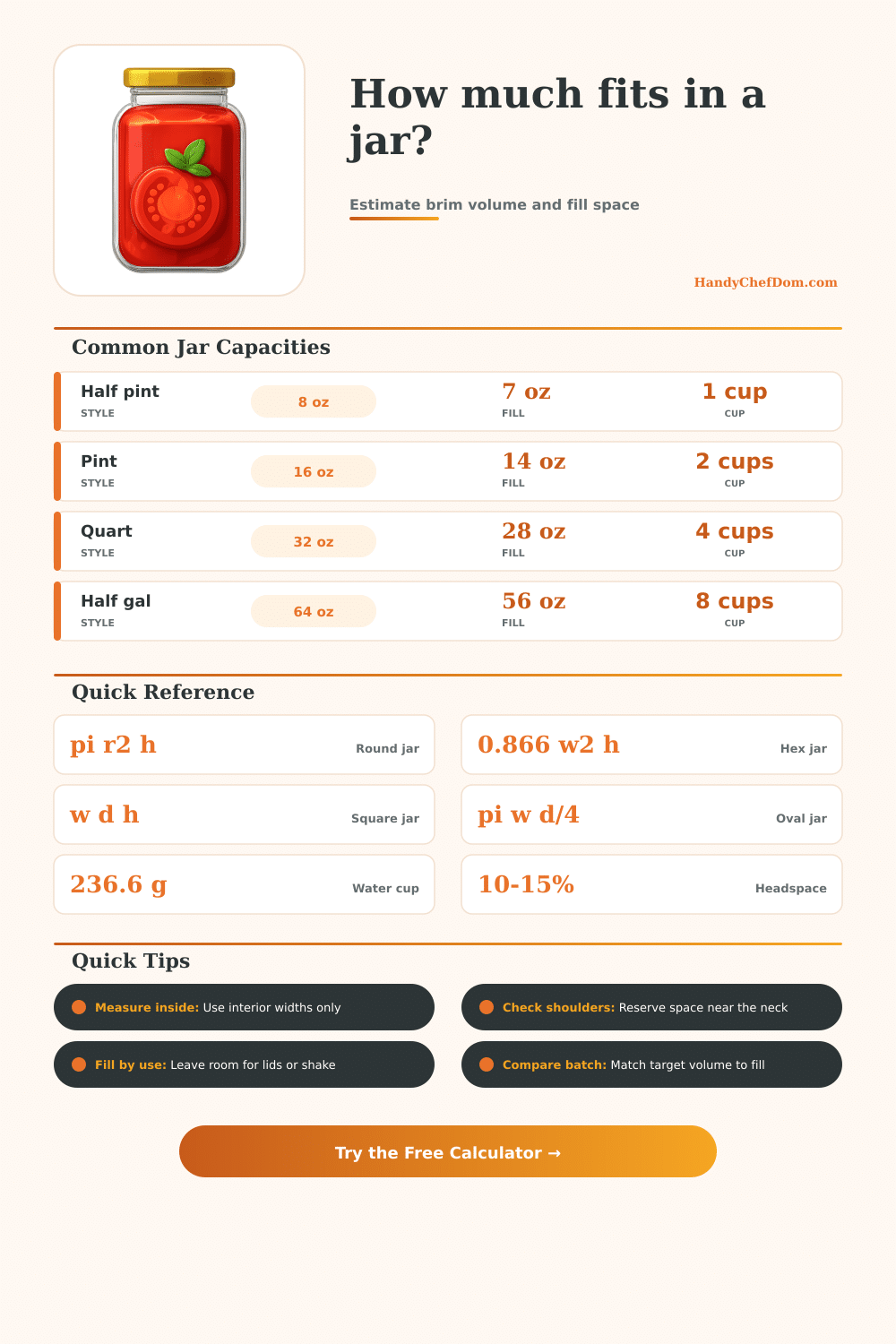
| Style | Brim | Fill | Cups |
|---|---|---|---|
| Half pint | 8 oz | 7 oz | 1 cup |
| Pint | 16 oz | 14 oz | 2 cups |
| Quart | 32 oz | 28 oz | 4 cups |
| Half gal | 64 oz | 56 oz | 8 cups |
| Shape | Area | Input | Note |
|---|---|---|---|
| Round | pi r2 | Dia x H | Classic jars |
| Hex | 0.866 w2 | Flat x H | Honey style |
| Square | w d | W x D x H | Pantry bins |
| Oval | pi w d / 4 | W x D x H | Apothecary |
| Fill | Headspace | Use | Note |
|---|---|---|---|
| 70% | 30% | Shaky jars | Most room left |
| 80% | 20% | Dry goods | Easy lid margin |
| 90% | 10% | Preset fill | Balanced space |
| 95% | 5% | Display only | Tight top margin |
| Item | Per Cup | Per Pint | Use |
|---|---|---|---|
| Water | 236.6 g | 473 g | Baseline |
| Honey | 340 g | 680 g | Dense fill |
| Jam | 320 g | 640 g | Thick spread |
| Rice | 185 g | 370 g | Dry storage |
When you are preparing foods for storage, you must first understand the volume of a jar that you will be using to store the prepared food. The volume of the jar will determine the amount of food that can be placed into that jar. While many people may assume that the total capacity of the jar is the amount of food that can be placed into that jar, the total capacity and the amount of food that can be placed into the jar isnt always the same.
For example, most jar have a shoulder and a neck that narrows towards the top of the jar. In this case, you must measure the interior dimensions of the jar to determine how much food can fit into the jar, since the thickness of the glass will reduce the interior volume of the jar. If you dont account for the dimensions and the shape of the jars the volume of the food to be stored in the jars, then it is possible that the batch of food will be too large for the number of jars that have been prepared.
How to Measure Jar Volume and Headspace
The shape of the jar is one of the main factor in determining the volume of the jar. For example, round jars have a cylindrical shape, so you will use the radius of the jar to calculate the volume. Additionally, jars that are in the shape of hexagons take up 86% of the area of a square, so you can use the area of a square to calculate the volume of food that can fit into the jars.
For jars that have straight sides, you can calculate the volume of food by multiply the width, depth, and the height of the jar. Finally, oval jars have a different calculation that can be used to calculate the volume of the jars, since the jars are not in the shape of a circle. Thus, the shape of the jar is a determining factor in calculating the volume of the food that can be stored in those jars.
Jars also must have headspace for the food to expand while it is being stored. Thus, headspace is the space within the jar that remains between the food and the lid of the jar. Head space is required so that the food does not overflow out of the jar while it is being stored.
For most cooking processes, a ninety percent fill level for the jars is recommended, so that there is ten percent headspace within the jar. However, for dry goods, seventy percent headspace may be used. Thus, the cook should determine the fill level for the jars prior to the food is prepare, so that the cook can calculate in advance how many jars will be needed for the food preparation.
The taper of the jar may also affect the amount of food that can be stored within the jar. For example, if the jars have a significant taper, there will be less usable volume for the food within the jar than if there is straight sides on the jar. Thus, the cook can calculate the volume of these tapered portion of the jars with frustum math.
Additionally, the opening of the jars may affect the food that is stored within the jars, as well. For example, if the jars have thin openings, foods that are thick may clog the opening of the jar. Thus, jars that are to be used to store thick foods, such as jam, should have wide openings to allow that jam to enter the jar.
Density also relates to the discussion of food storage within the jars. For example, if the food has a high density, it will weigh more than food that has a low density. Foods like honey have a high density, and therefore weigh more than water.
Foods like rice have a low density, and therefore weigh less than honey. Thus, if you are shipping or placing the food upon a shelf with a weight limit, the density of the food should be considered. Furthermore, if the volume of the food within the jars is known, as well as the density of the food, it is possible to calculate the total weight of that food within the jars.
Mistakes can be made in the kitchen, and some of those mistakes may be due to the ignoring of the geometry of the jars. For example, if the measurements of the food are taken outside of the jars, the volume of the jars may be overestimated. If the volume of the jars is overestimated, then there may not be enough jars to contain the batch of food.
Furthermore, if you calculate the volume of the food without accounting for headspace, the food may overflow out of the jars. Thus, to avoid these types of mistakes, the usable volume of each jar should be calculated, the amount of headspace that is required for that type of food should be accounted for, and the total volume of food to be stored should be accounted for in relation to the total usable volume of the jars. You should of accounted for the jars size before starting.
It is actualy alot of work to fix errors later. The jars volume is important.