🥘 Kimchi Calculator
Scale salt, seasoning paste, jar fill, and batch yield for baechu, baek, or radish kimchi.
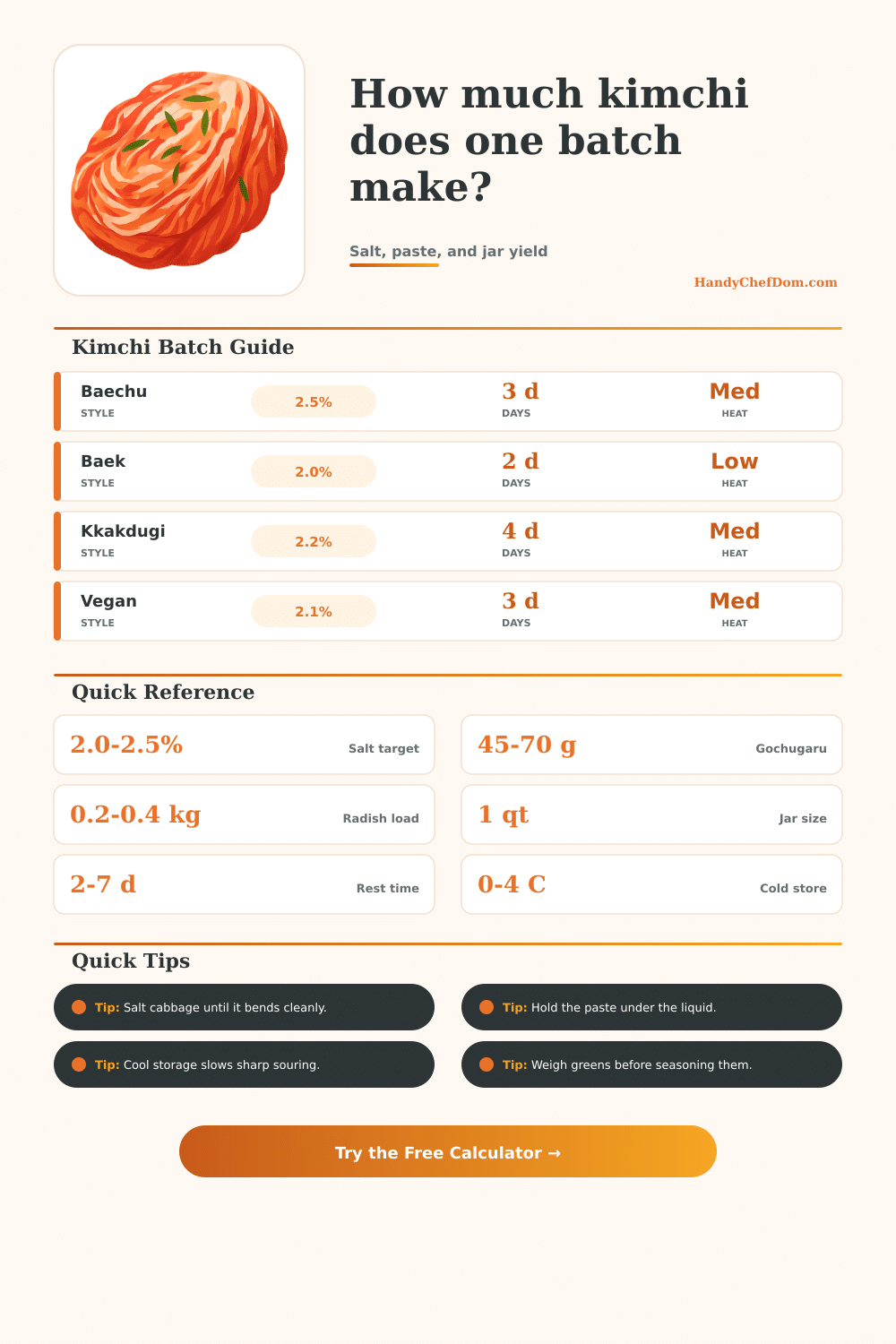
| Style | Salt | Heat | Days | Texture |
|---|---|---|---|---|
| Baechu | 2.5% | Med | 3 | Crunchy |
| Baek | 2.0% | Low | 2 | Clean |
| Kkakdugi | 2.2% | Med | 4 | Firm |
| Vegan | 2.1% | Med | 3 | Bright |
| Cabbage | Weight | Leaves | Yield |
|---|---|---|---|
| Small | 1.5 kg | 10-12 | 1 jar |
| Medium | 2.0 kg | 14-16 | 1-2 jar |
| Large | 2.5 kg | 18-20 | 2 jar |
| Extra large | 3.0 kg | 22+ | 2-3 jar |
| Light pack | 1.2 kg | 8-10 | 1 jar |
| Deep pack | 3.5 kg | 24+ | 3 jar |
| Market bunch | 2.8 kg | 20+ | 2 jar |
| Style | Gochugaru | Fish sauce | Garlic |
|---|---|---|---|
| Baechu | 60 g/kg | 45 g/kg | 30 g/kg |
| Baek | 0 g/kg | 20 g/kg | 20 g/kg |
| Kkakdugi | 50 g/kg | 35 g/kg | 28 g/kg |
| Vegan | 55 g/kg | 0 g/kg | 30 g/kg |
| Radish | 48 g/kg | 30 g/kg | 26 g/kg |
| Low-salt | 45 g/kg | 18 g/kg | 24 g/kg |
| Mixed | 58 g/kg | 42 g/kg | 29 g/kg |
| Salt | Water | Rest | Note |
|---|---|---|---|
| 2.0% | 600 ml/kg | 1.5 h | mild |
| 2.5% | 700 ml/kg | 2 h | classic |
| 3.0% | 750 ml/kg | 3 h | firm |
| 3.5% | 800 ml/kg | 4 h | strong |
| 2.2% | 650 ml/kg | 2 h | crisp |
| 2.8% | 725 ml/kg | 2.5 h | balanced |
| 1.8% | 550 ml/kg | 1 h | soft |
| Temp | Days | Flavor | State |
|---|---|---|---|
| 20 C | 1-2 | Fresh | mild |
| 18 C | 2-3 | Bright | active |
| 10 C | 4-7 | Sour | steady |
| 4 C | 7+ | Deep | cold |
| 22 C | 12-24 h | Sharp | fast |
| 12 C | 3-5 d | Round | mid |
| 0 C | hold | Stable | stored |
To make kimchi that ferments proper, a person must use the correct ratio of salt to vegetable. The amount of salt that is used will have a direct effect on the texture of the kimchi. Using too little salt will cause the kimchi to have a soft texture with unpleasantly flavors.
Using too much salt will make the kimchi too hard to eat. Many people use a specific percentage of salt to make sure that the kimchi retain the same flavor and texture as kimchi made with napa cabbage which contains the same percentage of water as the salt percentage that is used. The weight of the trimmed cabbage head needs to be measured to determine the amount of salt to use.
How to Make Good Kimchi
A head of cabbage can contain many leaves, but the number of leaves can differ from head to head depending on teh genetics of the cabbage. The person should also measure the percentage of seasoning paste that is used in relation to the weight of the cabbage head. Gochugaru, which is the Korean chili pepper powder, can be added to provide heat and color to the kimchi; however, the cook can adjust the amount of gochugaru to provide different strength of heat to the kimchi.
Fish sauce or a vegan alternative to fish sauce can be added to provide umami flavor to the kimchi. The amount of fish sauce that should be measured is per kilo of cabbage heads because this ensure that the umami flavor is evenly distributed in the kimchi. Garlic and ginger can also be added to the seasoning paste; however, the effectiveness of the garlic and ginger rely on the seasoning paste being the correct concentration.
If the seasoning paste is incorrect in relation to the weight of the cabbage, the seasoning paste will not penetrate the cabbage heads and will create bare spot or a messy texture in the kimchi. The cabbage heads have to be packed tight in the storage jars to ensure that there are no air pocket in the kimchi; air pockets can make the kimchi too soft at the bottom of the jar. Radish can also be added to kimchi to increase the yield.
Radish ferments at a faster rate than cabbage so the level of salt need to be adjusted if radish is used in kimchi. Adding radish will also increase the total yield of kimchi that is produced. With the increased yield, more jars will be needed for storage of the kimchi.
The capacity of the jars must be considered to ensure that too much kimchi is not pack into the jars. If there is too much kimchi in the jars, the gases produced by the kimchi will build up the pressure within the jar that could lead to the kimchi being force out of the jar or the seal of the kimchi jars may break. Accounting for the shrinking of the vegetables and the expansion of the liquid will allow for the correct amount of headspace to be prepared for each jar of kimchi.
The temperature in which the kimchi is stored will impact the fermentation time of the kimchi. Kimchi ferments quick in warmer rooms as compared to kimchi that is stored in colder temperatures, such as a refrigerator. The warmer the room in which the kimchi is stored, the more faster that the kimchi will become sour.
Cold refrigerator temperatures will slow the fermentation process as the kimchi develop deeper flavors over time. Depending on the type of kimchi to be produced, the fermentation time may change; baek kimchi, which contains less gochugaru than other type of kimchi, ferments in a shorter time than other types of kimchi. Additionally, kkakdugi, which is kimchi that contains radish cube, takes an extra day to ferment to allow the radish to remain firm.
The level of salt in kimchi will also impact the fermentation process; the cabbage must be rested in the salt for approximately two hours to allow the cabbage leaves to bend without snapping. To avoid common mistake while making kimchi, a person should split large batch of cabbage into smaller jars. Using smaller jars will allow the seasoning paste to be distributed evenly to each cabbage head.
Additionally, using smaller jars will also allow the brine to reach each leaf of cabbage. It is always important to weigh the cabbage after it has been trimmed as the weight of the cabbage can differ from head to head. Using older heads of cabbage may release less brine, so the addition of a small amount of water may be required to compensate for the lack of brine from older cabbage.
Once the kimchi is fermented, the kimchi needs to be stored in cold storage. Kimchi stored in refrigerators will sour more slow as well as retain its texture for several week. Kimchi can be eaten after three days when it has a bright flavor or fermented for seven days for a deeper flavor.
Knowing the total yield of the kimchi will allow a person to plan how many portion of kimchi will be produced. Additionally, knowing the total yield will allow a person to determine whether they would like to save the kimchi or use it in stews.