Wattage Conversion Calculator
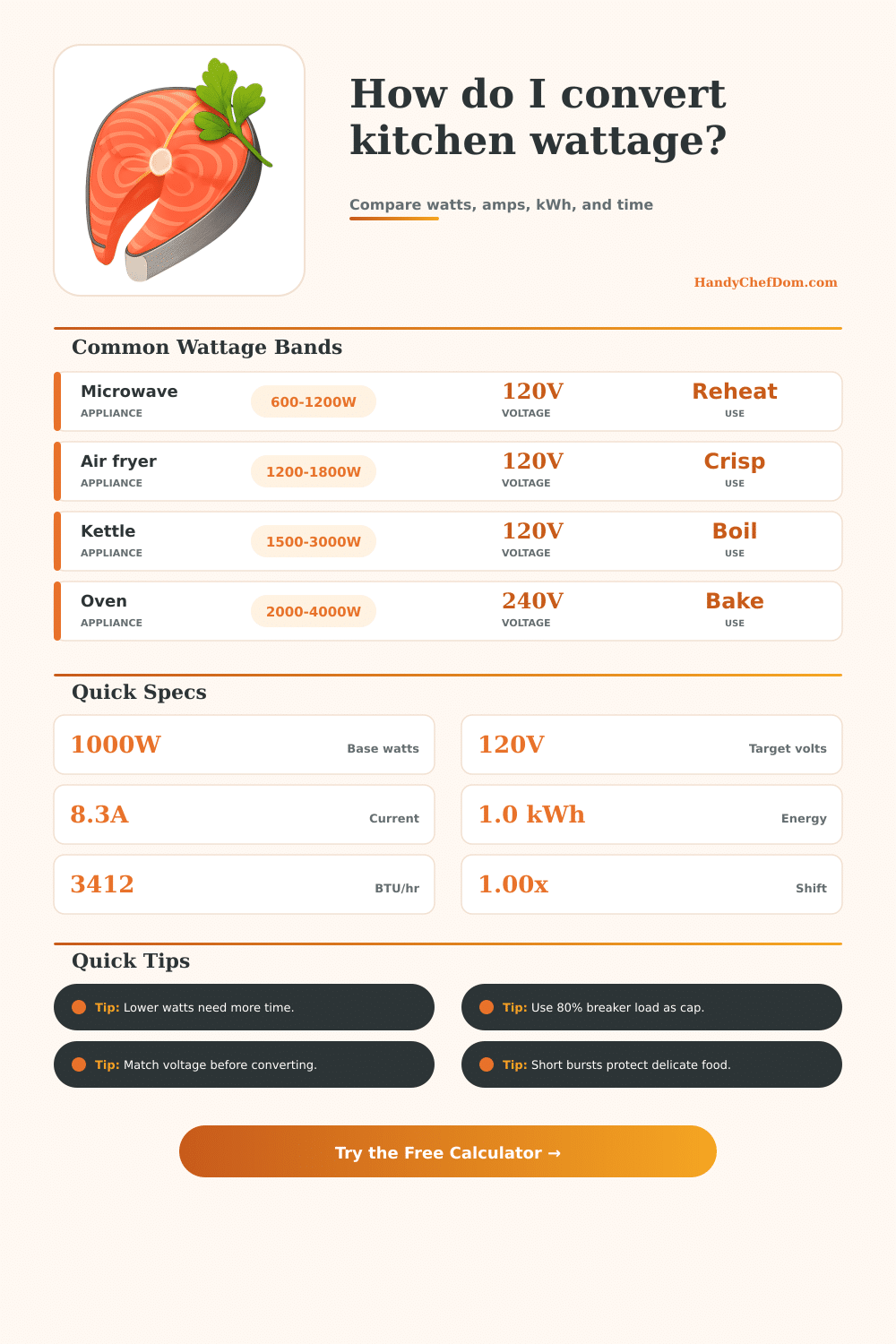
Convert kitchen wattage between watts, amps, kW, and BTU/hr while checking cook time, circuit headroom, and appliance match in one place.
Use the source appliance as the baseline and the target appliance as the destination. Lower wattage stretches time, while bigger batches and lower power levels increase the conversion factor. The calculator also checks whether the target load fits the breaker cushion you choose.
| Appliance | Range | Voltage | Use |
|---|---|---|---|
| Microwave | 600-1200W | 120V | Reheat |
| Air fryer | 1200-1800W | 120V | Crisp |
| Toaster oven | 1000-1800W | 120V | Toast |
| Kettle | 1500-3000W | 120V | Boil |
| Rice cooker | 400-900W | 120V | Steam |
| Full oven | 2000-4000W | 240V | Bake |
| Watts | 120V amps | 240V amps | kWh per hr |
|---|---|---|---|
| 300 | 2.5A | 1.3A | 0.30 |
| 600 | 5.0A | 2.5A | 0.60 |
| 1000 | 8.3A | 4.2A | 1.00 |
| 1500 | 12.5A | 6.3A | 1.50 |
| 2000 | 16.7A | 8.3A | 2.00 |
| 2400 | 20.0A | 10.0A | 2.40 |
| Source | Target | Ratio | Base time |
|---|---|---|---|
| 700W | 1000W | 0.70x | 7:00 |
| 900W | 1200W | 0.75x | 8:00 |
| 1000W | 1500W | 0.67x | 6:40 |
| 1200W | 1800W | 0.67x | 6:40 |
| 1500W | 2400W | 0.63x | 6:15 |
| 2400W | 1500W | 1.60x | 16:00 |
| Breaker | 120V safe | 240V safe | Note |
|---|---|---|---|
| 15 A | 1440W | 2880W | Compact |
| 20 A | 1920W | 3840W | Small |
| 30 A | 2880W | 5760W | Family |
| 40 A | 3840W | 7680W | Heavy |
Kitchen appliances use wattage to measure how much power they uses. This wattage determine the speed at which the appliance can generate heat. For example, if you switch from use a microwave to an air fryer, you cant simply swap the appliances.
Microwaves use 1000 watt of heat energy to pulse at the water molecules in the food. Air fryers use 1500 watts of heat energy to circulate hot air around the food. Because the air fryer take longer to heat the center of the food, it may take longer for the food to reach the center when cooked in an air fryer then in a microwave.
How Wattage Affects Cooking Time, Energy Use and Safety
Understanding the wattage of the appliances allow cooks to adjust cooking times when changing appliances. The amount of food you cook will also impact how much wattage is require within the kitchen. If you cook more food, the heat will take longer to reach the center of the food.
If there is an increase in the amount of food being prepared, you will need to increase the cooking time. The power level of the appliances can also be adjusted. If the microwave, for instance, is set to 70 percent of it’s maximum power level, the microwave will take longer to cook food.
Efficiency is another factor that impact the amount of wattage used by the appliances, and the efficiency of the appliances can vary by appliance type. Electrical safety is another necessary part of understanding wattage. The kitchen appliances will have a circuit that include a breaker that limits the amount of electricity that can travel through the circuit.
The standard 15-amp circuit on a 120-volt line will allow circuits to draw up to 1440 watts of power. However, if you use the full power of 1440 watts for appliances on the circuit, there will be no safety margin for electrical overloads. For example, if a 1500-watt kettle is plugged into a 15-amp circuit, the circuit will likely trip the kitchen breaker.
To ensure safety, cooks will have to calculate the total wattage of the appliances on a kitchen circuit before appliances are purchased. If a 240-volt system were to be used, the amperage will decrease for the same amount of wattage use by the appliances. 240-volt circuits will provide more capacity for heavy kitchen appliances on the circuit.
Many people makes mistakes when they attempt to convert recipes from one appliance to another. For example, a recipe may be written to use a 1000-watt toaster oven to perform a task that takes 15 minutes with a 1400-watt toaster oven. In this instance, the 1000-watt toaster oven will take longer to cook the food.
The size of the appliance also matter. A smaller sized appliance will heat more fast than a larger sized appliance. People will often make the mistake of only considering the wattage of the appliances and not the difference in the way that the appliances use heat.
Air fryers use convection heat to cook food. Ovens use radiant heat to cook food. Kettles use direct heat to cook water.
Therefore, the wattage of the appliances is not the only thing to consider when converting recipes from appliance to appliance. Wattage also relate to the energy consumption of the appliances. Energy consumption is measured in kilowatt-hours.
To calculate the number of kilowatt-hours consumed by an appliance, you must multiply the wattage of the appliance by the amount of time that it is on. For instance, a 2400-watt oven that is on for three hours will use more energy than a slow cooker that is also on for three hours at the same time. The voltage of the appliances must also be consider.
For instance, if a 120-volt appliance is placed into a 220-volt outlet, the appliance will heat up too quick. However, if a 220-volt appliance is placed into a 120-volt outlet, the appliance will not perform it’s functions. Appliances can be categorized according to their wattage.
Appliances that use 400 to 900 watts are referred to as low wattage appliances. These appliances are typically used for tasks like steaming rice. Appliances that use between 1000 and 1500 watts of power is known as balanced appliances.
These appliances are typically used for different cooking tasks in the kitchen. Appliances that use between 1500 and 2200 watts are known as fast heat appliances. These appliances are used for tasks like heating water in a kettle or frying food in a fryer.
Appliances that use over 2400 watts are considered heavy load appliances. These appliances requires their own electrical line into the circuit. Understanding the different categories of appliances by their wattage will allow cooks to avoid overloading the kitchen circuits.
Additionally, cooks will be able to understand the time it will take for the food to cook on the appliances.