Kosher Salt to Table Salt Conversion Calculator
Convert kosher salt to table salt by brand, spoon style, and recipe context. Keep baking exact, cooking practical, and every pinch easier to repeat.
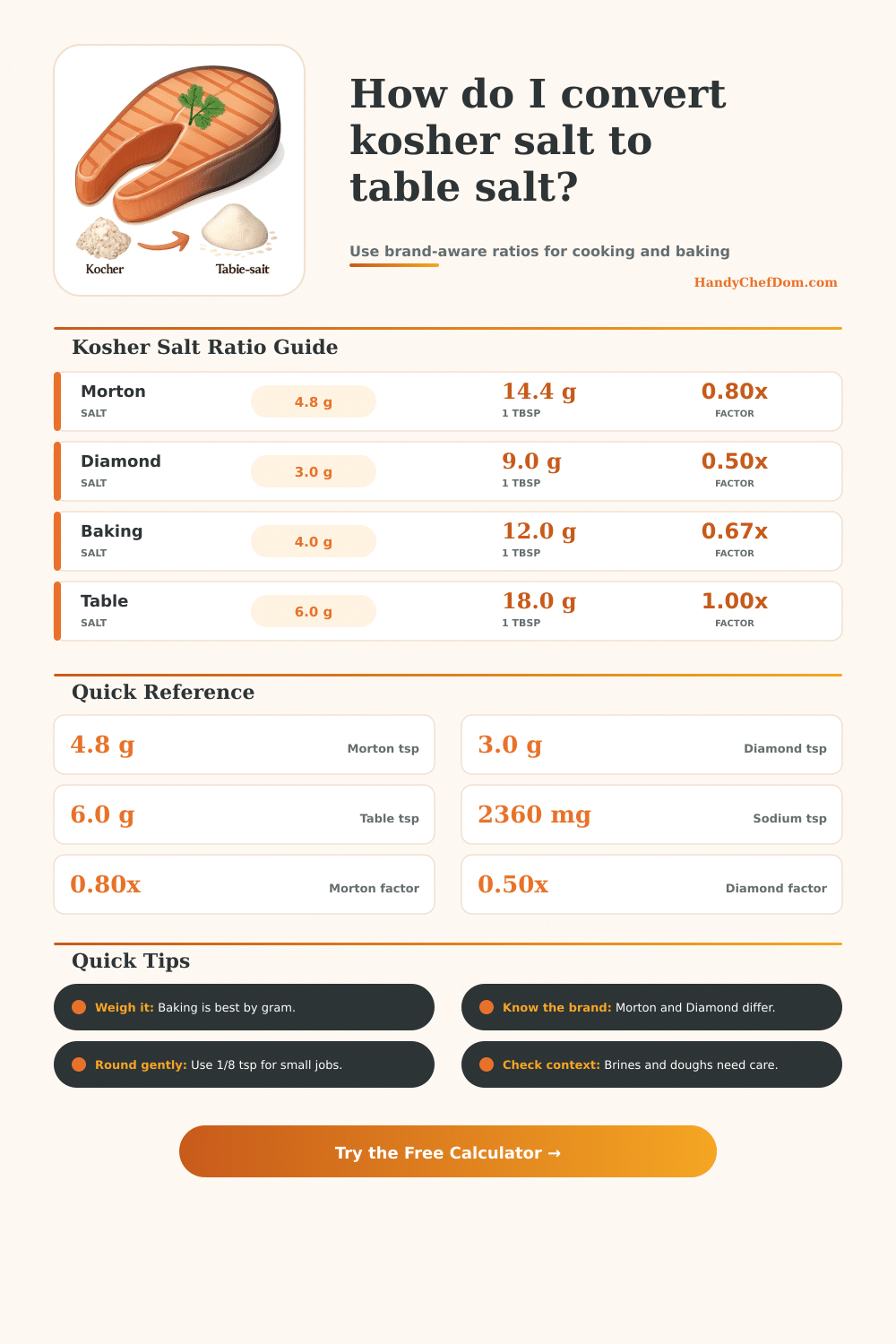
This calculator treats weight as the most exact path, then uses brand density and spoon style to estimate the matching table salt measure.
| Salt | 1/4 tsp | 1 tsp | Table ratio |
|---|---|---|---|
| Morton Coarse Kosher | 1.2 g | 4.8 g | 0.80x |
| Diamond Crystal Kosher | 0.8 g | 3.0 g | 0.50x |
| Diamond Baking Salt | 1.0 g | 4.0 g | 0.67x |
| Morton Table Salt | 1.5 g | 6.0 g | 1.00x |
| Measure | Tsp | Tbsp | Notes |
|---|---|---|---|
| 1/4 tsp | 0.25 | 0.08 | Small pinch |
| 1/2 tsp | 0.50 | 0.17 | Little spoon |
| 1 tsp | 1.00 | 0.33 | Recipe unit |
| 1 tbsp | 3.00 | 1.00 | Big spoon |
| Context | Best Salt | Round To | Why |
|---|---|---|---|
| Baking | Table | Exact | Precision |
| Cooking | Morton | 1/8 tsp | Fast dissolve |
| Brine | Morton | 1/4 tsp | Batch size |
| Finish | Diamond | Pinch | Light touch |
| Step | Math | Result | Use |
|---|---|---|---|
| 1 | Input x density | grams | Start mass |
| 2 | Grams / 6 | tsp table | Table swap |
| 3 | g x 0.393 | mg sodium | Diet check |
| 4 | Round step | suggested | Kitchen use |
Table salt and kosher salts are different type of salt. Table salt and kosher salt contain different densities of salt and has different shapes of crystals. Table salt has compact crystal that allow it to fit tight within a measuring spoon.
Kosher salt has large space between it’s crystals that allows it to contain more air. Because kosher salt has more air in its crystals, it weighs less then table salt if the two salts is measured in teaspoons. Because kosher salt weigh less than table salt, more volume of kosher salt must be used to provide the same amount of saltiness to the food being prepare.
How to Use and Measure Table Salt and Kosher Salt
The density of kosher salt can differ depending on the brand of kosher salt that are used. Some brands of kosher salt create heavy flakes while other brands use airy pyramids of salt crystals. If air pyramids of salt are use, more of the salt will be needed to provide the same amount of sodium content as table salt.
Fewer air pyramids will require less of the salt to provide the same amount of saltiness as table salt. The humidity in the air can affect the salt crystals to make them clump together. If this occur, the volume of salt that is added to a measuring spoon will change, altering the amount of salt that are added to the recipe.
When changing table salt for kosher salt, it is important to adjust the recipe for the new type of salt. If a recipe use one teaspoon of table salt, one teaspoon of kosher salt will not contain enough salt to provide the same flavor. Salt is important in baking recipes to provide the proper structure to the baked good and to allow the yeast to activate proper.
Using too much or too little salt can change the structure of the baked product and prevent the recipe from baking proper. For recipes like brines or rubs, which contain salt in large amounts, it is acceptable to use less precise measurement of the salt. Using a scale to measure the amounts of salt in a recipe will provide the most accurate measurement.
Using weight rather than volume will make sure that the density of the salt does not change the amount of salt in the recipe. If the recipe is to be measured in grams, the gram of kosher salt can be converted to grams of table salt to ensure that the sodium content are the same in the final product. Sodium content is important to understand in relation to salt.
One gram of salt contain 393 milligrams of sodium. One teaspoon of table salt contains 2360 mg of sodium while one teaspoon of light kosher salt contains 1200 mg of sodium. Because the amount of sodium in each type of salt is not the same, the cook will have to adjust the amount of salt that is measured to provide the same amount of sodium to the recipe.
Before using any type of salt in place of another in a complex recipe, it is best to first practice using the salt substitute in simple recipes. Simple recipes like soups or food cooked in boiling water will allow for more flexibility in case the amount of salt used is incorrect. If the salt is used in soups, it can easy be adjusted while the food is cooking.
If salt is used in baking recipes, it is more difficult to fix the amount of salt that has been used. Using a scale will provide the best result for any recipe. If you are to use volume measurements, it is also important to know the brand of kosher salt that will be used and the humidity in the kitchen.
With experience and understanding of how much of each type of salt is required for different recipes, any salt substitution will be successful when used in cooking.