Lamb Roasting Time Calculator
Plan roast time, pull temperature, and rest windows for leg, shoulder, rack, and loin cuts with confidence.
Time uses a cut base rate, then adjusts for oven temperature, roast style, starting meat temperature, and pan setup.
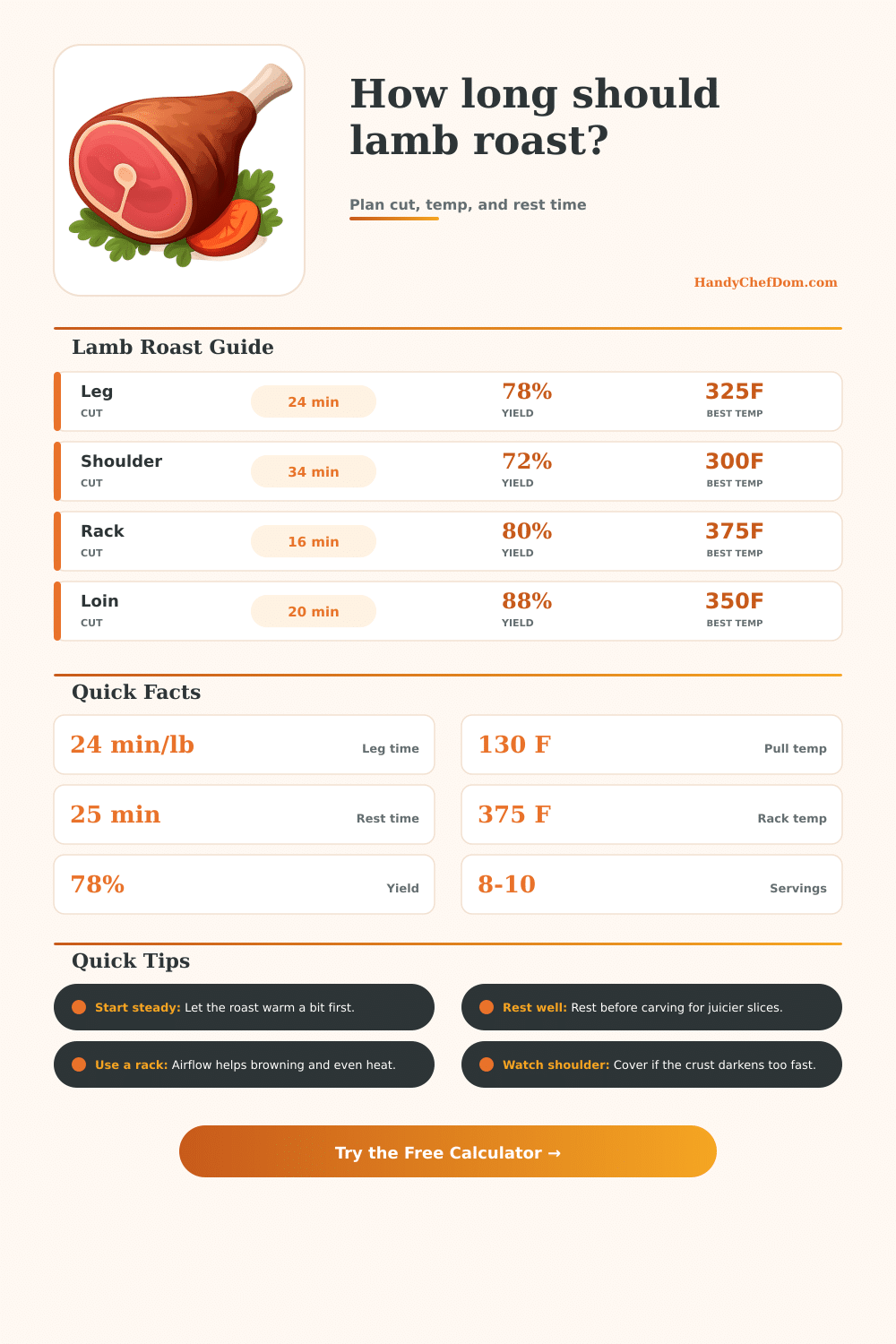
| Cut | Time/Lb | Yield | Best Temp |
|---|---|---|---|
| Bone-In Leg | 24-26 min | 78% | 325°F |
| Boneless Leg | 21-23 min | 90% | 325°F |
| Shoulder | 32-36 min | 72% | 300°F |
| Rack | 15-18 min | 80% | 375°F |
| Loin | 19-21 min | 88% | 350°F |
| Shank | 40-44 min | 68% | 300°F |
| Doneness | Pull Temp | Rest Temp | Note |
|---|---|---|---|
| Rare | 125°F | 130°F | Very pink |
| Medium Rare | 130°F | 135°F | Juicy center |
| Medium | 140°F | 145°F | Balanced |
| Well Done | 155°F | 160°F | Firm slice |
| Oven Temp | Factor | Style | Result |
|---|---|---|---|
| 275°F | 1.22x | Slow | Longest time |
| 300°F | 1.10x | Gentle | Moist roast |
| 325°F | 1.00x | Standard | Classic timing |
| 350°F | 0.90x | Hot | Faster finish |
| 375°F | 0.80x | High heat | Crust focus |
| 400°F | 0.74x | Fast | Watch closely |
| Guest Count | Leg | Shoulder | Rack |
|---|---|---|---|
| 4 guests | 2.5 lb | 3.0 lb | 1.5 lb |
| 6 guests | 4.0 lb | 4.5 lb | 2.0 lb |
| 8 guests | 5.5 lb | 6.0 lb | 2.5 lb |
| 10 guests | 7.0 lb | 7.5 lb | 3.0 lb |
| 12 guests | 8.5 lb | 9.0 lb | 3.5 lb |
| 16 guests | 11 lb | 12 lb | 5 lb |
When cooking an leg of lamb, precision are required because different cut of lamb will react differentally to heat. For instance, the conduction of heat will differ between a bone in leg of lamb and a rack of lamb chops due to the presence of the bone in the leg of lamb. Additionally, the shoulder of lamb will require a longer cooking time due to the connective tissue within the shoulder of lamb.
Before cooking a leg of lamb, you should select the correct cut of lamb and adjust the cooking time according to the cut of lamb. Another variable to consider in the cooking of an leg of lamb is the temperature at which the oven is set. At high temperatures (such as 400 degrees), the cooking time will be shorter for the leg of lamb, but the high temperature may dry out the edges of the leg of lamb.
How to Cook a Leg of Lamb
At low temperature (such as 275 degrees), it will take longer to cook the leg of lamb, but the low temperature allow for the collagen in the lamb to break down. The cook should choose the temperature of the oven according to the cut of lamb that is prepared and the texture of the cooked lamb that is desired. The internal temperature of the leg of lamb should be considered to control the level of doneness of the lamb.
If the internal temperature of the leg of lamb is to 125 degree, the lamb will be rare. If the internal temperature of the leg of lamb is to 130 degree, the leg of lamb will be medium rare. If the internal temperature of the leg of lamb is to 155 degree, the leg of lamb will be well-done.
But will lose more moisture during cooking. The internal temperature will continue to rise after the leg of lamb is removed from the oven, thus making it necesary to use a meat thermometer to properly cook the lamb to the level of doneness that is desired. Following roasting the leg of lamb, it is necesary to allow the leg of lamb to rest for 20 to 30 minutes.
Allowing the lamb to rest permits the juices that were contained within the leg of lamb to redistribute throughout the meat. If the cook does not allow the leg of lamb to rest, the juices will escape from the leg of lamb once the leg of lamb is slice. Allowing the leg of lamb to rest will ensure that the cooked leg of lamb is moist and juicy when serve to guests.
Different preparation method for the leg of lamb can alter the cooking process of the leg of lamb. For instance, if the cook prepares the leg of lamb with a dry rub or salt applied to the surface of the leg of lamb, the salt will draw moisture to the surface of the lamb and help create a more crispier crust. Additionally, if the leg of lamb is marinated prior to roasting, the marinade will add moisture to the leg of lamb, but may slightly increase the cooking time.
Finally, if the leg of lamb is stuffed prior to roasting, the stuffing will insulate the leg of lamb and increase the cooking time for the leg of lamb. The amount of leg of lamb that is prepared should be planned in accordance with the number of guest that will be served the leg of lamb. A 5-pound bone in leg of lamb will provide enough meat for 8 to 10 people when serve with side dish.
The shape of the leg of lamb can also impact the cooking time of the lamb. For example, a boneless leg of lamb that has been butterflied will cook faster then a bone in leg of lamb of the same weight; the butterflied leg allows for better circulation of air around the leg of lamb. Finally, you should of checked the internal temperature of the leg of lamb 10 minutes prior to the end of the cooking time to ensure that the lamb will not be overcook.