Mash Water Calculator
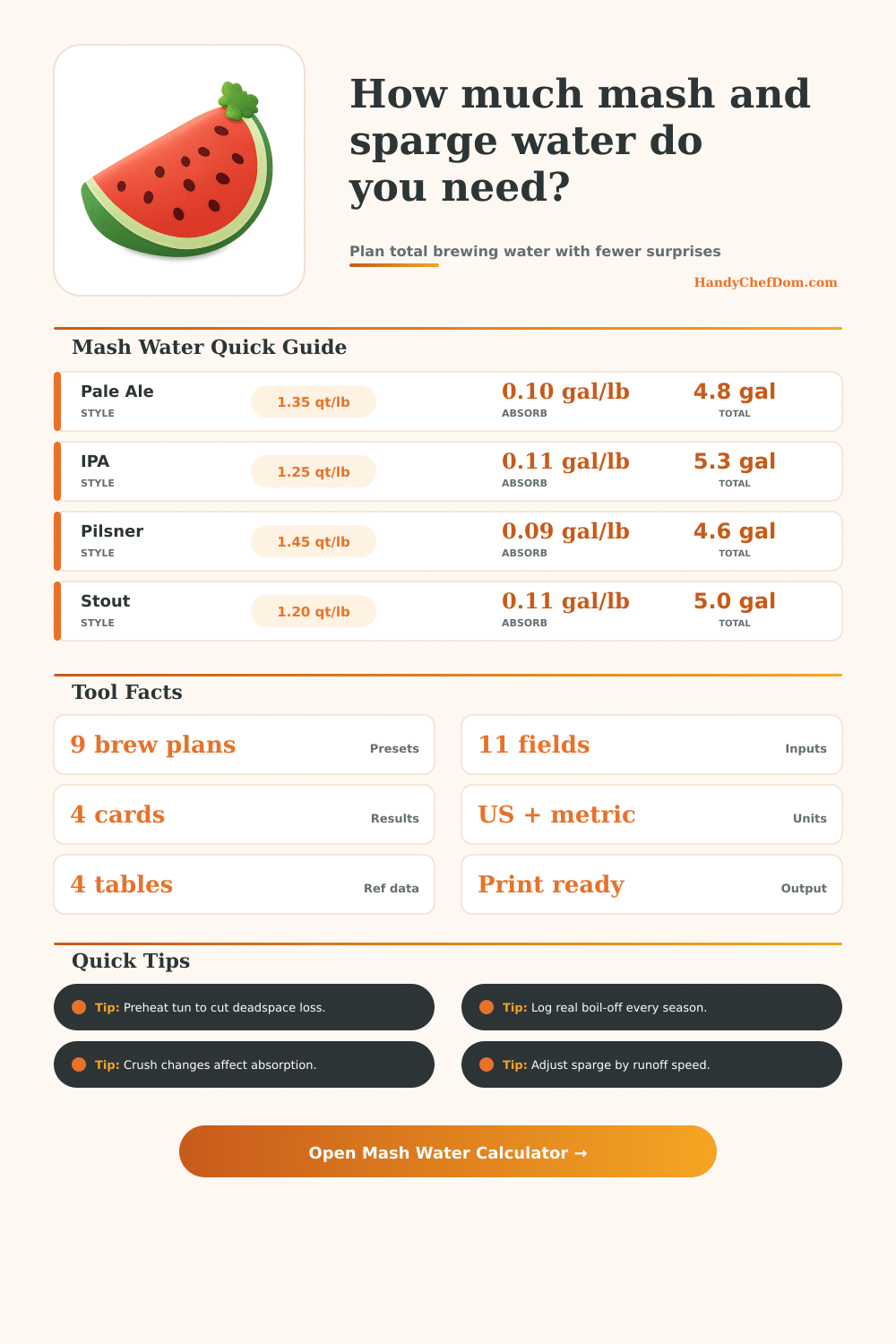
Plan mash liquor, sparge water, and total brew-day volume from grain bill, mash thickness, boil losses, and system deadspace so your pre-boil target lands closer on the first run.
📌 Brew Presets
🏷 Planning Labels
⚙ Mash Inputs
Method: total water equals kettle target plus grain absorption and mash tun deadspace. Mash liquor uses thickness, then remaining volume is assigned to sparge based on mode.
Mash Water Breakdown
📊 Profile Comparison
📑 Reference Tables
| Mash thickness | US ratio | Metric ratio | Typical fit |
|---|---|---|---|
| Very thick | 1.00 qt/lb | 2.1 L/kg | High gravity mashes |
| Thick | 1.20 qt/lb | 2.5 L/kg | Porter and stout |
| Balanced | 1.35 qt/lb | 2.8 L/kg | Pale ale and amber |
| Standard | 1.50 qt/lb | 3.1 L/kg | Lager and pilsner |
| Thin | 1.75 qt/lb | 3.6 L/kg | BIAB and easy stir |
| Grist type | Absorption | Runoff trend | Adjustment note |
|---|---|---|---|
| Base malt heavy | 0.10 gal/lb | Normal | Use baseline settings |
| Wheat and rye | 0.11 gal/lb | Slower | Add 4-8% more water |
| High oat blend | 0.12 gal/lb | Slower | Watch mash viscosity |
| Adjunct rice blend | 0.09 gal/lb | Faster | Reduce extra margin |
| Dark roast heavy | 0.11 gal/lb | Normal | Check pH and runoff |
| Sparge mode | Volume split | Collection pace | Use case |
|---|---|---|---|
| Batch sparge | Mash + top-up | Moderate | Cooler mash tun |
| Fly sparge | Steady trickle | Slower | Higher extraction focus |
| No-sparge BIAB | All in mash | Fast drain | Simpler brew-day flow |
| Double batch | Two equal rinses | Moderate | High gravity batches |
| Grain bill | 5 gal batch | 6 gal batch | 7 gal pre-boil |
|---|---|---|---|
| 9 lb | 4.5-4.9 gal | 5.5-5.9 gal | 6.7-7.2 gal |
| 11 lb | 4.8-5.3 gal | 5.8-6.4 gal | 7.1-7.7 gal |
| 13 lb | 5.2-5.8 gal | 6.3-6.9 gal | 7.6-8.3 gal |
| 15 lb | 5.6-6.2 gal | 6.8-7.5 gal | 8.0-8.8 gal |
💡 Two Practical Tips
Calculating the volumes of mash water is a necessary part of the brewing process. Calculating the volumes of mash water ensure that you have the correct amount of liquid for each step in the brewing process. If you fail to correctly calculate the volume of mash water, you could find yourself with too much liquid to boil or not enough liquid after the sparging process is complete.
The amount of liquid that is required for brewing will depend on the amount of liquid that the grain will absorb, the amount of liquid that remains in the dead space within your mash tun, and the amount of liquid that evaporate during the brewing process. The thickness of the mash that is created during the brewing process will have a direct impact on the function of the enzymes that take place within the mash. Thicker mash recipes use 1.2 quarts of water for each pound of grain.
How to Calculate Mash Water for Brewing
This type of mash will allow for the enzymes to remain concentrated within the mash. For thinner mash recipes, 1.5 quarts of water is used for each pound of grain. This type of mash allow for the brewing process to be easier to stir.
Because more water is contained within the grain during thinner mash recipes, more sparge water is required for these recipes. The calculator will automatically adjust for the thickness of the mash to show the proper volume of sparge water needed for that type of recipe. The amount of liquid that the grain absorbs will also play a critical role in determining the total amount of liquid to be used in the brewing process.
The amount of liquid that grains absorb from the mash can differ depending on the type of grain that is used in the brewing process. Most grains will absorb 0.1 gallon of water for each pound of grain. However, grains like wheat, rye, and oats will absorb more water than the standard malt grains.
If wheat or oats is used in the brewing process, the absorption of water will be higher. This higher rate of absorption will reduce the amount of liquid that remains for the sparge step in the brewing process. Using the profile selector on the calculator will allow you to adjust for the differing absorption rates of the grains.
Adjusting this rate will ensure that the amount of sparge water that is calculated for the brewing process accurately reflects the amount of water that the grains will absorb. Dead space within the mash tun can also impact the total amount of water that is used within the brewing process. The dead space is the amount of liquid that will remain in the mash tun after it has been drained.
This space for liquid is due to the fact that the pickup tube or false bottom of the mash tun is positioned above the floor of the mash tun. To account for this space, you will need to measure the volume of the dead space within your mash tun. This amount of liquid will then need to be added to the total amount of water required for brewing to ensure that there is enough liquid to perform the brewing process.
The amount of liquid that will be lost during the boil is referred to as the boil-off rate. Depending upon the settings of your burner for the brew kettle and the length of the boil, the amount of water that will boil off will change. Your water volume calculator will require that you enter the hourly boil-off rate that you will use for your brewing process.
By entering this value, the calculator will provide you an estimation of the total amount of liquid that will evaporate during your brewing process. For example, if you enter a sixty-minute boil time, the amount of liquid that will be lost during boiling will be less than if you boil the liquid for ninety minutes at the same rate. By entering the boil-off rate, the calculator will ensure that the amount of liquid that you have in your kettle will reach the amount that you desire when boiling the liquids for brewing.
There are different methods to sparging. One method is called batch sparging. In batch sparging, the water is added in one or two steps.
Batch sparging is the simplest method to manage water during the sparge step. Another method is called fly sparging. In fly sparging, water is added to the mash tun while the liquid that is being brewed is being collected.
Fly sparging allow for the water to be drawn from the mash tun more efficiently. The third method is called no-sparge. In the no-sparge method, you add all of the water to the mash tun during the initial mashing step.
Because you add all of the water at the start of brewing, a higher ratio of water to grains is required for the no-sparge method. The results of each batch of beer that is brewed should be recorded to prepare for brewing processes in the future. By recording the results of each batch, you can adjust the absorption and dead space rates according to the results of each batch.
During each brewing process, it is important to note the volume of the first runnings, the volume of the liquid prior to boiling, and the amount of extra water that is added during the sparge process. If you find that the volume prior to boiling is too low, you can adjust the absorption or dead space value in the calculator. Using larger grain bills will have a significant impact upon any errors in calculation.
For instance, if you have a dead space in your mash tun that is 0.5 gallons, that error in measurement is small relative to the amount of water that is used when brewing a small batch of beer. However, that same error in measurement is much more significant when brewing a larger batch of beer. High-protein grains will absorb more water than grains with a lower protein content.
Therefore, recipes that use these types of grains will require more water to counteract the absorption of water by the grain. The goal of using such a calculator is to ensure that you have enough liquid in your kettle to reach your target gravity. The calculator allows you to account for each of these different brewing variables to ensure that brewing is a smooth process.