🥪 Sodium in Mayonnaise Calculator
Estimate sodium from regular, light, avocado oil, olive oil, homemade, or low sodium mayo using tablespoons, cups, or grams.
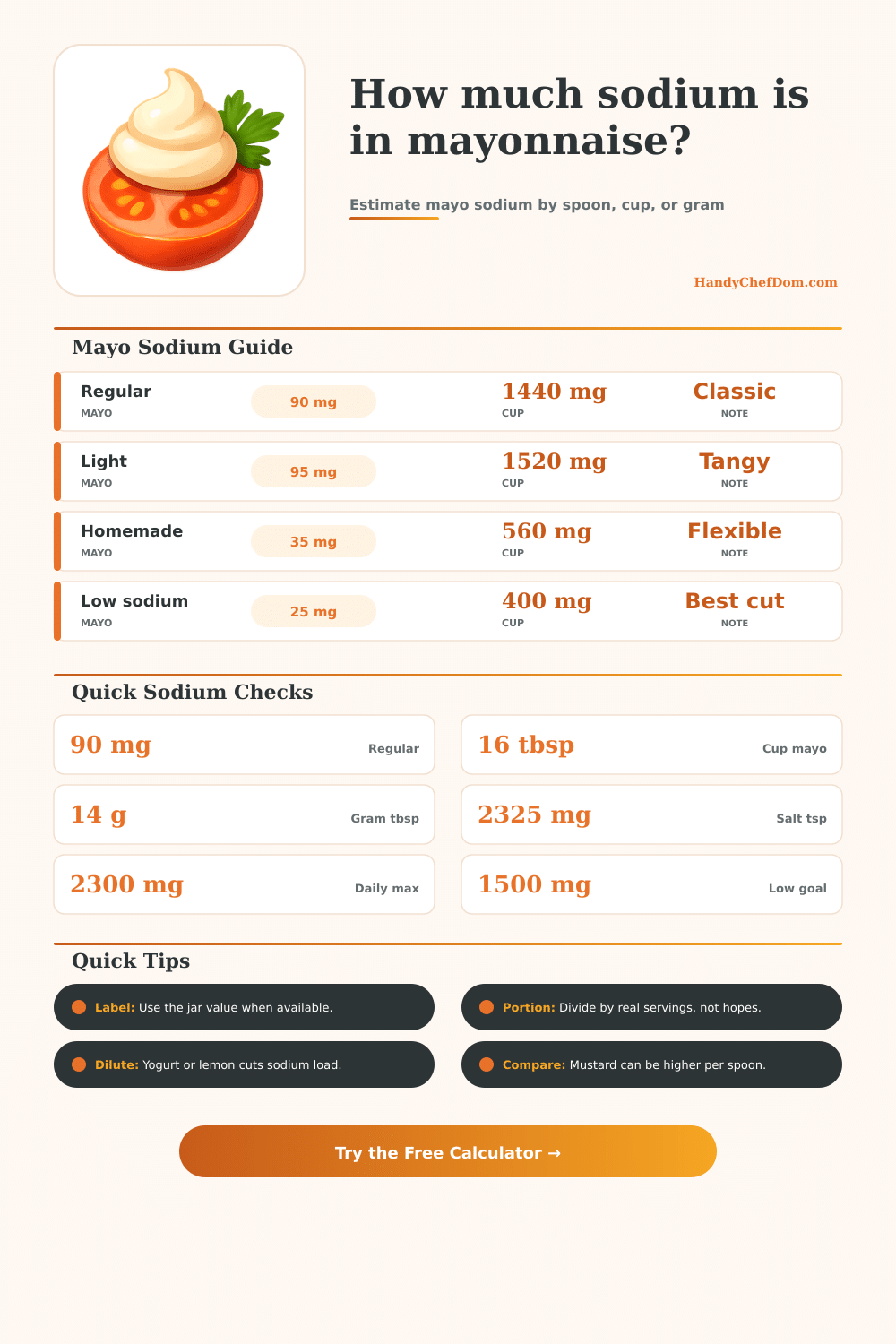
Regular mayonnaise is often about 90 mg sodium per tablespoon. If your jar lists a different number, enter it as the label override and this calculator will use that value instead.
| Mayo type | Typical sodium | Per 1/4 cup | Best use |
|---|---|---|---|
| Regular mayonnaise | 90 mg per tbsp | 360 mg | Everyday sandwiches and salads |
| Light mayonnaise | 95 mg per tbsp | 380 mg | Lower calorie spreads with similar sodium |
| Avocado oil mayonnaise | 85 mg per tbsp | 340 mg | Rich spreads where the label varies by brand |
| Olive oil mayonnaise | 80 mg per tbsp | 320 mg | Milder sodium estimate for blended-oil mayo |
| Homemade mayonnaise | 35 mg per tbsp | 140 mg | Salt-controlled batches and small jars |
| Low sodium mayonnaise | 25 mg per tbsp | 100 mg | Best option when sodium is the main constraint |
| Measure | Tablespoons | Approx grams | Regular mayo sodium |
|---|---|---|---|
| 1 teaspoon | 0.33 tbsp | 5 g | 30 mg |
| 1 tablespoon | 1 tbsp | 14 g | 90 mg |
| 2 tablespoons | 2 tbsp | 28 g | 180 mg |
| 1/4 cup | 4 tbsp | 56 g | 360 mg |
| 1/2 cup | 8 tbsp | 112 g | 720 mg |
| 1 cup | 16 tbsp | 224 g | 1440 mg |
| Condiment | Typical serving | Sodium estimate | Portion note |
|---|---|---|---|
| Mayonnaise | 1 tbsp | 90 mg | Often used in 1 to 2 tbsp portions |
| Ketchup | 1 tbsp | 160 mg | Can exceed mayo spoon-for-spoon |
| Yellow mustard | 1 tsp | 55 mg | Small serving, sharp flavor |
| Ranch dressing | 2 tbsp | 260 mg | Higher serving size changes the total |
| Relish | 1 tbsp | 120 mg | Sweet and salty accent |
| Unsalted yogurt | 1 tbsp | 7 mg | Useful low-sodium mayo diluter |
| Recipe use | Common mayo amount | Typical servings | Regular mayo per serving |
|---|---|---|---|
| Sandwich spread | 1 tbsp | 1 serving | 90 mg |
| Two sandwiches | 2 tbsp | 2 servings | 90 mg |
| Tuna salad bowl | 4 tbsp | 4 servings | 90 mg |
| Potato salad side | 1/2 cup | 8 servings | 90 mg |
| Party dip base | 1 cup | 16 servings | 90 mg |
| Creamy dressing | 1/4 cup | 8 servings | 45 mg |
Estimates are for meal planning only. If sodium intake is medically restricted, use your product label and your clinician's target.
Mayonnaise contain sodium. Additionally, mayonnaise can contribute to the sodium content of a meal if a person use many spoonful of mayonnaise as part of a meal. For example, one tablespoon of regular mayonnaise contain about 90 milligram of sodium; the more sodium that a person use in recipes like tuna salad, potato salad, or deviled eggs, the higher the sodium content of the meal as a whole.
Furthermore, the sodium content of a meal may not be readily apparent to an individual until the person has finish the entire meal containing the mayonnaise; the sodium content may be higher than that which the individual expected from the meal. The calculator that is include in this article allows an individual to calculate the amount of sodium that will be contained within a recipe that utilize mayonnaise. To calculate the amount of sodium that will be contained in a recipe, an individual must provide the type of mayonnaise that will be used in the recipe, the amount of mayonnaise that will be used in the recipe, and the number of serving that the recipe will provide.
How to Calculate Sodium in Recipes with Mayonnaise
Additionally, an individual can alter these values to reflect any label values for the ingredients that are different than the typical amounts for those ingredients (such as ingredients that are naturaly low in sodium, like plain yogurt), as well as the type of mayonnaise that is to be used. Since the fat and the egg that are contained in the product are the ingredients that contain the sodium within a mayonnaise product, an alteration to the type of mayonnaise that is to be used or the addition of other ingredients to the mayonnaise will alter the sodium content of the recipe in direct proportion to the change to those ingredients. Based off these values, the calculator can provide four different measurement for the recipe that contain mayonnaise: the total amount of sodium that will be found in the recipe, the amount of sodium that will be contained within each serving of the recipe, the rough equivalent amount of salt that would contain the same amount of sodium as the recipe, and the comparison of the amount of sodium that is contained in each serving of the recipe to a particular target amount of sodium for that individual each day.
Each of these four measurements allow an individual to make a decision regarding whether or not the mayonnaise should be a main ingredient in that recipe, or whether the recipe should be modified to use a different type of mayonnaise or to use less mayonnaise in the preparation of the recipe. Most brand of commercial mayonnaise will contain similar amount of sodium; salt is often added to commercial mayonnaise as both flavoring and preservative ingredients. Additionally, light brands of mayonnaise may contain higher amounts of sodium per spoonful of mayonnaise than regular brand of mayonnaise, since manufacturers often add more sodium to these brands of mayonnaise to compensate for the reduced amount of fat that is contained in the product.
Furthermore, brands of mayonnaise that contain avocado oil or olive oil can contain varying amount of sodium within their brands. Finally, the individual can have the most control over the amount of sodium that is contained within the prepared mayonnaise; the individual can decide how much salt to add to the mayonnaise that they cook themselves. Each of the reference tables located on this article provide a list of the differences in sodium content among the various brand of mayonnaise.
The sodium content within each serving of a recipe that contains mayonnaise can be altered by altering the portion size of the recipe and the number of servings of the recipe that are to be prepared. For instance, if a recipe call for half a cup of mayonnaise and the recipe is to provide twelve portions of the recipe, the amount of sodium will be divided among those twelve portions. However, if the same amount of mayonnaise is prepared for a recipe that provides only four portion of the recipe, each portion will contain more sodium than the portions that would be prepared if the recipe provided twelve servings.
These values can be altered within the calculator to reflect different portion size and number of servings of the recipe. Changing the portion size and number of servings will change the amount of sodium per serving of the recipe. This calculation will allow an individual to more easily make an informed decision regarding the sodium content that each portion of the recipe will contain.
The amount of sodium that is considered to be the target amount of sodium for each individual each day can differ; 2300 mg is the daily target for many individuals, but some clinician may recommend a target amount of 1500 mg of sodium per day to manage the blood pressure of those patients. Each of these targets can be entered into the target field within the sodium calculator. By entering a target amount of sodium each day, the calculator will produce a measurement of the fraction of the daily target for sodium that one serving of mayonnaise represents.
This value can help an individual to decide whether the mayonnaise should remain a main ingredient within the recipe, or whether it should be prepared in smaller amounts than the recipe may otherwise suggest. The portion sizes of many recipe that are prepared in kitchens are often not the same as the portion sizes that may appear within textbooks. Furthermore, the amount of mayonnaise that is used in a recipe may be more or less than that amount that is indicated for a standard serving of the recipe.
For instance, an individual may use more mayonnaise on a sandwich than is normally used for a serving, or they may use a larger amount of mayonnaise than that which is suggested for a portion that is to be provided to a number of servings. The portion-plan setting within the calculator allow a person to adjust the amount of mayonnaise that is suggested in the recipe. This amount can be changed for each individual, as they may require more or less mayonnaise to properly prepare the recipe for each person that is to be served with the recipe.
This portion-plan setting doesnt replace the act of measuring the mayonnaise that will be used in the recipe, but will help an individual to prepare an honest estimate of how much mayonnaise that each individual will require to prepare the recipe. The condiment that is compare to mayonnaise within the condiment reference table contains similar amounts of sodium. For instance, mayonnaise contains less sodium than brands of ketchup and ranch dressing, but contains more sodium than brands of plain mustard (due to the small serving sizes of mustard).
This comparison help to place the sodium content of mayonnaise in the context of other condiments that are often prepared and served with meals. Finally, the calculator can be used to determine whether altering the recipe in some simple way will help to lower the sodium content of the recipe; for instance, changing to a low-sodium brand of mayonnaise or adding yogurt to the recipe will lower the amount of sodium per serving of the recipe. Such a change can lower the sodium content to a level that is acceptable to that individual.
Furthermore, if individuals begin to develop the habit of utilizing the sodium calculator prior to adding mayonnaise to a recipe that is to be served, the individual will find that their meals will contain the sodium limit that are recommended for themselves.