How Much Yeast Per Gallon of Mead?
Set batch size, gravity, style, and yeast strain to get a realistic pitch rate, packet count, and nutrient dose.
The calculator blends the entered gravity with the honey load estimate, then applies style, strain, temperature, sweetness, and nutrient adjustments.
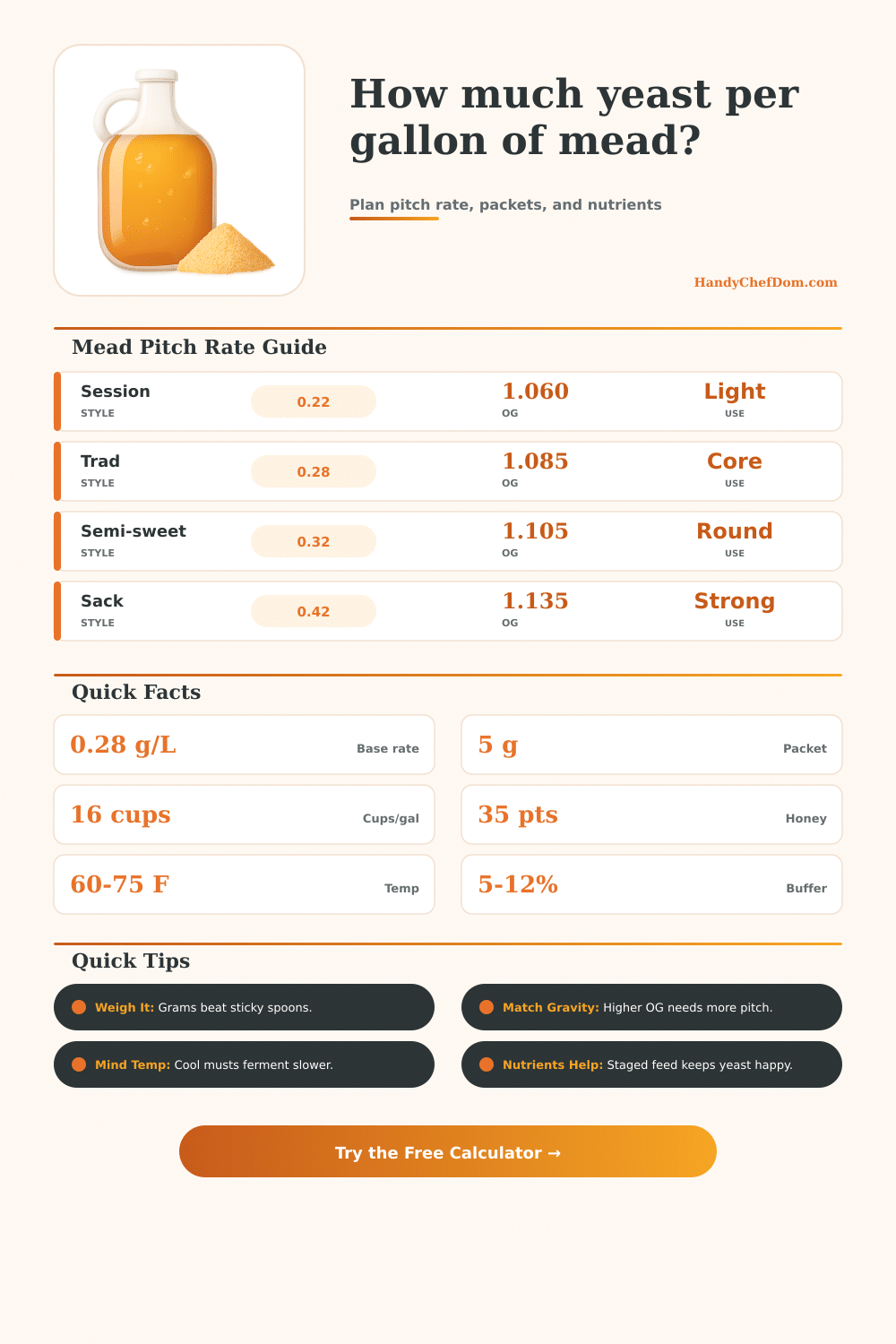
| Style | Base Rate | OG Band | Notes |
|---|---|---|---|
| Session | 0.22 g/L | 1.050-1.065 | Light and fast |
| Traditional | 0.28 g/L | 1.070-1.090 | Balanced core |
| Semi-Sweet | 0.32 g/L | 1.090-1.110 | Round finish |
| Sack | 0.42 g/L | 1.110-1.140 | Stronger must |
| High Gravity | 0.50 g/L | 1.120-1.150 | Stressful must |
| Strain | Factor | Tolerance | Best For |
|---|---|---|---|
| Neutral | 0.95x | 18% | Clean finish |
| Aromatic | 1.00x | 14% | Classic mead |
| Fruit | 1.03x | 15% | Melomel |
| Tolerant | 1.12x | 18% | Big musts |
| Cool | 0.97x | 16% | Cool cellars |
| Dessert | 1.06x | 14% | Sweet meads |
| Honey Load | Approx OG | Batch Feel | Pitch Note |
|---|---|---|---|
| 2.5 lb/gal | 1.088 | Light | Lower pitch |
| 3.0 lb/gal | 1.105 | Classic | Middle range |
| 4.0 lb/gal | 1.140 | Rich | Higher pitch |
| 5.0 lb/gal | 1.175 | Dense | Big pitch |
| Nutrient Plan | Rate | Feed Style | Use Case |
|---|---|---|---|
| None | 0.00 g/L | Skip | Low risk |
| Standard | 0.24 g/L | One dose | Most batches |
| Staggered | 0.30 g/L | Split feed | Healthy ferment |
| Aggressive | 0.36 g/L | Rich feed | High gravity |
When you prepare mead, you must consider an amount of yeast to add to the must. The amount of yeast you add will determine whether your mead ferment succesfuly or stalls during fermentation. If you add to few yeast, the yeast will struggle to consume the available sugars from the honey, leading to off-flavors or fermentation that stalls entire.
Adding too many yeast will waste your yeast products as excess yeast can create hot or yeasty flavor in your mead that mask the flavor of the honey. The amount of yeast you need will depend on the gravity of your must and the temperature of the environment where your mead will ferment. Gravity measure the amount of sugar in your must and determines the yeast’s workload.
How Much Yeast to Add to Your Mead
If you make a light mead with a gravity of around 1.060, you will need less yeast than if you prepared a dense mead with a gravity of 1.120 or higher. With higher gravity musts, the yeast will experience osmotic stress that slow its growth, forcing you to add more yeast to initiate the fermentation process. Fermenting temperatures play a significant role in how much yeast to pitch into your mead.
If you ferment at cooler temperatures under 65 degrees Fahrenheit, the yeast will work slow, forcing you to pitch more yeast into your must than warmer temperature fermentation. The higher the fermentation temperature, the faster the yeast will work, forcing you to pitch a lower amount of yeast into your must to avoid over-fermenting your mead. These two factors determines the amount of yeast to add to your must.
The style of mead you are fermenting and the type of yeast to use also determine the pitch rate of the yeast. If you use champagne yeast strain, they will produce strong fermentations that is suitable for traditional meads that require the flavor of honey to be the primary flavor in the finished mead. Aromatic yeast strains can preserve the subtle flavors of fruit meads.
However, aromatic yeast strains work more slowly than the neutral yeast strains. Therefore, you will need to pitch more yeast into your must to ferment with these strains. If you are using high-tolerance strains of yeast, they will be appropriate for making high-gravity meads.
These strains can take the alcohol content in the mead and allow you to add a lower pitch rate of yeast to your must. Another consideration in pitching yeast is the amount of nutrient for the yeast during fermentation. Since honey is low in nitrogen and amino acids, you must provide nutrient for the yeast.
Otherwise, the yeast will experience stress during fermentation. If the yeast stresses, it may produce undesirable flavor such as hydrogen sulfide. Adding nutrients to your must will provide the yeast with the support it needs.
If you provide consistent level of nutrients, the yeast can handle denser musts. Therefore, adding nutrients to your must may allow you to pitch less yeast into the must initial. The form of yeast you use also plays a role in the amount of yeast to add to your must.
If you use dry yeast, you can rehydrate the yeast pack. The dry yeast packets will contain the necessary amount of yeast to ferment your must. You can direct add liquid yeast to your must.
The yeast will be active without the need to rehydrate it. You can also use a yeast slurry to add the propagated yeast to your must. Since you are using propagated yeast, you need to add less total gram of yeast than if you were to add dry or liquid yeast packs.
When pitching yeast for your mead, you must avoid some common mistake. One common mistake is forgetting to rehydrate dry yeast in warm water. If you do not rehydrate it, you may kill the yeast.
Another mistake is using old yeast without consider its age. The viability of the yeast will be lower than fresh yeast. People also make the mistake of using a spoon to add yeast to the mead instead of using a scale to measure the yeast in gram.
Using a scale will provide the most accurate amount of yeast to your must. Finally, people often make the mistake of not tracking the gravity of the must daily during fermentation. Tracking gravity allow you to monitor the rate at which the yeast is fermenting the sugars in your must.