Microwave Wattage Calculator
Convert recipe time by microwave wattage, power level, and food type, then add stand time for a more accurate finish.
Enter the wattage used by the recipe, compare it to your microwave, then var the calculator adjust for power level, dish depth, and food type.
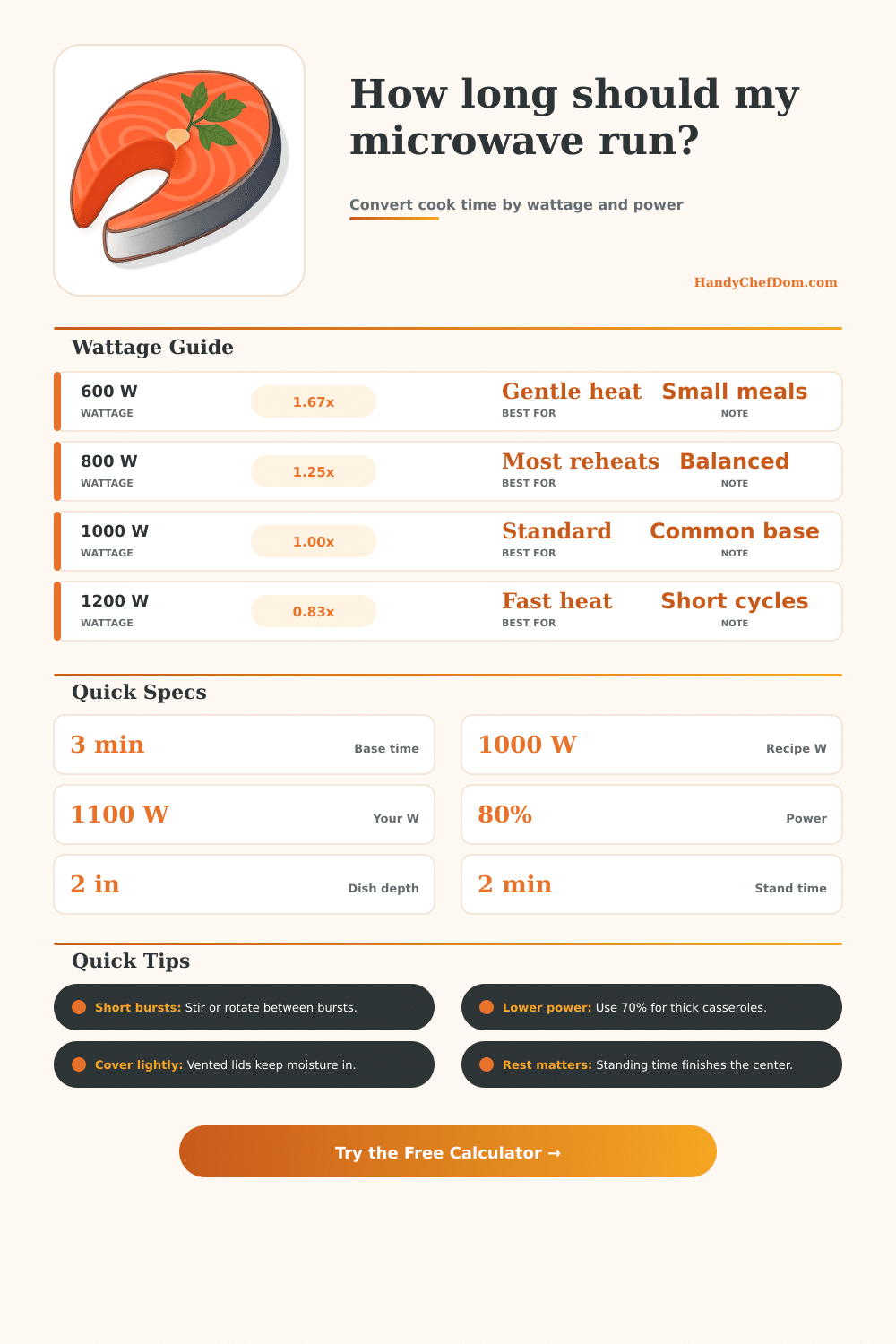
| Wattage | Multiplier | Best For | Note |
|---|---|---|---|
| 600 W | 1.67x | Slow heat | Small meals |
| 800 W | 1.25x | Most reheats | Balanced |
| 1000 W | 1.00x | Standard | Common base |
| 1200 W | 0.83x | Fast heat | Short cycles |
| Power | Use | Shift | Note |
|---|---|---|---|
| 100% | Full heat | 1.00x | Fastest |
| 80% | Medium high | 1.25x | Even heat |
| 60% | Medium | 1.67x | Gentle |
| 50% | Low | 2.00x | Slow finish |
| 30% | Defrost | 3.33x | Break up |
| Food | Factor | Cover | Rest |
|---|---|---|---|
| Soup | 1.05x | Vented | 1.5 min |
| Casserole | 1.10x | Loose | 3 min |
| Rice | 1.12x | Snug | 4 min |
| Veg | 0.92x | Vented | 1 min |
| Defrost | 1.35x | Flip | 5 min |
| Melt | 0.75x | Open | 0.5 min |
| State | Factor | Timing | Tip |
|---|---|---|---|
| Room | 1.00x | Base | Ready |
| Fridge | 1.10x | Slower | Stir once |
| Chilled | 1.05x | Slight lift | Watch edges |
| Frozen | 1.42x | Longest | Use defrost |
Microwaves comes in a variety of wattages. The wattage of the microwave determines the amount of energy that it will deliver to the foods that you are heating in the microwave. Most recipe are written for 1000-watt microwaves, but you may own a microwave that has either less wattage than 1000 watt, or that has more wattage than 1000 watts.
If you use a microwave that has more wattage than the recipe indicates, the food will cook too quick with hot spots throughout the food. If you use a microwave that has less wattage than the recipe indicate, the food will take longer to heating to the center of the food. Regardless of the type of food that you are heating in your microwave, it is important for you to adjust for the wattage of your microwave.
How to Heat Food in the Microwave
Power level are another important variable in the heating process of food in a microwave. Using a lower power level for heating will allow the microwave to cycle the heating of the food on and off so that the heating of the food is distribute more evenly throughout the food. For instance, if you use 80% power to heat food, the microwave will emit less energy than if you used 100% power, but this lower amount of energy will allow the heat to travel toward the center of the food.
This is especially helpful for foods that are dense and contain more mass, such as casserole or rice that will overcook if heated at 100% power. The density and depth of the food that you are heating will also affect the way that the microwave heats the food. For instance, food that is heated in a shallow dish will heat more evenly than food that is contain within a deep bowl.
This is because the microwave heats the outer inch of food, and the heat must travel towards the center of a deep dish through steam and conduction. For this reason, if you are heating food within a deep bowl, you may need to increase the cooking time of the food by five to eight percent. Additionally, if the food that you are heating starts at a cold temperature or is frozen, you will need to increase the cooking time for the food to heat to the center of the food.
For food that is frozen, you may need to increase the cooking time by 40% to allow for the defrosting of the food. Another factor in the heating time of food in a microwave is the portion and quantities of food. If you have a large amount of food in your microwave, you will need to heat the food for longer than if you had a smaller portion.
This is due to the fact that the more mass that is heated, the longer that it will take for the food to heat to the center of the food. Additionally, the type of food can also influence the length of time that you should cook the food. For instance, vegetables will heat faster than grain.
This is due to the fact that grains, like rice, require more time to rehydrate the starch in the rice, and can become mushy if overheated. Another important consideration in heating food with a microwave is the stand time for food. After cooking food in the microwave, it is important for the food to sit undisturbed for two to three minute after the cooking cycle ends.
During this stand time, the residual heat will continue to cook the food. For example, if you heat a casserole or rice in the microwave, the standing time allows for the steam to redistribute throughout the food, which prevents the outside of the food from becoming mushy. In order to avoid common mistake in the microwave, there are some changes that you can make to the way that you use your microwave.
For instance, one of the most common mistake is heating food at 100% power for a long period. This will cause the outside of the food to heat while the inside of the food is still cold. Instead, use short burst of energy to heat the food, and allow time to stir the food during the cooking period.
Stirring the food will allow for the heat to be distributed evenly, and will allow for an inspection of the center of the food. Additionally, if you are defrosting food that was previously frozen, use 30% power on the microwave to defrost the food. Pause the food within the microwave to separate the food into even clumps so that the outside of the food does not cook prematurely.
Microwaves also pose some safety considerations for their users. For instance, when heating liquids in the microwave, be sure to stir the liquid after it has been heated. This will allow for the release of any pressure that may have built up in the liquid while in the microwave, and will ensure that the liquid is even heated.
Additionally, do not place metal or foil in the microwave. The metal will reflect the energy from the microwaves, potentially leading to fires in the microwave. Use vented lids or paper wraps when heating food in the microwave to allow steam to escape.
Finally, calibrate your microwave to ensure it has the proper wattage. To calibrate the microwave, heat one cup of water that is brought to room temperature, and measure the length of time it takes to boil the water. This will tell you if the microwave is correctly calibrate to its wattage.