🧀 Mozzarella for Lasagna Calculator
Estimate mozzarella by pan footprint, number of cheesy layers, noodle coverage, lasagna style, cheese moisture, and serving count.
The calculator treats mozzarella as a coverage ingredient: inside layers need enough cheese to bind and melt, while the top layer needs a fuller blanket for browning.
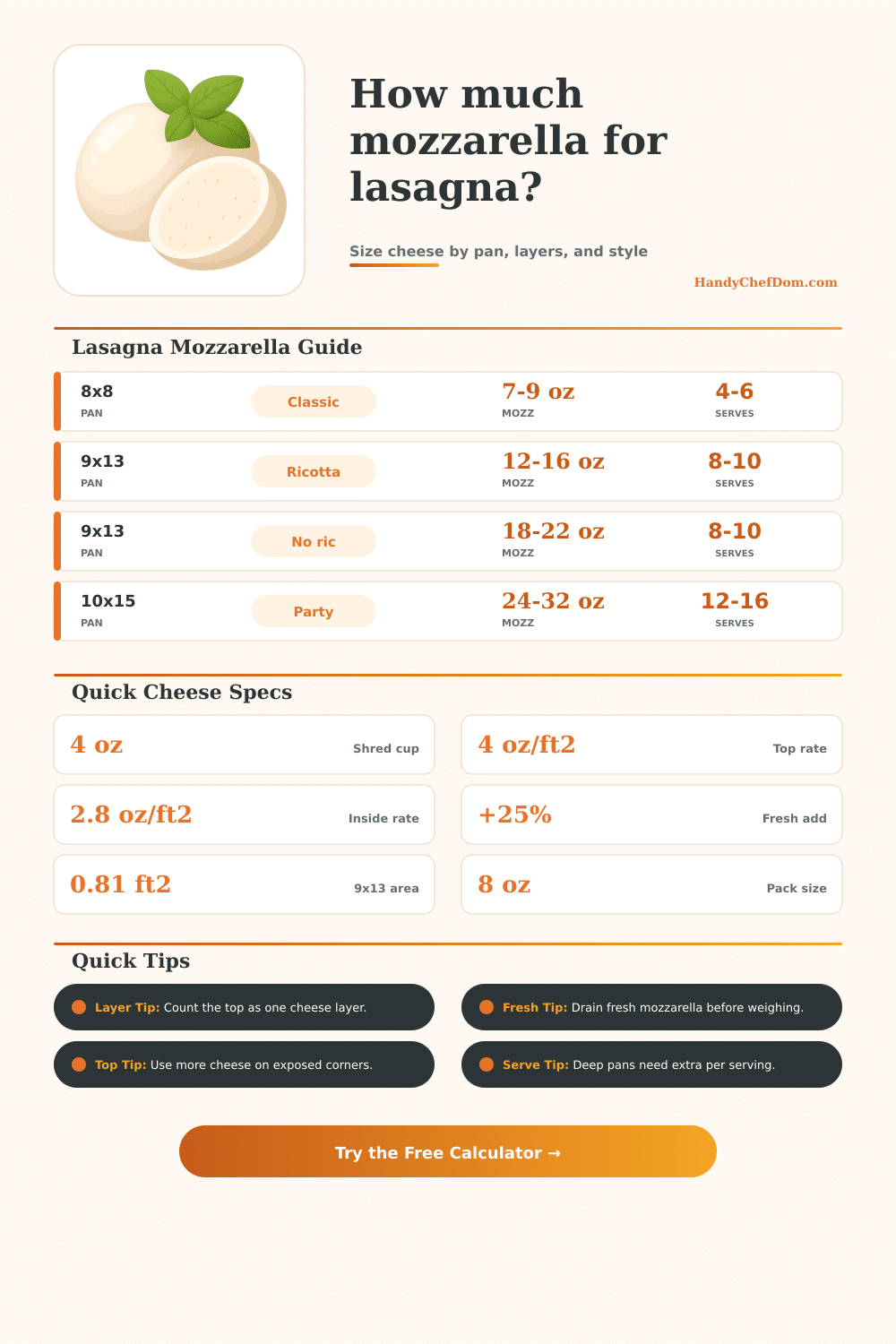
| Pan Size | Area | Classic Ricotta | No Ricotta | Typical Servings |
|---|---|---|---|---|
| 8 x 8 in | 0.44 sq ft | 7-9 oz | 10-12 oz | 4-6 |
| 9 x 9 in | 0.56 sq ft | 9-11 oz | 12-15 oz | 6-8 |
| 9 x 13 in | 0.81 sq ft | 12-16 oz | 18-22 oz | 8-10 |
| 10 x 15 in | 1.04 sq ft | 18-24 oz | 24-32 oz | 12-16 |
| 12 x 18 in | 1.50 sq ft | 28-36 oz | 38-48 oz | 20-24 |
| Mozzarella Type | Best Use | Approx Cup Weight | Calculator Factor | Moisture Note |
|---|---|---|---|---|
| Low-moisture shredded | All layers | 4 oz per cup | 1.00x | Reliable melt |
| Whole milk shredded | Top and center | 4 oz per cup | 1.03x | Richer melt |
| Part-skim shredded | Weeknight pans | 4 oz per cup | 0.95x | Less rich |
| Block, freshly grated | Even melt | 3.8 oz per cup | 1.00x | Low clumping |
| Fresh sliced | Top finish | 5 oz per cup | 1.25x | Drain first |
| Deli slices | Fast layers | 4.5 oz per cup | 1.02x | Even coverage |
| Coverage Level | Inside Layers | Top Layer | Best Fit | Texture Goal |
|---|---|---|---|---|
| Light | 2.2 oz/sq ft | 3.2 oz/sq ft | Ricotta-heavy | Soft layers |
| Standard | 2.8 oz/sq ft | 3.9 oz/sq ft | Family pan | Balanced melt |
| Generous | 3.4 oz/sq ft | 4.6 oz/sq ft | Cheesy slices | Visible pulls |
| Restaurant | 4.0 oz/sq ft | 5.4 oz/sq ft | Deep top melt | Full blanket |
| Lasagna Style | Cheese Role | Factor | Layer Advice | Serving Cue |
|---|---|---|---|---|
| Classic ricotta | Support cheese | 0.86x | Light middle | 1.2-1.6 oz |
| Meat sauce | Balanced | 1.00x | Even layers | 1.4-1.8 oz |
| Vegetable | Moisture buffer | 1.08x | Extra top | 1.5-2 oz |
| Bechamel | Top accent | 0.92x | Thin center | 1.2-1.6 oz |
| No ricotta | Main cheese | 1.25x | Full middle | 1.8-2.4 oz |
| Extra cheesy | Feature cheese | 1.35x | Heavy top | 2-2.8 oz |
Lasagna has always seemed easy: get the mozz right, and it’s done. This happens until someone cuts into a slice and it separate, or you bite through a large layer of rubbery cheese. Typically that boils down to two things: How many layers is there? And how much cheese did you expect the pan would hold? Did you put sauce or ricotta in the center, too? Those answers mean you don’t have to guess the rest of the equation.
The first actual lever is pan footprint. A wider surface spreads the same amount of cheese thinner so you need more total weight to keep the top from looking patchy. This means you’ll need more total weight in order to achieve an even-looking top. And then there’s depth. The deeper your dish, the more steam gets trapped and the farther out the cheese on the sides can slither before setting up. Enter length, width, and depth into the calculator and it do the math for you. This eliminates the guesswork of eyeballing square inches and converting them into ounces.
How to Calculate Cheese for Lasagna
Next, how many layers should you use? It turns out each sheet of pasta require at least one layer of cheese underneath to bind them together, but just one layer on top, that’s the one that gets all brown and stretchy when pulled off. So give that one a little more love, and don’t go too heavy with your hands on the others. The trick is if you add a bunch of cheese layers to the tool it will spread less thickly inside, leaving the outside still heavily protected against melting too much. This keeps slices from being either a glistening, greasy puddle or a dried-out stack.
“People are surprised by how much the type of cheese affects the math. Fresh slices hold moisture (which drips out when it’s baked) while low-moisture shredded is lighter-weight per-cup and melts consistently throughout. You might switch from shredded to fresh mozzarella. The tool can adjusts for the drip-loss, keeping the end-cooked weight correct. Coverage-level works the same way. If there is more ricotta, use less mozzarella; if there is less ricotta, you need more cheese to support the structure.
The final input that most cooks forget is servings. If you change to a larger pan (say from a 10-servings pan to a 20-servings pan), you don’t just double the cheese. The amount of cheese on top and lost on the edges stays the same, but space in the center increases. By entering the number of servings, the calculator can output how much cheese there is for each slice, saving you from the embarrassment of finding yourself halfway through second pan at your party because you ran out.
But it’s in comparing them, one to the next, that things get interesting. One night might use part-skim milk while another uses whole milk and the depth of the pan used also matters. Additionally, one might be a more luxurios-style dish different than the other. That makes a difference in the numbers, but not in the underlying logic. You won’t be left guessing as to why this or that recipe has always come up short; you’ll see exactly where the cheese is going.
After you’ve mastered treating mozzarella as a planned layer and not just an afterthought, everything else can be judged in your head. Can I go lighter here? Do I need another handful on top? The answer always comes out the same way. After you master that one habit, the result should of been the same every time instead of varying.