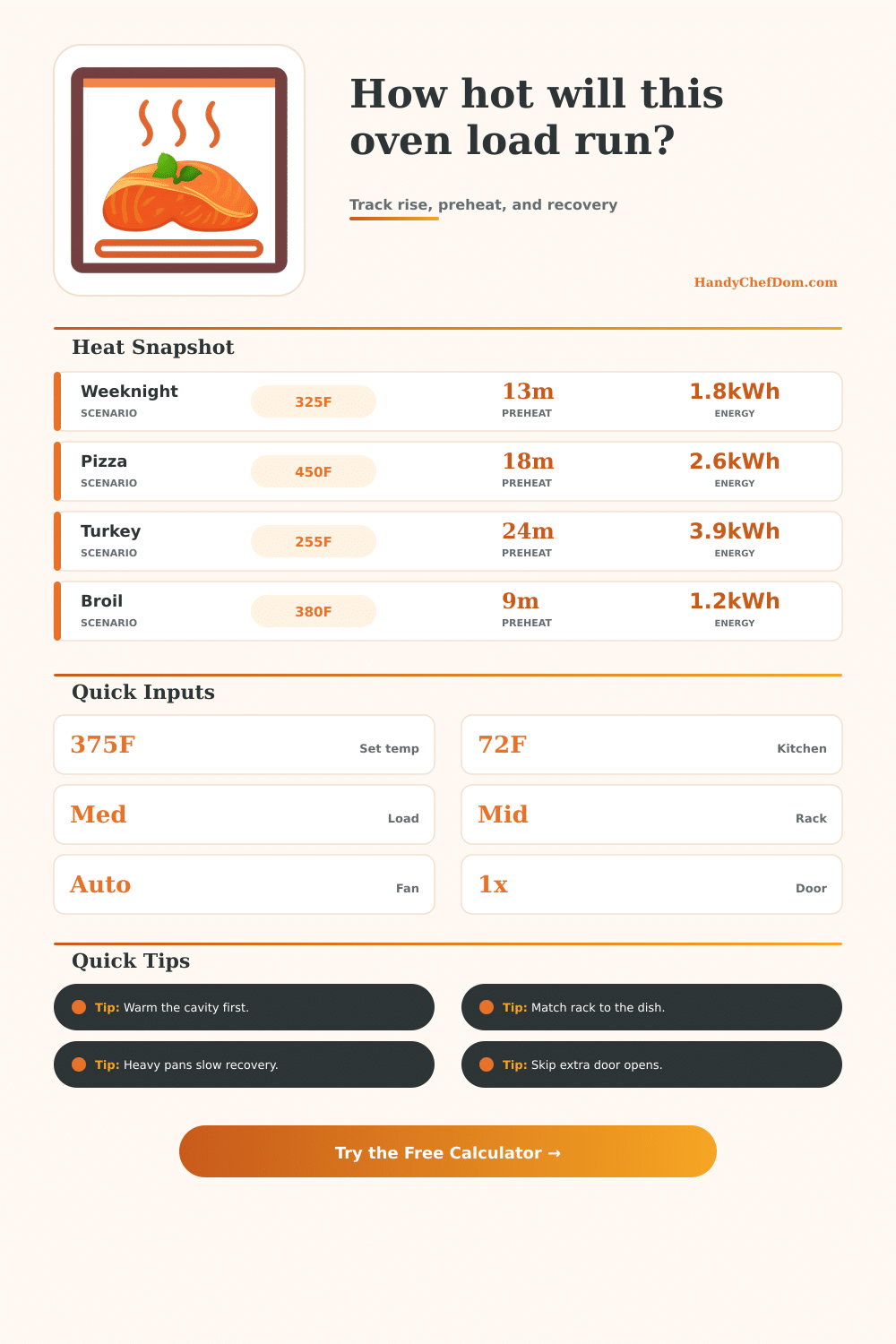
Oven Heat Calculator
Map oven class, rack position, load size, and door losses into a practical heat plan so roasts, trays, and stone bakes stay on target.
Choose the oven style and heat profile first, then tune the target temperature, kitchen temperature, rack level, and door opens to estimate rise, preheat, and recovery more realistically.
| Oven class | Watts | Rise rate | Best use |
|---|---|---|---|
| Compact countertop | 1500 | 25F/min | Small bakes |
| Toaster oven | 1300 | 23F/min | Quick trays |
| Standard range | 2400 | 30F/min | Daily meals |
| Single wall oven | 3000 | 33F/min | Roasts |
| Heat profile | Time | Preheat | Note |
|---|---|---|---|
| Bake | 1.00x | 1.00x | Steady heat |
| Roast | 1.05x | 1.06x | More recovery |
| Convection | 0.88x | 0.84x | Fan assist |
| Pizza | 1.20x | 1.18x | Stone load |
| Rack | Heat | Recovery | Use |
|---|---|---|---|
| Top | 0.98x | 1.05x | Broil |
| Upper | 1.00x | 1.02x | Pizza |
| Middle | 1.00x | 1.00x | Most bakes |
| Lower | 1.04x | 0.96x | Roasts |
| Load | Heat | Time | Door |
|---|---|---|---|
| Light | 0.92x | 0.90x | 1.00x |
| Medium | 1.00x | 1.00x | 1.00x |
| Heavy | 1.14x | 1.15x | 1.06x |
| Packed | 1.24x | 1.28x | 1.10x |
Oven temperature management are important for maintaining an ovens cooking temperature consistent. By managing the oven temperature, you can prevent uneven baking result. When you place a cold item into the oven, the oven temperature will drop due to teh cold item absorbing heat from an oven.
Due to the drop in oven temperature, the edges of the food will cook differently than the center of the food. In order to prevent this uneven cooking, it is important to understand how an ovens heat work to guarantee that the food cook evenly. The ambient temperature of the kitchen can play a big role in how the oven works.
How to Keep Oven Temperature Even
If the kitchen is cold, the oven will have to work harder to reach the desired temperature. Furthermore, the cold kitchen will lead to a longer preheat time for the oven. Additionally, the position of the rack can also play a big role in how the oven work.
The rack closest to the heatsink will receive the most heat, while the rack closest to the food will receive the least amount of heat from the heating element. Due to the rise of heat in an oven, the lower racks will take longer to reach the desired temperature than the upper racks of the oven. The size of the load in the oven will play a role in the temperature that the oven can reach.
If the load within the oven is light, the oven will be able to reach the desired temperature quick. However, if the load is heavy, such as roasting a large cut of meat, the oven will have to work harder to heat that much mass. Therefore, if the load within the oven is heavy, it will take longer to reach the desired temperature within the oven than if the oven is cooking a light load.
Convection fans in the oven will allow for more even cooking within the oven. Using a convection fan will cook the food in an oven more quickly due to the even distribution of heat within the oven. However, because the fan within the convection oven is constantly on, the oven will use more energy while using convection mode.
The type of oven that is used can also play a role in how the oven cooks the food. Toaster ovens usually heat up quickly but lose that heat quickly when the door to the oven is opened. Wall ovens contain more thermal mass than toaster ovens and retain heat better.
Commercial ovens are built to heat up very quickly and reach higher temperatures quickly than residential home ovens. Each oven type will work differently in the same scenario, so it is important to consider what type of oven will be used in the cooking scenario. If the oven is opened frequently, the temperature within the oven will drop.
Each time that the oven is opened, heat will escape from the oven. Furthermore, each time that the oven door is opened, it will take longer for the oven to reach the desired cooking temperature. For example, opening the oven door once might add two minutes to the cooking time of a food item.
However, if the oven is opened multiple times, the cooking time will be longer than if the oven was only opened once. In order to allow the food to cook evenly, the oven should not be opened unless it is necessary to do so. In order to avoid some of the most common mistake when using an oven, cooks can use specific protocols.
One protocol is to not begin cooking the food right away when the oven beeps to let the cook know that the oven has reached the desired temperature. The air within the oven may not have reached the desired temperature yet even if the elements has heated the food. Another common mistake is to use the wrong rack position within the oven for the food being cooked.
The rack in the middle of the oven is the most commonly used rack for most cooking scenario. However, the upper rack is used for broiling, and the lower rack is used for cooking food that require heat from the bottom of the food. In addition to the factor mentioned previously, there are some environmental factors that can affect the cooking process.
For example, cold stoneware will absorb more heat than metal cookware and take longer to reach the desired cooking temperature. Humidity in the environment might also play a role in how the oven heats the food. In areas with high humidity, the air will be heavier and take longer to heat up with the oven element.
Furthermore, where the kitchen is located within the area will play a role in how fast the oven heats the food. Due to the thinner air at high altitudes, the oven elements will have to work harder to heat the air within the oven to high cooking temperature. The oven will use energy to cook the food.
If the load within the oven is heavy, the oven will use more energy than if the load was light. Additionally, if the convection setting is on the oven, more energy will be used than if the oven is in the standard bake mode. By tracking the load and mode of the oven, cooks can track the amount of energy that the oven will use over time.
By being able to track the energy use of the oven, cooks can manage the cost of cooking. By understanding these different factor, cooks can plan their cooking session more effectively. By planning cooking sessions more effectively, cooks can ensure that the oven maintains the correct temperature for the food being cooked.